

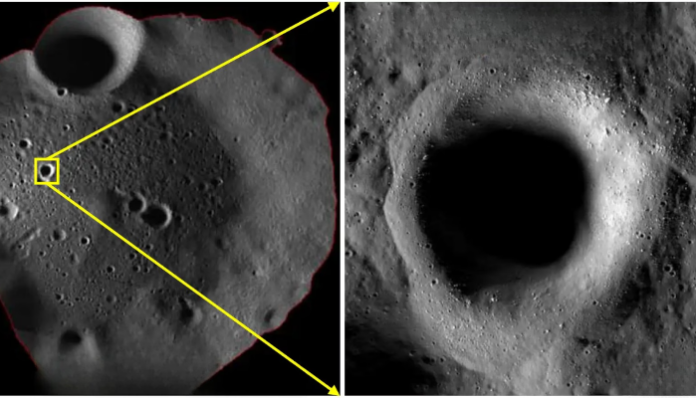
New scientific data from the Indian Space Research Organisation’s (ISRO) Chandrayaan-2 satellite suggested that ice might exist beneath the Moon’s surface in its south polar area. It is among the solar system’s coldest and most enigmatic areas. Dual Frequency Synthetic Aperture Radar (DFSAR) was used to make the landmark discovery. It is on the Chandrayaan-2 orbiter. It is the first fully polarimetric synthetic aperture radar to be deployed to the Moon and was designed to use microwave imaging to explore the lunar surface and subsurface. It operates in both L-band and S-band frequencies.
The lander of the Chandrayaan-2 project failed during its descent in 2019, but the orbiter continued to operate and provide exceptional scientific data, assisting India in expanding human understanding of the Moon’s hidden polar environment.
Researchers from Ahmedabad’s Physical Research Laboratory carried out the latest research, which concentrated on a unique class of “doubly shadowed craters” situated inside the lunar South Pole’s permanently shadowed regions (PSRs). Temperatures in these craters drop to approximately 25 Kelvin, or minus 248 degrees Celsius, owing to the complete absence of sunlight and protection from thermal radiation. These areas are ideal for retaining water-ice for billions of years due to their extremely frigid temperatures.
PHOTO | ISRO press release reads: "Chandrayaan-2 Dual Frequency Synthetic Aperture Radar (DFSAR) Observations Reveal Subsurface Ice in Lunar South Polar Regions."
— Press Trust of India (@PTI_News) May 27, 2026
"A detailed investigation of sub-surface ice in the lunar South Polar Region using observations from the… pic.twitter.com/ZEKqkQralI
Researchers discovered radar evidence compatible with potential underlying ice beneath the floors of four doubly shadowed craters. ISRO informed, “Using advanced radar polarimetric analysis, scientists identified radar signatures consistent with the possible presence of subsurface ice beneath the floors of four doubly shadowed craters in the lunar South Polar Region.”
The scientists overcame a significant obstacle in earlier lunar research by developing an innovative radar-based technique to differentiate real ice deposits from rugged rocky terrain. The method combines the Circular Polarisation Ratio (CPR) and Degree of Polarisation (DOP).
The degree to which the reflected radar signal maintains its initial polarisation state upon interaction with the surface or subsurface material is measured by DOP, a radar polarimetric parameter. This technique aids in separating radar signals generated by rough rocky terrain from actual ice signatures. The researchers concluded that areas with DOP values less than 0.13 and CPR readings of more than one probably show “volumetric scattering,” a radar effect linked to underlying ice deposits rather than surface rocks.
“Among the investigated craters, one crater of 1.1 km diameter within Faustini crater shows particularly strong evidence of subsurface ice, supported by both radar observations and distinctive lobate-rim morphological characteristics. A lobate-rim morphology refers to a flow-like or lobed appearance, suggesting the impact may have penetrated subsurface ice, producing the observed lobate-rim crater,” the official statement read.
The results could possibly have major implications for lunar exploration in the future. The identification of ice is noteworthy because it could be employed in the future to support human life on the moon. The ice can be used to create hydrogen and oxygen, which can then be used to make drinking water, breathing oxygen and even rocket fuel for upcoming missions.
“These findings provide important new insights into the distribution of lunar polar volatiles and have significant implications for future lunar exploration missions, including identification of potential ice-bearing regions for future landing and in-situ resource utilisation (ISRU) activities,” ISRO highlighted.
In 2023, India’s Chandrayaan-3 mission achieved a successful landing near the polar region, marking the first time any country has accomplished this feat. This was a groundbreaking achievement for both the Indian and the global science community. Furthermore, Chandrayaan 1, launched in 2008, already discovered water and hydroxyl molecules on the lunar surface.
