

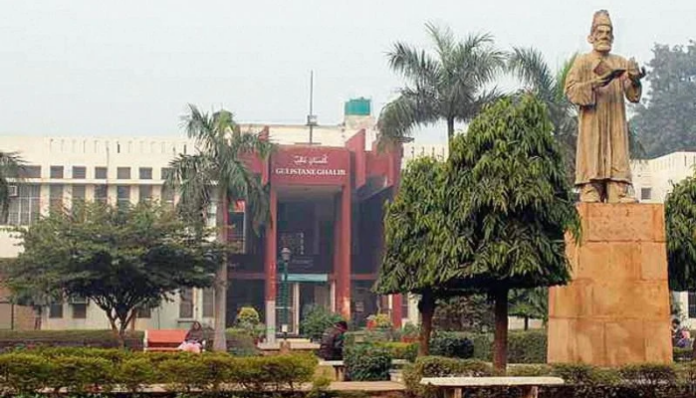
On Monday, 26 October, Jamia Millia Islamia University announced that student union elections would resume after nearly 20 years, following sustained protests by students demanding the restoration of an elected representative body on campus.
Jamia Registrar Mahatab Alam Rizvi arrived at around 4:30 am on Monday (26 October) to hold talks with the protesting students. He shared the administration’s order and urged them to call off their agitation, saying their demands had been addressed.
However, the protesting students rejected the university’s notice, saying it neither sets a definite timeline for the election process nor addresses their demand for the Proctor’s resignation.
Key directives from the official notice
The official notification dated 26 October, 2026 explicitly states that the Competent Authority of JMI considered the students’ demands and issued the following directives:
1. The Jamia Millia Islamia Students’ Union Election will be held 15 days from the date of approval of the constitution of the Students’ Union of Jamia Millia Islamia.
2. Suspension and Show-Cause Notices issued to students during the period of protest are hereby revoked.
3. A Committee shall be constituted to enquire into the actions of security staff during the period of protest.
Jamia Millia Islamia announces resumption of student union elections after two decades. In an order issued on Monday, the university administration said the elections would be held within 15 days of the approval of the students’ union constitution. “The Jamia Millia Islamia Students’ Union Election will be held after 15 days, from the date of approval of the constitution of the Students’ Union of Jamia Millia Islamia,” the order stated. The announcement comes after days of protests by students, who have been demanding the restoration of the elected students’ union, which was dissolved by the university administration in 2006.
— ANI (@ANI) October 26, 2026
Additionally, the order notes that the protesting students have agreed to issue a public apology for any defamatory statements or social media posts made against the university administration during the agitation, with all such posts to be taken down immediately. The protest was formally called off upon the issuance of this order, with the administration stating that compliance with these terms will be monitored.
The 20-year hiatus: Why elections were suspended
Jamia Millia Islamia (JMI) dissolved its central students’ union on March 31, 2006, effectively halting university-wide campus elections following violent clashes, administrative confrontations, and severe disruptions to academic life. The ban brought an abrupt end to an elected body that had only recently been restored in December 2005 under then Vice-Chancellor Professor Mushirul Hasan, following an earlier hiatus dating back to 1996.
According to reports, the administration’s decision stemmed from escalating indiscipline and political friction between union representatives and university authorities. The central point of contention was the student union’s perceived interference in non-academic administrative matters, particularly admission procedures, hostel seat allotments, and student disciplinary inquiries.
The university administration publicly maintained that union leaders were routinely overstepping their jurisdiction, attempting to dictate institutional policy, and applying coercive pressure on faculty and administrative staff.
The institutional friction quickly escalated into open physical violence across the campus. Reporting in 2006 highlighted severe clashes involving student factions and university officials, most notably a violent confrontation involving the proctorial board and then Proctor Rocket Ibrahim. Allegations of assault, intimidation, and factional brawls proliferated, creating an atmosphere of chronic insecurity.
In July 2006, following renewed clashes that forced an indefinite campus shutdown, the administration barred the entry of outgoing union president Shams Pervez and several other student leaders.
Furthermore, an official explanation submitted to the Rajya Sabha in 2012 recorded that the union had been dismantled after repeated violent episodes, which had culminated in physical threats and an attack directed at the Vice-Chancellor.
University officials argued that campus-wide elections had introduced hyper-partisanship, muscle power, and external political interference into an institution meant to prioritize scholarship. To protect the campus environment from recurring disruptions, the administration completely froze central union activity.
Successive vice-chancellors, including Najeeb Jung between 2009 and 2013, continuously declined to revive central elections, advocating instead for decentralized, department-level “subject associations”. Under this alternate model, students were permitted to elect course representatives via secret ballots strictly to coordinate academic seminars, lectures, and cultural activities without engaging in broader campus politics.
Over the subsequent two decades, the absence of an elected union remained a flashpoint. While student groups organized recurrent hunger strikes and filed petitions in the Delhi High Court demanding democratic representation, the university repeatedly defended the 2006 dissolution before the judiciary and the Ministry of Education.
Authorities consistently pointed to the violent fallout of 2006 as definitive evidence that central union elections risked derailing student safety, institutional autonomy, and day-to-day academic order.
