

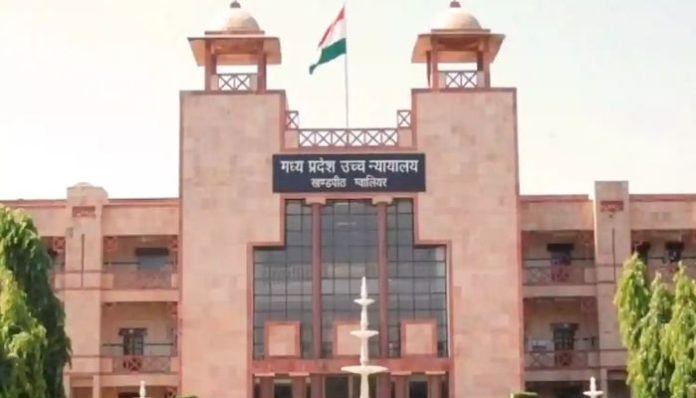
The Madhya Pradesh High Court has partly allowed a plea by a journalist who was accused of cheating and extortion. The court stated that freedom of the press cannot be used as a means of obtaining illegal benefits from individuals. The court added that even though the press plays a significant role in a democratic setup, freedom of the press cannot be misused by obtaining illegal benefits.
The bench of Justice Himanshu Joshi made these observations while hearing a petition seeking the quashing of an FIR registered under Sections 384 (extortion) and 420 (cheating) of the Indian Penal Code (IPC).
The court highlighted the role of journalists in society, but also stressed that professional freedom must not be misused.
“A journalist acts as a watchdog of society and performs the essential function of disseminating information concerning matters of public interest. Reporting on issues related to public land, compliance with legal regulations, and government functioning falls within the legitimate sphere of journalistic scrutiny. However, the shield of freedom of the press cannot be permitted to become a weapon for extracting illegal benefits,” the court said.
FIR filed over demand for money
The case began with a complaint filed on 5th August 2023 by Koklal Yadav, who claimed to be the district president of the Yadav community, lodged a complaint on the 5th August 2023. According to the complaint, the petitioner met the complainant and other individuals, including Bharat Yadav, Badri Yadav, Ramswaroop Yadav, and Rajesh Yadav, on the 18th July, 2023. They met at the Yadav Lounge in Gwalior.
The petitioner introduced himself as a journalist and claimed that the construction of the building near the Revenue Inspector’s office was illegal. According to the FIR, the journalist claimed that the construction of the building was taking place on the “Gauthan” lands, which are the common land of the villagers. It is claimed that the construction of the building was taking place without the proper conversion of the land and the requisite permission from the Panchayat (Extension to Scheduled Areas) Act, 1996 (PESA Act).
The complainant claimed that the journalist demanded money from him. He claimed that the journalist told the individuals that if the money was not paid, he would write a news article about the construction and the individuals.
The complainant had refused to pay the money. After this, the journalist had published a news article in the Pradesh Today newspaper that had photographs of some officials from the Gondwana Gantantra Party. The journalist had raised allegations of irregularities in the construction of a memorial.
Based on these allegations, the complainant submitted a written complaint, which led to the registration of an FIR.
Court finds no evidence of cheating
While examining the matter, the High Court explained the essential ingredients of cheating under Section 420 of the IPC. These include deception of a person, dishonest inducement, delivery of property due to such inducement, and the presence of dishonest intent from the very beginning of the transaction.
The court observed that the key element of deception was missing in this case.
However, the court noted that the allegations relating to extortion under Section 384 appeared to be made out at the initial stage.
Court emphasises responsible journalism
Before concluding the matter, the bench also spoke about the importance of responsible journalism in a democratic society.
“If a journalist, instead of disclosing facts in public interest, seeks to demand unlawful benefits by leveraging the threat of publication for personal gain, such conduct erodes public confidence in the media institution and cannot claim protection under the guise of professional duty,” the court observed.
The bench further added that while courts must ensure that criminal proceedings are not used to suppress honest reporting, they must also ensure that journalism is not used as a cover for acts that appear to be extortion.
Case history dating back to 2016
The accused had earlier approached the court seeking anticipatory bail, and an earlier application filed in 2016 had been dismissed.
At that time, the allegations against the applicant included executing an agreement to sell land measuring 2,415 square feet for ₹56 lakh, even though he allegedly owned only 572 square feet of the land. According to an order passed by the Tahsildar of Ghansore in Seoni district on 15th May 2015, the applicant had permission to sell only 1,058 square feet of land.
The court had earlier refused bail, observing that the applicant had not produced any documents to show ownership of the larger area of land.
Later, the applicant filed another plea stating that the dispute had been settled between him and the complainant. Considering the changed circumstances and the compromise between the parties, the court granted relief.
In the present case as well, the High Court partly allowed the petition. It quashed the proceedings related to the offence of cheating under Section 420 of the IPC but allowed the case related to extortion under Section 384 to continue.
