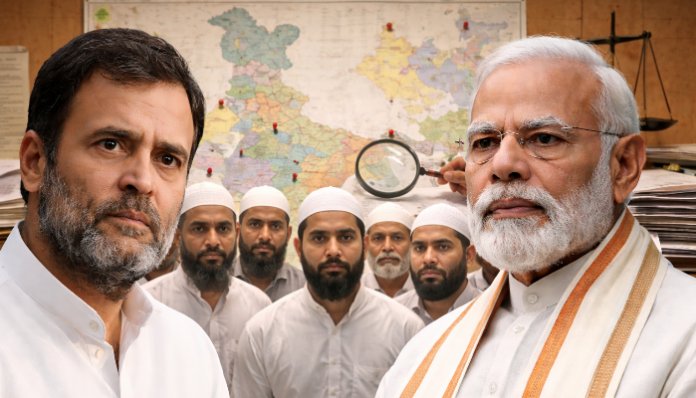
The Indian National Congress, after tirelessly advocating for “jitni abadi utna haq (rights proportionate to population),” has started its propaganda against the demarcation process, which is critical for ensuring fair representation in the Lok Sabha and State Legislative Assemblies in light of the demographic transitions and to prevent the possibility for underrepresentation or overrepresentation of particular areas.
However, the opposition has sought to cast aspersions on the move, wary of its potential impact on long-cultivated vote banks. Leading the charge, Rahul Gandhi has accused the Bharatiya Janata Party of attempting to “gerrymander Lok Sabha seats to secure an advantage in the 2029 elections.”
On 15th April (Wednesday), he tweeted that the “proposed bills remove all Constitutional safeguards on delimitation, giving full power to the Delimitation Commission which the govt itself will appoint and direct” in his usual fact-free diatribe, which he is known for delivering after every progressive decision taken by the Centre.
Notably, the commission is appointed by the President of India, but the grand old party has never concerned itself with the truth and is unlikely to alter its ways, particularly when its underhanded plans to favour the second-largest majority and its long cultivated vote bank — Muslims — at the expense of Hindus to secure its electoral future are on the brink of being washed over.
One of the BJP's dangerous plans is to “gerrymander” all Lok Sabha seats to its advantage for the 2029 elections
— Rahul Gandhi (@RahulGandhi) April 15, 2026
The proposed Bills remove all Constitutional safeguards on delimitation, giving full power to the Delimitation Commission which the govt itself will appoint and… pic.twitter.com/7iFz4GmcAH
The Gandhi scion then invoked the delimitation that took place in Assam and Jammu and Kashmir and alleged that it was “hijacked” and “anti-BJP regions and communities were split-up for electoral advantage.” He then switched to the superfluous and unfounded rhetoric about how the Election Commission has been taken over by the saffron party and PM Modi “is confident that he can capture the Delimitation Commission too.” Gandhi added that the “Congress will not allow this to happen.”
“Delimitation should be based on a transparent policy framework, developed after wide consultations with a consensus. Indians of all communities and States should feel confident that they will be represented and their voices will be heard. This is the only way forward to protect and strengthen our democracy,” he declared.
The underlying reason for distress is not “concern for democracy” but the dread of losing the long-nurtured electoral advantage
Rahul Gandhi’s lofty assertions about democracy and the constitution might appear impressive and even sincere to an unsuspecting or naive mind, however, the politics practised by his party over the years reveal the true motivations of his fears. Telangana Chief Minister Revanth Reddy correctly articulated this when he stated, “Congress signifies Muslims, and Muslims signify Congress.”
The fundamental issue revolves around the party’s appeasement of Muslims, which has only grown stronger over time, accompanied by special awards bestowed upon on the community for their loyalty, while Hindus have consistently faced the fallout of these actions, as their appeals for justice have been purposefully disregarded.
The delineation is vital to escape this perilous monopoly of the second-largest community over specific neighbourhoods, termed as “Muslim areas,” which essentially devolve into no-go zones, each with its own regulations where even a perceived infraction can provoke a deadly reaction for Hindus and even for authorities merely fulfilling their responsibilities, as has been observed time and again.
The onslaught on Hindus during their sacred occasions for daring to hold a procession have already become a norm in the country. The attack on the Durga procession that culminated in the brutal killing of Ram Gopal Mishra in Bahraich in 2024 stands as yet another stark testament. Devotees are refrained from conducting the religious event at specified sites to avoid “triggering” Muslims and avert communal incidents.
The Congress-led opposition and their ecosystem, which react like popcorn in a hot pan at the mention of a “Hindu Rashtra,” in the name of secularism, had a crucial part in establishing these exclusive sectors and the sentiment of unchallenged authority among Muslims based on numerical strength. The anti-majoritarian principle of Congress unsurprisingly flips on its head in relation to the Muslim community.
As a result, the phenomenon of ghettoisation persisted relentlessly, bolstered by political support in lieu of votes, enabling Muslims to treat these localities as sovereign territories within the country. This is used to rationalise assaults on Hindus, their religious processions, administration, officials, security forces, cops and any individuals who ventured there in defiance of the “consent” of the locals, in a complete travesty of law and order.
These places are proudly designated as “mini-Pakistan” by both the residents and politicians such as Bobby Firhad Hakim, as well as employed not only to normalise religious extremism but also to intimidate Hindus and non-Muslims via horrific acts.
The house is for sale: Hindus forced to migrate; authorities also not spared
Hindus are always at the receiving end from Kashmir to Kerala and Maharashtra to West Bengal as Islamists need no excuse to incite unrest and target them. This trend remained unchanged over the years from the valley to Murshidabad, where the Hindus had to abandon their homes to protect their lives and dignity in the face of terrorism and violence.
These scenes have regularly played out where aggressive Muslim mobs chanting “Allah Hu Akbar” have caused Hindus to flee for their safety and the protection of their women. A similar incident took place in Delhi’s Hauz Qazi over a parking dispute, which escalated into the desecration of a Durga Mandir in 2019, eventually forcing another wave of Hindu exodus.
Hindu families in the national capital put up “houses for sale” posters in 2025. The matter began with an argument over the expansion of a mosque in Brahmpuri. Stones were thrown by radicals, prompting the Hindus to resort to this action out of fear of communal clashes. The Dalit Hindus of Daudpur Kota village in the Aligarh district encountered a similar fate that year due to harassment from Muslims.
40 Hindu families also decided to abandon their properties after suffering continuous attacks from a Muslim neighbour and his aides in Bhagwan Nagar Block A, under the Kamala Nagar area of Agra, in February. Times progressed, but the situation for Hindus has continually remained dire.
On the other hand, those in uniform or personnel trying to carry out their legal obligations are also not exempt. Stone pelting and attacking the administration and authorities when acting against illegal Islamic structures is a frequent occurrence, but the risk to their lives is plausibly heightened when they operate in Muslim-majority regions, as illustrated in the Banbhoolpura area of Haldwani, Uttarakhand.
This is the reason for the protests preceding the anti-Hindu Delhi riots, most notably articulated by the likes of Sharjeel Imam, leveraging the strength of his community to cut off the “Siliguri Corridor” or “Chicken’s Neck”.
Only Muslim candidates can represent “Muslim areas”
Jammu and Kashmir has witnessed all of it, from Pakistan-sponsored jihad to the exodus of Kashmiri Pandits, except a Hindu chief minister. The position has been continuously filled by Muslim persons and suggesting otherwise is met with firm rejection and controversy. People from different belief systems can sit in the highest offices in a Hindu-majority India, but to even consider the same in a region dominated by Muslims is viewed as blasphemy.
This is visible in other such constituencies as well, for instance, Baharampur which removed Congress leader Adhir Ranjan Chowdhury after All India Trinamool Congress (AITC or TMC) put forward the candidacy of former cricketer Yusuf Pathan from Gujarat. A Hindu candidate has no place in the presence of one who shares the faith of the majority population in these constituencies.
This is electoral exclusion and an affront to the democratic rights of the non-Muslim communities. They are not afforded the opportunity to contest from these areas, and if they try, the likelihood of victory is negligible as faith supersedes every single issue, including development and progress, for the Muslim voters. The minorities in these regions are politically and otherwise marginalised, with a low probability of improving their circumstances.
How Congress fostered and appeased Muslims for its political goals
The street power of Muslims transforms into a veto power during elections, as the community is known for voting as a unified block and parties comply with their unreasonable demands and shower them with extravagant privileges for electoral success. This is the rationale behind the tendency to segment Hindus by caste while considering Muslims as a single unit during elections.
Furthermore, the disdain they openly voice for the saffron party and their willingness to collaborate with anyone they believe can defeat it is also apparent. Congress is well aware of this and has left no stone unturned in its efforts to appease the community, enacting controversial policies to solidify their support against the BJP.
Sonia Gandhi, who was leading the United Progressive Alliance (UPA), won against Atal Bihari Vajpayee’s National Democratic Alliance (NDA) in the 2024 general elections. A few months later, the central government passed a resolution to explore measures aimed at benefiting the “socially and economically backward sections among religious and linguistic minorities.” The BJP had vehemently opposed the implementation of the report and resisted reservations for Dalit Christians, accusing the Congress of engaging in vote bank politics.
However, this was not the first time Sonia Gandhi, the super prime minister and real centre of authority in the government, tried to curry favour with her cherished community disguised as “welfare schemes for the underprivileged” for defeating the BJP. The government established the Minority Affairs Ministry in January 2006 by splitting the Ministry of Social Justice and Empowerment. Abdul Rahman Antulay served as the first minister in 2006, and Salman Khurshid took over in 2009.
It’s interesting to note that the United States Ambassador to India, David Mulford, mentioned Antulay in a private memo that WikiLeaks made public. The cable unveiled that the latter had expressed scepticism concerning the 26/11 terror attack, claiming that “Hindutva forces” might have been involved in it. Congress notoriously refrained from taking any decisive action against the Islamic Republic following the deadly attack, in order to avoid upsetting its Muslim voter base in India.
Meanwhile, the government headed by Congress even attempted to adopt volatile measures to pass legislation consisting of the Communal Violence Bill, in addition to the countless programs put up for minorities, particularly Muslims. The bill was tabled by UPA1 in 2005. A revised draft of the same was presented by UPA2 in 2011 under the direction of the National Advisory Council (NAC).
It basically declared that only minorities and Scheduled Castes (SCs) and Scheduled Tribes (STs) could be considered “victims” and the majority Hindus would always be projected as the perpetrators of communal violence. Its definition of “offences” was so broad that it might apply to any kind of crime. The accused were presumed guilty with the burden of proof resting with them. There were several other provisions that expressly targeted Hindus, perhaps as a gesture of gratitude to the Muslim community for returning Congress to power.
Delimitation threatens to disrupt Congress’ appeasement politics
The aforementioned clearly highlights the perverse politics employed by the Congress party to maintain its grip on power in the country. However, the delimitation is a major obstacle in their corrupt strategy to pander to the Muslim community for electoral gains. The “Muslim areas” that the Congress facilitated for its use as a voting bloc against the BJP might lose their influence.
They could now lose the unfair status and become regular voters, similar to Hindus, who have had to grapple with the consequences of the political ploys executed by Congress. Hence, Rahul Gandhi is irked not due to a supposed “threat” to democracy, or the Constitution but rather because the “vote bank” politics of his party is at stake.