The Modi government is set to table the Constitution (131st Amendment) Bill, 2026, in a Special Session of Parliament scheduled for 16th and 17th April. The bill aims to raise the strength of the Lok Sabha from 543 to 850. Even before being brought on the floor of the parliament, the Bill’s delimitation proposal has outraged anti-BJP parties and the leftist media cabal. While parties like Congress and DMK have claimed that delimitation in its proposed form would reduce the seats of southern states, the leftist propaganda outlet The Quint has declared it a “3-step vote chori”.
In The Quint article headlined, “Delimitation Bill is a 3-Step Vote Chori Against Opposition”, ‘journalist’ Aditya Menon dubbed the proposed delimitation as 3-step vote theft by the Modi government, claiming that the conspiracy involves selective use of population, nationwide gerrymandering, and targeted reduction of seats wherein the BJP has electorally struggled, especially in southern states. The converted Islamist draws on examples from delimitation exercises in Assam and Jammu and Kashmir to claim that somehow the entire delimitation process is going to be conducted to empower BJP strongholds.
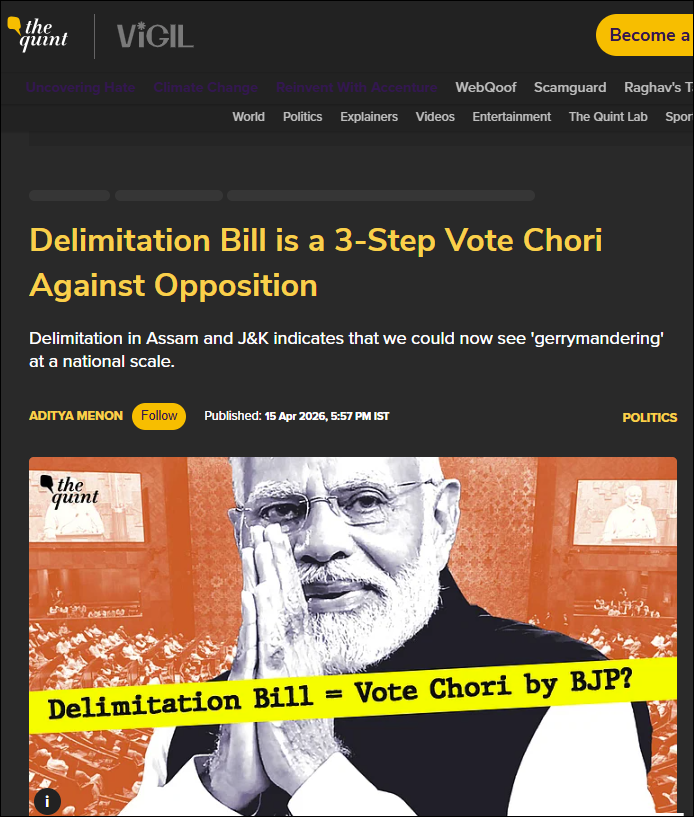
Menon cites The Hindu projections, which indicate that Uttar Pradesh’s seats will rise from 80 to 138, Bihar’s seats rise from 40 to 72, Tamil Nadu’s seats from 39 to 50, and Kerala’s from 20 to 23, to argue that the proposed delimitation will cause reduction in the proportion of seats not only in southern states but also “where the BJP performs poorly.”
“Uttar Pradesh, which has 80 seats in the 543-member Lok Sabha at present, should have had 125 seats in the new 850-member Lok Sabha. It will now have 138 seats due to a higher population growth rate. Bihar, which should have had 62 seats, will now have 72. Rajasthan, which should have had 39, will have 47. In contrast, Tamil Nadu, which should have had 61 seats in the increased Lok Sabha, will have 50. Kerala will have 23 instead of 31. Andhra Pradesh will have 34 instead of 39,” The Quint article reads.
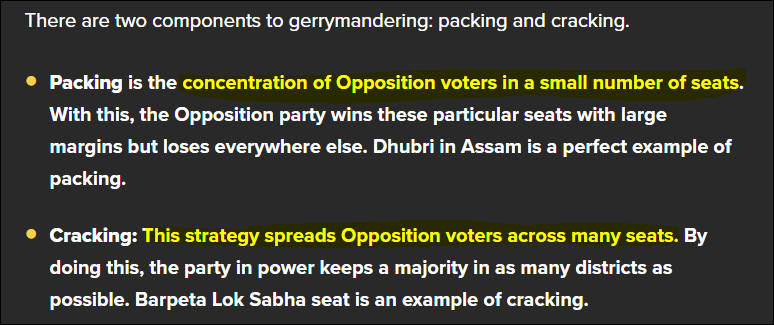
The propaganda piece pivots to the Muslim victimhood narrative, arguing that if the ‘one person, one vote’ principle was actually respected, Muslim-majority seats in Assam, like Dhubri, 10 lakh extra voters from Barpeta would not have been added to Dhubri to make it a “Hindu-majority seat overnight” during the 2023 delimitation exercise.
Aditya Menon relies on the tried and tested tactic of Islamo-leftist propagandists of cherry-picking numbers and blending them with a victimhood narrative to villainise the Modi government and create panic.
The entire ‘gerrymandering’ narrative, that too, to disempower Muslim voters, is bogus and only a panic-triggering term that The Quint is throwing. In Assam, the Election Commission used the 2001 Census data as well as population density categories A/B/C districts, with an allowed ±10% deviation from the state average.
Densely populated districts, like a Muslim-majority Dhubri, received adjustments to project smaller, indigenous, tribal communities in low-density areas like Kokrajhar. The ECI’s goal was equitable voter load and to protect indigenous communities. The ’10 lakh extra voters’ in Dhubri was a practical density-based math and not deliberate packing. Population density is a key aspect of the delimitation process, but the delimitation process does not rely on or target religious demographics.
Neither the existing laws nor the proposed delimitation bill makes any mention of religion-based “packing and cracking”.
Similarly, in the 2022 delimitation exercise in Jammu and Kashmir, the Delimitation Commission considered population, border proximity, administrative factors, and geography. Anantnag was merged with Rajouri and Poonch areas across Pir Panjal, creating the Anantnag-Rajouri Lok Sabha constituency that bridges the Pir Panjal range, connecting Anantnag in the Valley with the Rajouri-Poonch border districts in the Jammu division.
Although the delimitation process does not involve religious demography as a deciding factor, the merger did result in creating a new diverse and competitive electoral landscape wherein Muslim Muslim-majority districts of Rajouri-Poonch were combined with South Kashmir. If Aditya Menon’s chagrin is about the process resulting in the dismantling of the Muslim electoral veto, then coping and seething is the only option he has.
In addition to the Muslim victimhood propaganda, Aditya Menon also claimed that the proposed delimitation exercise will “penalise” southern states and even Punjab for better family planning, resulting in the reduction of the proportion of seats.
The Quint did not stop at the Muslim victimhood, and the ‘south will lose seats’ fear mongering. The leftist rag even invoked a ‘linguistic minority’ angle while arguing that the Modi government is supposedly making selective use of the population and census.
“In Assam, the government went for delimitation as per the 2001 census and not the latest figures, citing the need to “protect smaller communities”. These also happen to be communities that have tended to vote for the BJP in the past few elections. This could have be used to preserve the interests of linguistic minority states such as the South or Punjab, which will lose out as per the latest population figures. But the government chose not to do it. Clearly, population as a criterion and choice of census is being done in a way that benefits the BJP and harms the Opposition,” The Quint article reads.
This whole ‘chose not to preserve the interests of linguistic minority states’ is a blatant misrepresentation of not only the constitutional framework but also the explicit provisions of the proposed amendment bill.
The government has stated that seats in every state will increase by 50% on a pro-rata basis, essentially preserving their current proportional strength in the Lok Sabha. Neither any southern state nor Punjab nor West Bengal will lose even a single seat in absolute terms. Contrary to the fear-mongering narrative and a deliberate misrepresentation, the proposed pro-rata expansion is not a simple population-proportional model.
It is factually correct that southern states have fared well with regard to population control measures and economically. This commendable performance is rewarded by granting absolute gains proportional to their current share. The number of seats in absolute terms is only going to increase.
The Indian Constitution demands population-based seats. The 1971 freeze was a temporary measure to ensure population control measures were implemented without the fear of states losing political representation. This freeze, however, cannot become a perpetual southern entitlement.
Article 81 explicitly requires Lok Sabha seats to be allocated to states “as far as practicable” in proportion to population. The 42nd Amendment froze allocation on 1971 figures simply as a short-term incentive for family planning and other population control measures. The 84th Amendment extended this freeze only until the first Census after 2026. Thus, continuing the freeze indefinitely would violate the “one person, one vote” principle.
Gerrymandering requires deliberate partisan manipulation, as it happens in the US. However, in India, the Delimitation Commission is quasi-judicial, independent, and faces judicial review.
While the opposition is portraying the delimitation proposal as ‘punishment’ for the South, in reality, Northern voters are systematically under-represented. The fact is, more than the fear of southern states losing seats, the anti-BJP cabal is opposing delimitation because the most populous states in the country would be getting more representation. They are interpreting the delimitation exercise and its outcome in terms of the division of seats between pro-BJP and anti-BJP voter pockets across the country.
Although the BJP has enjoyed power in Karnataka earlier and is a part of the ruling coalition in Andhra Pradesh, southern states are portrayed as historically against the BJP, while the northern states, many of which are ruled by the BJP at present, are portrayed as pro-BJP states. The entire outrage comes across as an attempt to secure an equal number of seats for southern states as northern states by disregarding the population criteria.
This whole ‘south states are being punished’ for better implementation of population control measures narrative collapses if we look at the population dynamics.
Delimitation is a constitutional process of redrawing electoral boundaries and reallocating seats in the Lok Sabha to ensure roughly equal population per constituency. North Indian states are highly underrepresented, while South Indian states are overrepresented to some extent.
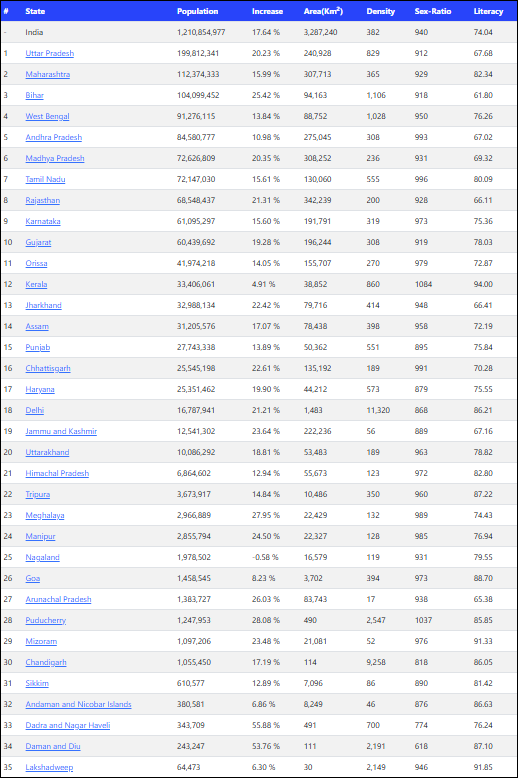
The population of Rajasthan, as per the 2011 Census, is 6 crore 85 lakh, and the number of Lok Sabha seats is 25, while Karnataka’s population, as per the 2011 Census data, is 6 crore 11 lakh. Despite having around 75 lakhs more population, Rajasthan has three seats fewer.
Similarly, Madhya Pradesh’s population as per the 2011 Census is 7 crore 26 lakh. The state has 29 Lok Sabha seats at present. However, Tamil Nadu, with a population of 7 crore 21 lakh, has 39 seats.
If we do the math and calculate per-Member of Parliament population, an MP in Rajasthan represents around 27.42 lakh people, while an MP in Tamil Nadu represents 18.50 lakh people. An MP in Uttar Pradesh represents roughly 24.98 lakh people, and an MP in Kerala represents 16.70 lakh people.
This essentially means that an MP from Kerala, for example, represents nearly half as many people as an MP from Uttar Pradesh. Does that not mean that a Kerala voter’s vote is 1.6 times more valuable than that of an Uttar Pradesh voter? Is this not a mockery of the “one person, one vote” principle?
This disparity can also be traced in the Member of Parliament Local Area Development Scheme. Every MP gets Rs 5 crore allocated for local area development, irrespective of the constituency’s population. Result? Per-capita spending is significantly higher in smaller-population constituencies compared to higher population constituencies. The proposed delimitation exercise is designed to address these disparities.
The Central government has assured that the number of seats will go up, essentially on a pro-rata basis, using the latest published Census. Even if the Delimitation exercise happens after the 2026 census, the population difference in Southern vs Northern states will be in expected lines of the 2011 census.
To fulfil its repeated assurance that southern states will not lose a single seat, the Modi government’s amendment bill proposes altering the definition of population from the “last preceding census” to “population as ascertained at such census, as Parliament may by law determine”. This essentially hands the Parliament broader options while allotting seats. There is also a possibility that the Centre would come up with a one-cycle hybrid formula. However, The Quint, Aditya Menon and the extended anti-BJP ecosystem are deliberately peddling alarmist narratives to cause panic and stir unrest in the country.
Aditya Menon: The master of fake news and anti-BJP propaganda
This, however, is not the first time that The Quint’s Aditya Menon has peddled anti-BJP propaganda and fake news. Back in January 2022, when a breach in Prime Minister Narendra Modi’s security occurred in Punjab, Menon wrote an article for The Quint, in which he blatantly downplayed the seemingly deliberate security lapse that led to PM Modi being stuck for 20 minutes not too far away from the Pakistan border. Menon claimed that earlier, PM Modi was stuck for 2 hours in traffic in BJP-ruled Uttar Pradesh, yet no one was outraged, whereas when a similar situation happened in Congress-ruled Punjab, people were outraged since they somehow harboured some sort of hatred for Punjabis. The fact, however, was that PM Modi’s convoy was stuck in traffic in Uttar Pradesh only for 2 minutes, not 2 hours as claimed by The Quint.
In 2020, Aditya Menon, a Hindu who converted to Islam, attempted to rationalise Shaheen Bagh mastermind Sharjeel Imam’s secessionist and violent remarks by equating them with the ISI propaganda of blockades imposed in Kashmir by Hindu organisations in 2008.
Downplaying 2020 anti-Hindu Delhi Riots violence-accused Sharjeel Imam’s anti-India remarks, Menon contended that the former JNU student had simply asked for a “chakka jam or a blockade of the highways and railways leading to Assam”. However, in his pursuit to defend Imam, Menon cunningly drew a parallel with the Amarnath agitation in 2008 when Hindu organisations had allegedly blocked the Jammu-Srinagar highway. Menon had argued that if that wasn’t considered sedition, then the Imam’s call to block the roads and railways leading to Assam should not be considered separatist either.
Aditya Menon’s fear-mongering narrative that the delimitation exercise will somehow benefit the BJP electorally is rooted in his hatred for the BJP and its voter base. A significant section of India’s middle class, despite its own complaints with the Modi government, has remained a loyal BJP voter, is nationalist, and thus is also hated by the likes of Aditya Menon.
Back in December 2020, Menon had published an X post villainising the Delhi’s middle class, for their non-support to the anti-CAA and farmers’ protest. He received support from propagandist Rohini Singh, who called the Indian middle class “most immoral”.
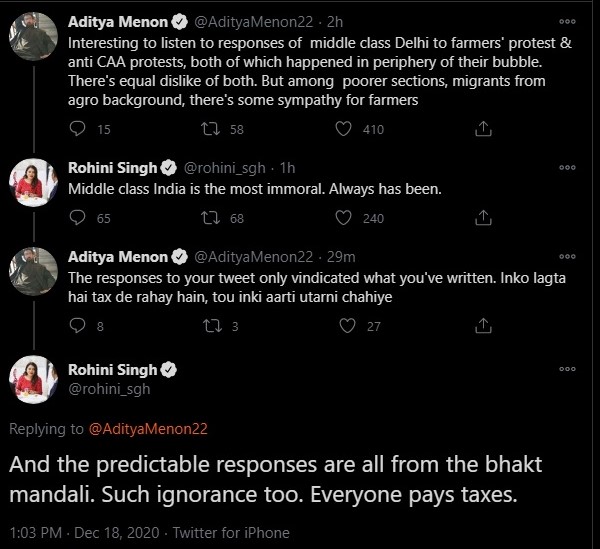
In 2019, when Hindu activist Kamlesh Tiwari was brutally murdered by jihadis for his remarks against the Muslim prophet, Aditya Menon had joined fellow Islamists to deflect attention from the brutality of the Hindu activist’s murder. While a Hindu man was murdered, Menon accused the ‘Hindutva Brigade’ of spreading ‘hatred’ against Muslims, making the social outrage in reaction to Tiwari’s murder and the imaginary ‘compassionate’ Muslim response to the same, a bigger and more concerning issue than the murder itself.
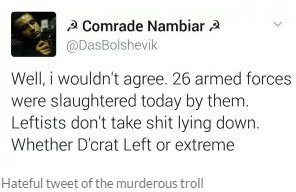
In 2017, Aditya Menon had supported a murderous social media troll “Comrade Nambiar” who celebrated the death of 26 CRPF men who were killed by Maoists.
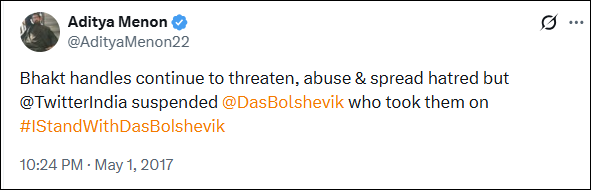
“Bhakt handles continue to threaten, abuse & spread hatred but @TwitterIndia suspended @DasBolshevik who took them on #IStandWithDasBolshevik,” Menon posted in May 2017.
In 2016, Menon, who then worked as a Catch News journalist, posted with the caption that said a picture of a young girl closing the eyes of a dead man with the claim that said the picture was taken from Kashmir. The picture, however, was from 2012 and not from Kashmir but Syria.