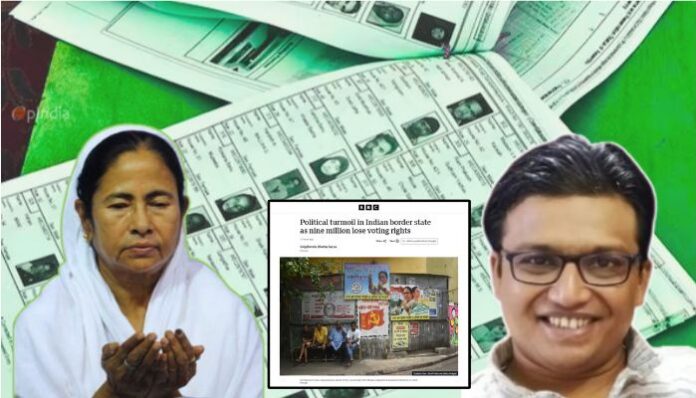
The Special Intensive Revision (SIR) exercise in the poll-bound West Bengal has resulted in the deletion of nearly 90 lakh voter names. The Election Commission’s confirmation that 27,16,393 voters were found ineligible during the final stage of the revision process became the trigger for the Islamo-leftist political and media cabal to peddle the Muslim victimhood bogey. In this vein, Snigdhendu Bhattacharya wrote a propaganda article for the BBC, wherein he casts aspersions on the integrity of the ECI while pushing an apocryphal narrative that around 2.7 million Muslims were deliberately disenfranchised.
In the article headlined, “Political turmoil in Indian border state as nine million lose voting rights”, Bhattacharya pushed a border state panic narrative and framed the name deletions as a politically motivated “loss of voting rights” that could “shape state policies”. Staying true to the objective of the propaganda piece, the Kolkata-based ‘independent journalist’ emphasised the imaginary targeting of Muslims.
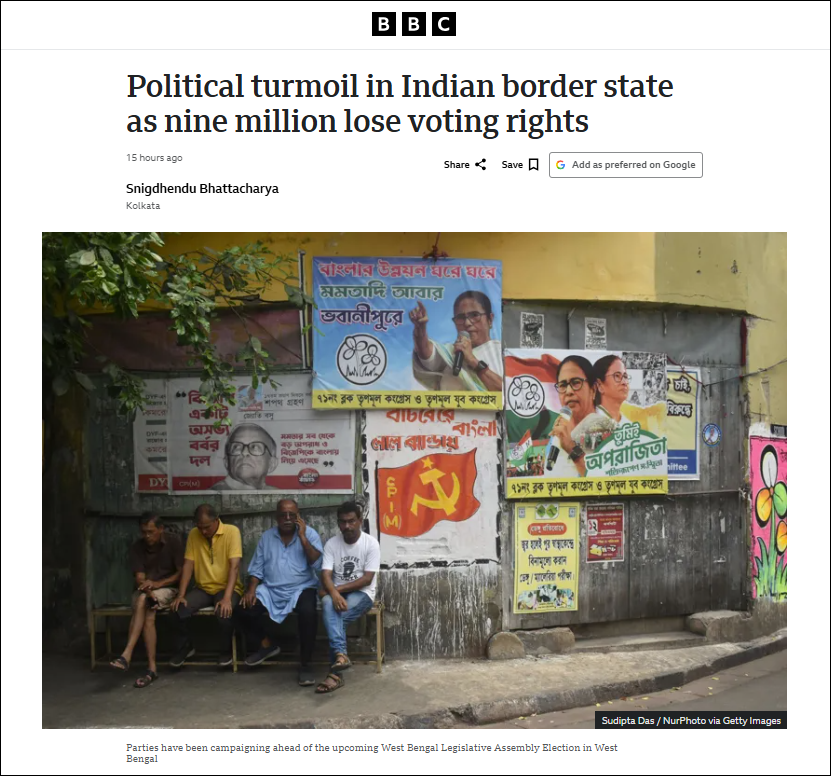
The article shrewdly drops numbers, geography, political statements and sympathy-evoking personal stories as dots for readers to connect and see through a supposed conspiracy at play to ‘snatch away the voting rights’ of West Bengal’s Muslims, who traditionally vote against the BJP.
“India shares a 4,096km (2,545-mile) largely porous and partly riverine border with Bangladesh, and a significant stretch of it runs through West Bengal. This has added a fraught political edge to debates over migration and voter rolls in the state,” the BBC article published on 12th April reads.
Sniddhendu Bhattacharya insinuated that the Supreme Court took a wrong decision in allowing the voting to be conducted later this April “without settling all disputes over the deletions”, leaving “the fate of 2.7 million voters remains undecided.”
91 lakh voters in West Bengal declared ineligible in SIR exercise: Transparent scrutiny or targeted disenfranchisement of Muslims?
Notably, in December 2025, the ECI deleted 58.25 lakh voters who were found to be deceased, absent, shifted, or had duplicate entries in the draft rolls. This slashed the total voter base down from 7.66 crore to 7.04 crore. Subsequently, an additional 5 lakh names were removed from the final rolls on 28th February, taking the overall number of deletions to just under 91 lakh.
Of 60.06 lakh voters who were initially put under adjudication, nearly half were found ineligible. The highest number of deletions was recorded in Muslim-dominated Murshidabad, where more than 4.55 lakh voters were found ineligible out of 11 lakhs marked for adjudication. Murshidabad district shares a border with Bangladesh. Muslim mob violence and Bangladeshi Muslim infiltration are major issues here. Apparently, that explains the high number of ineligible voters being detected and weeded out of the electoral roll. Similar has been the story of Malda and other border area districts.
The large number of voter name deletions in border districts and a massive increase in the influx of Bangladeshi Muslims via the porous Indo-Bangladesh border indicate a systematic conspiracy to alter the religious demography of these districts. However, to cover up this conspiracy, the Islamo-leftist cabal is concocting a false narrative that ECI and the BJP have colluded to arbitrarily disenfranchise Muslims.
The official ECI breakdown demonstrates that the vast majority were standard clean-up categories like dead, absent, permanently shifted, untraceable at registered addresses, or bogus. These are routine issues in electoral rolls, the SIR, not just in West Bengal, but all the 13 states and UTs covered so far, were explicitly designed to address issues like ghost voters, migration, and outdated entries, etc. The ECI followed the laid procedure during the SIR exercise, even while facing threats and pressure from the local TMC government. However, the BBC article makes no mention of how the ECI officials were under constant duress, and even judicial officers in Malda were harassed by Muslim mobs for doing their jobs, since doing so does not align with the Muslim victimhood narrative.
“Constituency-wide data compiled by political parties suggests that around 65% of the 2.7 million in limbo are Muslims. Overall, Muslims account for 3.11 million – about 34% – of the nine million removed, significantly higher than their 27% share in West Bengal’s population, according to the 2011 census,” the BBC article reads.
Contrary to the narrative pushed by the BBC, the 2.7 million “undecided” cases, or the 27,16,393 voters deleted, underwent judicial scrutiny and not blanket exclusion. These were flagged for discrepancies and reviewed by around 705 judicial officers under the Calcutta High Court monitoring, as well as Supreme Court oversight. Of the 60.06 lakh cases, 32.68 lakh were retained as eligible, while 27.16 lakh were ruled excludable. However, the door for objections is not shut. Those who believe that their names were erroneously excluded could and still can appeal through 19 dedicated tribunals.
The Supreme Court has indeed allowed the polling to take place on 23rd and 29th April, and noted that the SIR exercise “went off smoothly” in other states, with West Bengal as an “outlier” due to the litigation. The top court, however, has consistently laid emphasis on ensuring safeguards and timelines while halting the SIR process or the polling itself.
Also, the BBC article cited data compiled by ‘political parties’ to claim that “Muslims account for 3.11 million – about 34% – of the nine million removed, significantly higher than their 27% share in West Bengal’s population…”.
The BBC, however, downplayed the fact that it is Hindus who comprised 63% of the deletions in absolute terms. Even some Hindu-dominated areas like Paschim Bardhaman and the Matua community pockets in North 24-Parganas saw significant deletions. Despite this, the BBC article, though, acknowledges Hindu voter deletions, frames the SIR exercise around Bangladeshi Muslim infiltration and pushes an anti-Muslim conspiracy narrative, almost as if to incite panic and violence in a state where Islamist-orchestrated lawlessness is more normal than peace.
The Election Commission has also said that deletions followed verification and not any playbook of targeting Muslims. There is zero evidence of any deliberate foul play to exclusively target and disenfranchise Muslim voters, and yet the BBC relied on lame AI and opacity excuses to lend credence to their conspiracy theory.
Even if, for argument’s sake, it is assumed that the ECI and the BJP indeed joined hands to influence the electoral roll in the BJP’s favour, why would a political party that posits itself as pro-Hindu let the SIR process result in Hindus accounting for 63% of deletions? Why would BJP, a party hungry for a maiden victory in West Bengal than its rivals, commit such a suicidal blunder?
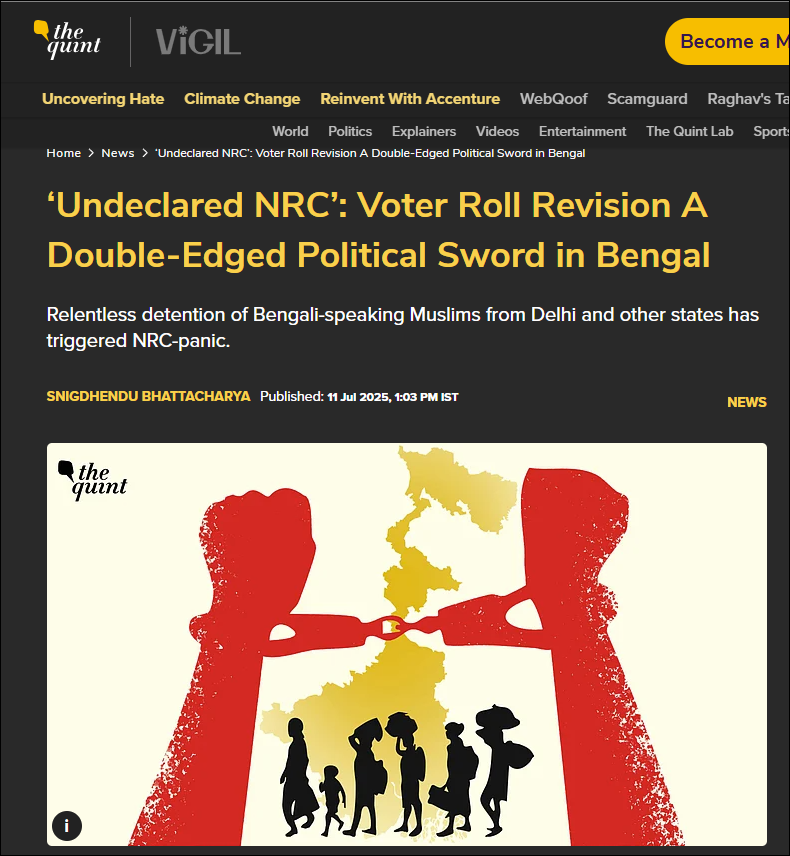
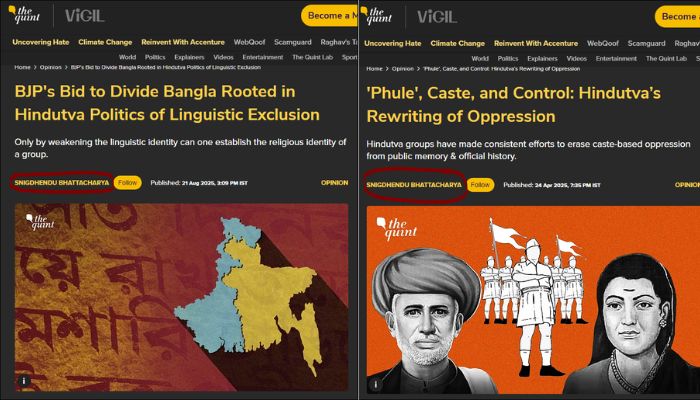
Despite this, Snigdhendu Bhattacharya, who regularly writes for Islamo-leftist rags like The Wire, Newslaundry, The Quint, Article-14, etc, and in a Quint article called the SIR in Bengal, “undeclared NRC”, decided to rely on anecdotal cases and TMC/ party sources rather than ECI’s official data and the Supreme Court’s oversight.
Electoral roll frozen, deleted voters cannot vote in upcoming assembly elections
There’s no way permanently deleted voters can be allowed to partake in the electoral process just because a significant portion of them happen to be Muslims. The ECI has already frozen the West Bengal voter list, and no fresh additions can be made to the electoral roll until the Supreme Court directs so.
This has essentially been confirmed even by the Supreme Court on 13th April.
A bench of CJI Surya Kant and Justice Jomalya Bagchi said that people whose names have been removed from the voter list and whose application for re-inclusion is still pending, such people cannot be allowed to vote in the upcoming Bengal Assembly elections. The apex court said this while hearing the petition moved by 13 people who sought the court’s intervention in the deletion of their names from the electoral roll. The court, however, termed their plea as “premature”, directing them to approach the appellate tribunals instead.
In response to TMC leader Kalyan Bannerjee’s request that 1.6 million appeals have been filed and that these people be allowed to vote in the coming election, CJI Suryakant said, “That is entirely out of the question. If we were to permit this, then the voting rights of the individuals involved would have to be suspended.”
Meanwhile, Justice Bagchi noted that around 3.4 million appeals have been filed in the SIR exercise. “Since the petitioners (Quaraisha Yeasmin and others) have already approached the appellate tribunals… in our considered view, the apprehensions expressed in the petition are premature. If the plea is allowed, then necessary consequences will follow,” the court said.
Pertinently, the court clarified that if the application for adding a name is approved on 9th April 2026 or even a few days thereafter, then the name of such a person will appear in the voter list, and then he can vote. However, the court made it abundantly clear that people whose cases are still pending cannot be allowed to vote in the elections.
The author of the BBC article has the habit of writing anti-Hindu, anti-BJP and sometimes pro-TMC pieces
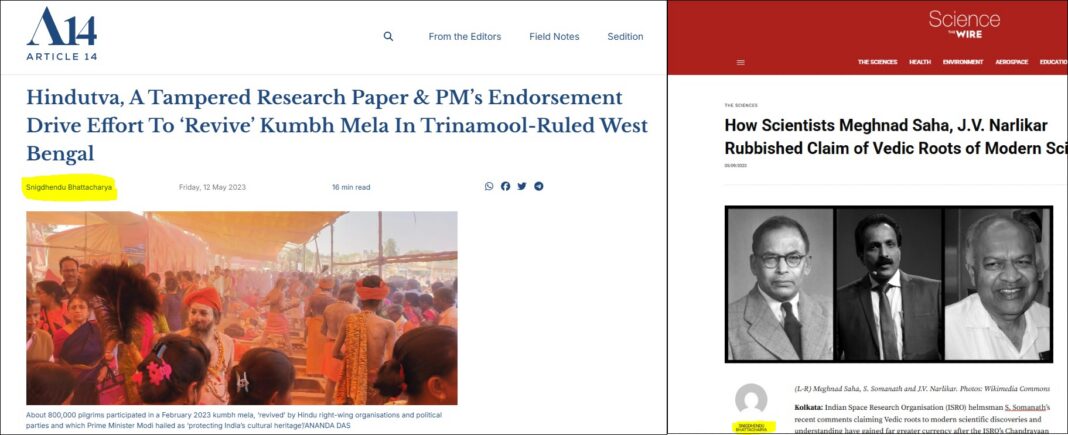
However, Snigdhendu Bhattacharya’s special dedication to pushing the Muslim victimhood narrative is understandable given that he has a record of writing anti-Hindu and anti-Hindutva propaganda articles.
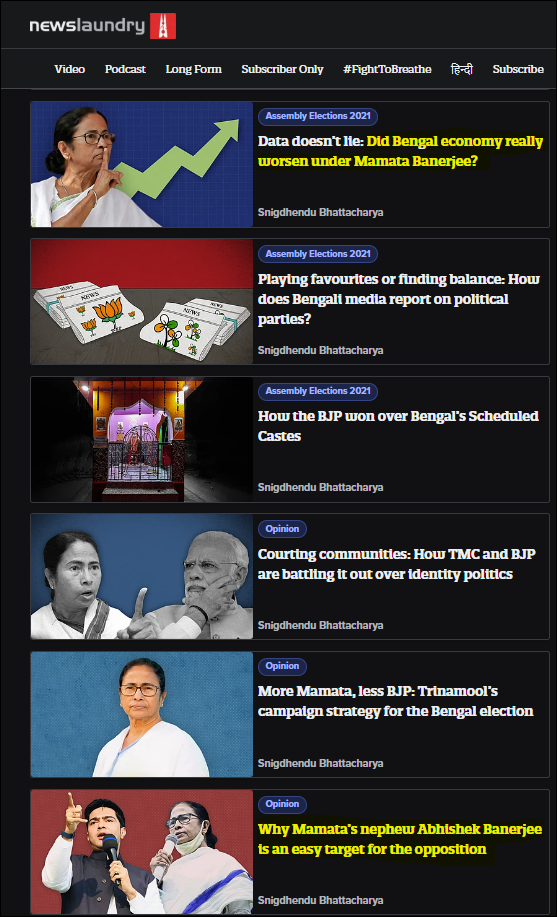
Bhattacharya also has a track record of writing pro-TMC propaganda pieces, particularly during elections.
West Bengal is among the states with the highest numbers of illegal Bangladeshi immigrants. In the last three years, over 2600 Bangladeshi nationals were apprehended and sent back to Bangladesh. There are ten districts of West Bengal which share a border with Bangladesh, namely North 24 Paraganas, Nadia, Murshidabad, Malda, North Dinajpur, South Dinajpur, Darjilling, Koochbihar and Jalpaiguri.
The ethnic and linguistic similarities make cross-border movement historically difficult to track. Many such Bangladeshi infiltrators, mostly Muslims, have managed to obtain local identity documents and get their names added to voter lists. What better way there could have been than conducting an SIR and weeding them out of the electoral roll and eventually deporting them, unless there is a political party and its ideological media allies that want infiltrators-turned-votebank to stay and thrive?
It was seen last year that there was panic among illegal infiltrators right after the ECI announced the house-to-house enumeration for the second phase of the SIR in November 2025. Many even admitted to having illegally entered India and not having any valid documents. The sudden self-imposed exodus indicated the fear among these Bangladeshi illegals of getting caught.
It, however, is not surprising that the BBC platformed a biased ‘independent journalist’, Snigdhendu Bhattacharya, to peddle Muslim victimhood propaganda about West Bengal SIR. The UK-based media outlet has a track record of publishing anti-India and anti-Hindu content, be it their 2022 Leicester violence coverage, 2020 anti-Hindu Delhi Riots reportage, humanisation of Hindu-hating Pakistani Field Marshal Asim Munir, the recent fear mongering about India’s oil reserves amidst the global energy crisis caused by the Iran war or the whitewashing of the 2024 anti-Hindu pogrom orchestrated by Muslim mobs in Bangladesh.