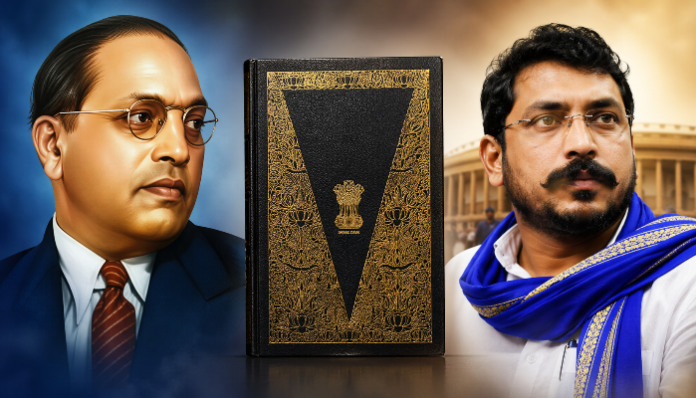
On Friday (17th April), Chandra Shekhar Aazad, also known as Chandra Shekhar Aazad Ravan of the Bhim Army (Bharat Ekta Mission) and Azad Samaj Party (Kanshi Ram), incited a fresh controversy during his problematic speech in the Lok Sabha. He alleged that if the government genuinely aims to strengthen backward communities, women and Dalits, then it should implement separate electorates.
He maintained that reservations have not succeeded in empowering these groups and are merely a slogan. To achieve social justice, he argued, it is imperative to shift towards complete, courageous and direct remedies to the issues rather than relying on half-hearted slogans.
The Lok Sabha MP from Nagina referenced Bahujan leader Kanshi Ram and his book “Chamcha Yug” (Age of Stooges) to claim that representatives elected from reserved seats are compelled to operate within the system and tend to be more loyal to their party than to their community. “Therefore, a separate electorate is the only feasible solution,” he declared.
It is evident that his comments in the Parliament are not only unlawful but also contradict the essential tenets of the Indian Constitution and the “idea of India” as envisioned by the founders of the republic. More importantly, Article 325 categorically dismisses such recommendations built on religion, race, sex or other factors.
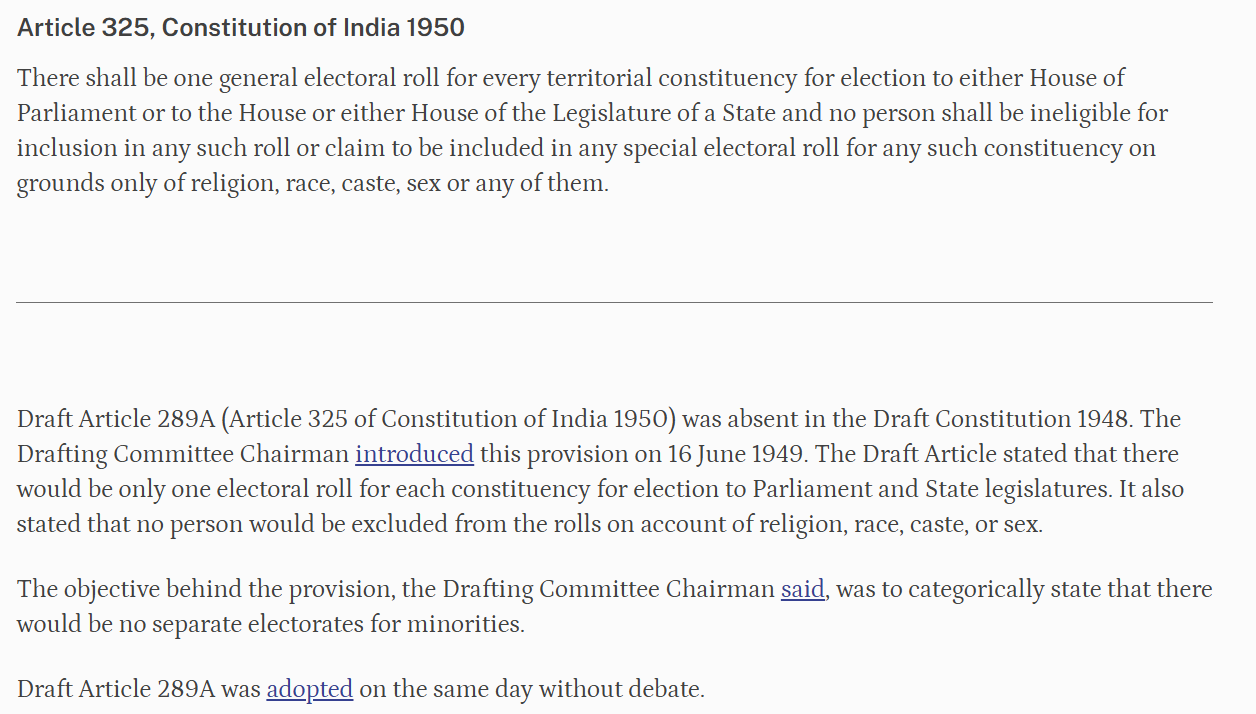
What is stated in Article 325 of the Constitution of India
“There shall be one general electoral roll for every territorial constituency for election to either House of Parliament or to the House or either House of the Legislature of a State and no person shall be ineligible for inclusion in any such roll or claim to be included in any special electoral roll for any such constituency on grounds only of religion, race, caste, sex or any of them,” Article 325 of the Indian Constitution clearly stipulates.
The 1948 Draft Constitution did not include Draft Article 289A, which was subsequently enacted as Article 325. On 16th June 1949, the Chairman of the Drafting Committee introduced this provision. It specified that each constituency would have a single electoral roll for polls in state legislatures and Parliament.
Furthermore, no person would be left off the list due to their sex, caste, race, or religion. According to the chairman, the intention was to strike out the possibility of a separate electorate. It was unanimously approved the same day without any debate.
The definitive support for one of the foundational principles of the Constitution, as articulated by Dr Bhimrao Ramji (BR) Ambedkar, reveals that the country invariably stood for fair and just electoral equality for every eligible citizen, without providing a conducive environment for the seeds of communalism and separate electorates sown by the British. The decision gained even greater significance against the backdrop of a violent partition proposed by the All-India Muslim League and endorsed by the colonisers.
Ambedkar specifically rejected separate electorate during the Constituent Assembly debates
The architects of modern India underlined that democracy must be centred around universal adult suffrage and the concept of “one person, one vote,” instead of communal divisions throughout the Constituent Assembly debates, which were held between December 1946 and January 1950.
Ambedkar, the brain behind the Constitution, exemplified the same during the discussions over the aforementioned 289A “with reference to amendment number 110 of List I (Fifth Week)” which was tabled in the presence of Dr Rajendra Prasad, who was the permanent President of the Constituent Assembly, on 16th June 1949.
The former highlighted that “the object of this is merely to give effect to the decision of the House that there shall hereafter be no separate electorates at all. As a matter of fact, this clause is unnecessary because by later amendments we shall be deleting the provisions contained in the Draft Constitution which make provision for representations of Muslims, Sikhs, Anglo-Indians and so on.”
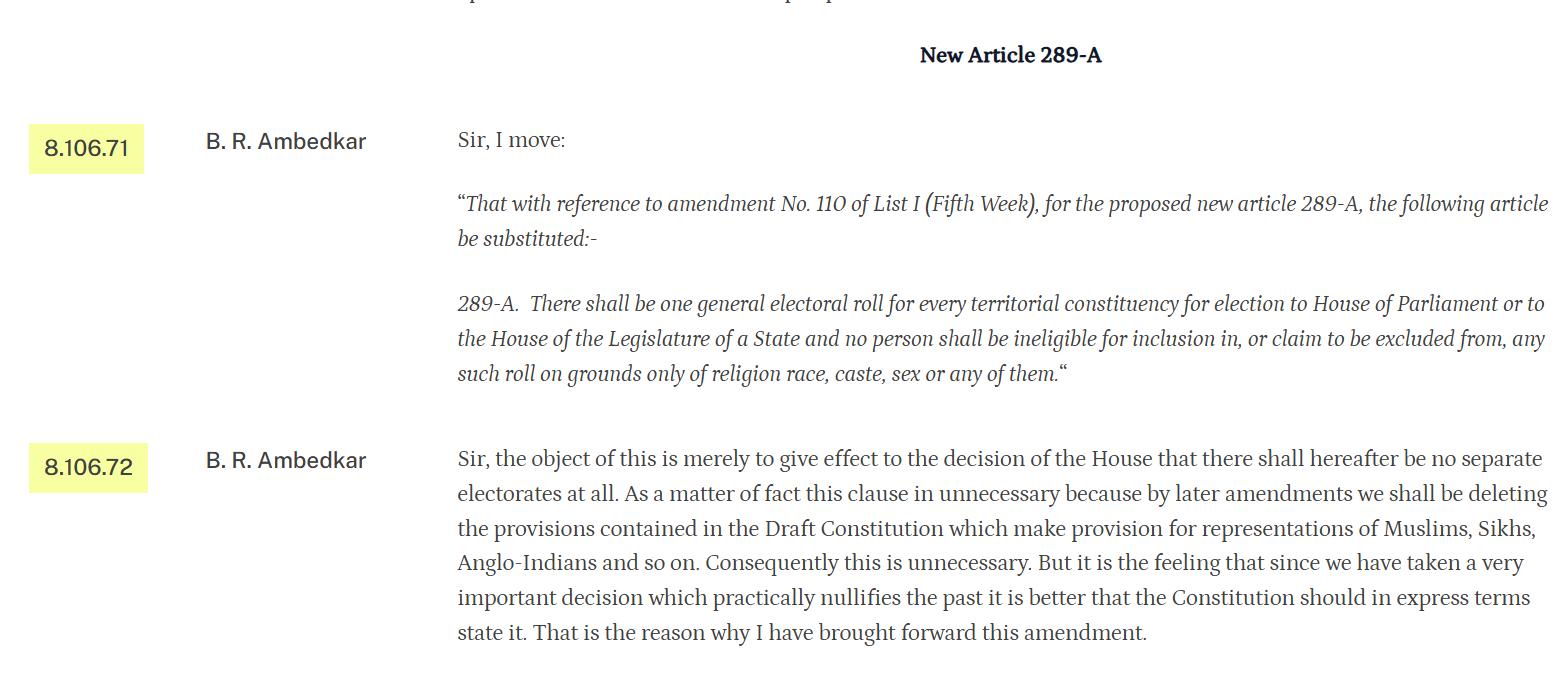
Ambedkar added, “Consequently, this is unnecessary. But it is the feeling that since we have taken a very important decision which practically nullifies the past, it is better that the Constitution should in express terms state it. That is the reason why I have brought forward this amendment.”
When asked if the objective was to pass the amendment, Ambedkar replied that he wanted to express the reasoning behind his submission, pointing out how firmly he believed in the cause of disallowing separate electorates.
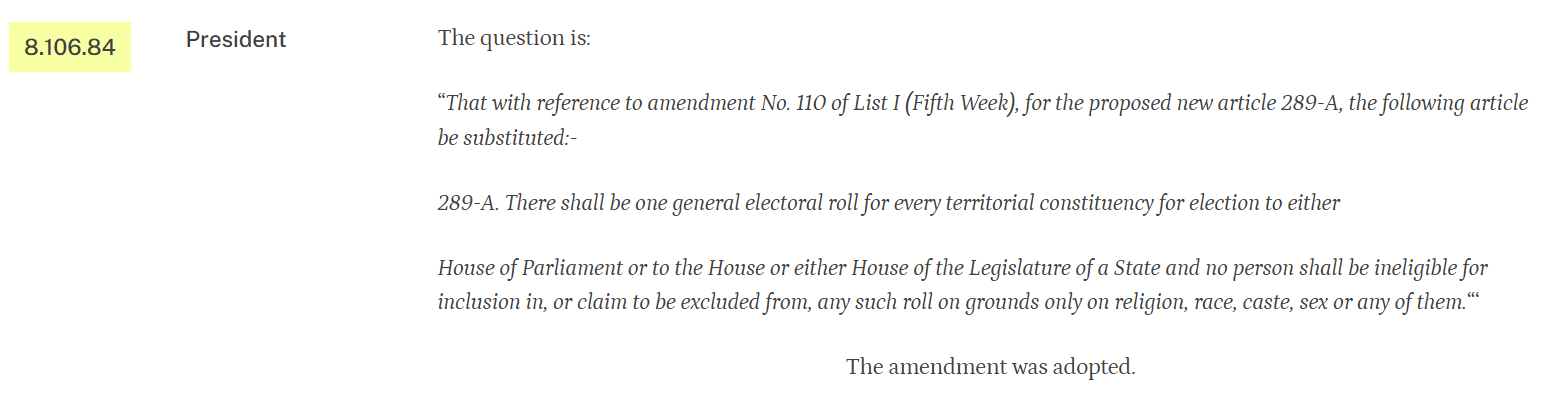
Afterwards, Article 325 was adopted to prevent separate electoral records defined by religion, race, or caste, to guarantee equal political rights for all nationals and to foster national unity and social integration through a common electoral procedure.
The roots of the separate electorate
The origins of the separate electorate can be traced back to British India, when the foreign regime acquiesced to the demands presented by the Islamists to facilitate their communal agenda. The British Parliament’s Indian Councils Act 1909, also referred to as the Morley-Minto Reforms, proposed the creation of distinct electorates for Muslims.
This formalised sectarian divisions in the political landscape by enabling the community to elect their representatives solely on religious grounds. The system, which endured for many decades, fostered religious rather than national identity, prompting the Muslim League to advocate for a separate state, ultimately leading to the bloody division of the nation in 1947 and the establishment of the Islamic Republic of Pakistan in 1956.
The Indian Council Act marked the first time that seats in legislative bodies were distributed according to identity. Thus, “Depressed Classes” (Scheduled Castes) also received some seats in 1919 before experiencing a rise in 1925. This matter later turned into a point of dispute between Mohandas Karamchand Gandhi and Ambedkar, who desired a special electorate for the Dalits before relinquishing the demand.
The disagreement between Gandhi and Ambedkar
The “Communal Award” of August 1932 attempted to provide Depressed Classes, Muslims, Sikhs, Indian Christians and others with separate electorates for the election of members of provincial legislative assemblies during the 1931 “Second Round Table Conference.”
Gandhi rejected the notion of a separate electorate for the Depressed Classes but not for other groups, perceiving it as a ploy by the British to split the Hindu population, perpetuate social divisions and reinforce their faltering grasp on power. The decision, in his opinion, suggested that Dalits were not part of the Hindu community as he began a fast till death while incarcerated in Yerwada Central Jail in Poona.
On the other hand, Ambedkar wanted a separate electorate for the Depressed Classes he spoke for during the “First Round Table Conference” in 1930. However, Gandhi and the Indian National Congress (INC) regarded it as a scheme to weaken and fracture Indian society.
He witnessed the British employing their notorious “Divide and Rule” policy to protect their interests and expand their power with the award. His rigorous fast put public pressure on Ambedkar to intervene and eventually the hunger strike concluded when the two sides reached an agreement.
The Poona Pact: The resolution of the conflict
The “Poona Pact” was inked between Dr Madan Mohan Malviya on behalf of Hindus from higher castes and Ambedkar in the name of the downtrodden sections on 24th September 1932. It increased the number of reserved seats within a framework of shared electorates, and the earlier clamour in relation to Depressed Classes was effectively abandoned.
Interestingly, Ambedkar campaigned for communal representation since his appearance before the Franchise (Southborough) Committee in 1918-1919. He had, however, raised serious doubts about the communal electorate’s suitability as an instrument of achieving representation, reported The Print.
Ambedkar promoted adult suffrage, which would determine voting rights based on age rather than income, prestige, or education, during his appearance before the “Simon Commission.” He mentioned that there should be a mixed electorate with allocated seats, otherwise the Depressed Classes should have representation similar to Muslims amid the cross-examination.
The Muslim League representatives, princely states and others opposed his request for universal adult suffrage. The British government was also hesitant to grant universal adult suffrage to the country. This could be attributed to the alteration of his stance and insistence on a separate electorate.
However, Ambedkar’s primary focus was on pushing for representation for the scheduled castes within the political structure of the country rather than on the concept of a separate electorate for them.
Conclusion
India has already borne the brunt of partition, which was instigated by the demand for a separate electorate for the Muslim community. This not only has its beginnings in radicalism and extremism masquerading as justice and representation.
However, it is also harmful to the social and cohesive fabric of the nation, which will be exploited by malicious and vested interests to exacerbate the fault lines and widen the divide in society. It will derail India, its developmental trajectory and undo the progress made over the years.
Separate electorates hold no relevance in contemporary India, nor will they in the future, nor did they in the past. The conspiracy intentionally devised by the invaders to dominate the country cannot be reinforced under the guise of “empowerment,” when in truth it just acts as a mechanism of division, undermining national unity and a major hindrance to the advancement of India and its people.
Of course, the problems or concerns encountered by the people should be highlighted and resolved, but this cannot be accomplished at the expense of the country, mangling its Constitution. Ravan needs to grasp the simple fact that his political aspirations cannot be allowed to forge ahead while risking the present and future of the nation.