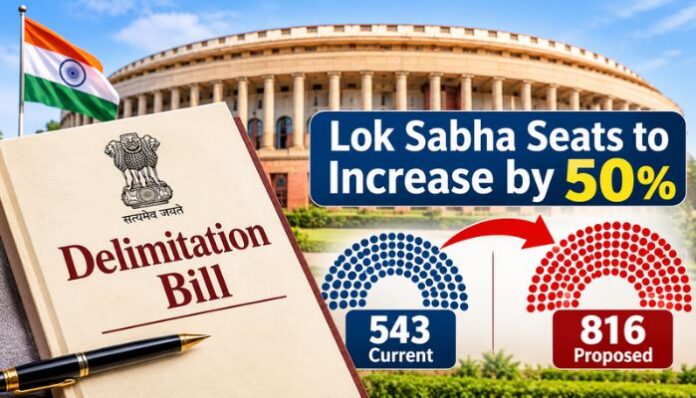
On Friday, 27th November, the Union Cabinet, approved the proposed delimitation legislation, paving the way for a major expansion of the Lok Sabha and the implementation of the 33% women’s reservation law. The Centre is expected to introduce the Constitution (One Hundred and Thirty-Second Amendment) Bill, 2026, and the Delimitation (Second) Bill, 2026, during the special sitting of Parliament beginning 30th November.
The proposed legislation seeks to increase the number of Lok Sabha seats allocated to every state and Union Territory by 50%. Under the proposed arrangement, the strength of the Lower House could rise from its present 543 seats to around 816. The proposed expansion includes 815 seats for states and 35 for Union Territories, while the constitutional amendment would provide for a maximum strength of 850 members.
The proposed delimitation framework marks a significant step towards reshaping India’s parliamentary landscape. With the Lok Sabha’s strength set to rise by 50%, from the existing 543 seats to 816, every state and Union Territory stands to witness an expansion in its parliamentary representation. The Union Cabinet’s approval of the Delimitation Amendment Bill is a landmark step towards strengthening democratic representation and paving the way for 33% reservation for women in the 2029 Lok Sabha elections. The people of India deserve representation that reflects their aspirations, and they are now set to receive it. This is more than a legislative reform; it is a decisive commitment to inclusive democracy and Nari Shakti’s rightful place in nation-building. #DelimitationBill #WomenReservation
— BJP (@BJP4India) November 28, 2026
The government also intends to bring forward the implementation of the Nari Shakti Vandan Adhiniyam, 2023, which provides for 33% reservation for women in the Lok Sabha and state Legislative Assemblies. The proposed changes could allow the women’s quota to come into effect before the 2029 Lok Sabha elections.
How will the number of Lok Sabha seats change for each state?
The proposed increase is expected to follow a uniform formula, with every state and Union Territory receiving a 50% increase in its existing Lok Sabha seats. The idea is to expand the House without changing the proportion of seats held by different states.
Under the proposed 816-seat model, Uttar Pradesh, which currently has the highest number of Lok Sabha seats at 80, could get 120 seats. Maharashtra’s strength would rise from 48 to 72, while West Bengal’s seats would increase from 42 to 63. Bihar, which currently has 40 seats, could get 60, and Tamil Nadu’s representation would rise from 39 to 59.
Madhya Pradesh could see its seats increase from 29 to 44, while Karnataka’s tally would rise from 28 to 42. Gujarat’s representation would go up from 26 to 39. Andhra Pradesh and Rajasthan, which currently have 25 seats each, could get 38 seats each. Odisha’s strength would increase from 21 to 32, while Kerala’s seats would rise from 20 to 30.
Telangana could get 26 seats against its current 17, while Assam and Jharkhand would see their representation increase from 14 to 21 seats each. Punjab’s seats could rise from 13 to 20, and Chhattisgarh’s from 11 to 17. Haryana, which currently has 10 Lok Sabha seats, could get 15 under the proposed arrangement.
Among the Union Territories, Delhi’s representation could increase from seven to 11 seats. Jammu and Kashmir and Uttarakhand, which currently have five seats each, could get eight seats each. Himachal Pradesh’s seats would rise from four to six.
Arunachal Pradesh, Goa, Manipur, Meghalaya and Tripura could see their representation increase from two to three seats each. Dadra and Nagar Haveli and Daman and Diu would also get three seats against the current two.
The smaller states and Union Territories that currently have one Lok Sabha seat each, including Mizoram, Nagaland, Sikkim, Puducherry, Chandigarh, Ladakh, Lakshadweep and the Andaman and Nicobar Islands, are proposed to retain one seat each in the 816-seat model.
The percentage share of most states would therefore remain almost the same. For instance, Uttar Pradesh currently accounts for around 14.73% of the Lok Sabha’s seats. Under the proposed model, its share would be around 14.71%. Similarly, Maharashtra’s share would remain close to 8.8%, while Bihar’s would stay around 7.35%.
| Rank | State / Union Territory | Current Seats (543) | Current Share (%) | 816-Seat Model | 816-Model Share (%) |
| 1 | Uttar Pradesh | 80 | 14.73% | 120 | 14.71% |
| 2 | Maharashtra | 48 | 8.84% | 72 | 8.82% |
| 3 | West Bengal | 42 | 7.73% | 63 | 7.72% |
| 4 | Bihar | 40 | 7.37% | 60 | 7.35% |
| 5 | Tamil Nadu | 39 | 7.18% | 59 | 7.23% |
| 6 | Madhya Pradesh | 29 | 5.34% | 44 | 5.39% |
| 7 | Karnataka | 28 | 5.16% | 42 | 5.15% |
| 8 | Gujarat | 26 | 4.79% | 39 | 4.78% |
| 9 | Andhra Pradesh | 25 | 4.60% | 38 | 4.66% |
| 9 | Rajasthan | 25 | 4.60% | 38 | 4.66% |
| 11 | Odisha | 21 | 3.87% | 32 | 3.92% |
| 12 | Kerala | 20 | 3.68% | 30 | 3.68% |
| 13 | Telangana | 17 | 3.13% | 26 | 3.19% |
| 14 | Assam | 14 | 2.58% | 21 | 2.57% |
| 14 | Jharkhand | 14 | 2.58% | 21 | 2.57% |
| 16 | Punjab | 13 | 2.39% | 20 | 2.45% |
| 17 | Chhattisgarh | 11 | 2.03% | 17 | 2.08% |
| 18 | Haryana | 10 | 1.84% | 15 | 1.84% |
| 19 | Delhi (NCT) | 7 | 1.29% | 11 | 1.35% |
| 20 | Jammu and Kashmir | 5 | 0.92% | 8 | 0.98% |
| 20 | Uttarakhand | 5 | 0.92% | 8 | 0.98% |
| 22 | Himachal Pradesh | 4 | 0.74% | 6 | 0.74% |
| 23 | Arunachal Pradesh | 2 | 0.37% | 3 | 0.37% |
| 23 | Dadra & Nagar Haveli and Daman & Diu | 2 | 0.37% | 3 | 0.37% |
| 23 | Goa | 2 | 0.37% | 3 | 0.37% |
| 23 | Manipur | 2 | 0.37% | 3 | 0.37% |
| 23 | Meghalaya | 2 | 0.37% | 3 | 0.37% |
| 23 | Tripura | 2 | 0.37% | 3 | 0.37% |
| 29 | Andaman and Nicobar Islands | 1 | 0.18% | 1 | 0.12% |
| 29 | Chandigarh | 1 | 0.18% | 1 | 0.12% |
| 29 | Ladakh | 1 | 0.18% | 1 | 0.12% |
| 29 | Lakshadweep | 1 | 0.18% | 1 | 0.12% |
| 29 | Mizoram | 1 | 0.18% | 1 | 0.12% |
| 29 | Nagaland | 1 | 0.18% | 1 | 0.12% |
| 29 | Puducherry | 1 | 0.18% | 1 | 0.12% |
| 29 | Sikkim | 1 | 0.18% | 1 | 0.12% |
| — | Grand Total | 543 | 100.00% | 816 | 100.00% |
The state-wise breakdown table projected by Hindustan Times
There are, however, some mathematical complications in applying a uniform 50% increase. States with an odd number of existing seats would end up with fractions. For example, Tamil Nadu’s 39 seats would become 58.5, while Madhya Pradesh’s 29 would become 43.5 and Punjab’s 13 would become 19.5. Since a state cannot be allocated half a seat, these figures need to be adjusted.
One possible approach is to round such figures up. However, this would take the total strength of the Lok Sabha to around 824 seats if applied to all states and Union Territories with odd numbers. The 816-seat model instead keeps the seats of several smaller states and Union Territories with only one existing seat unchanged. The final allocation will depend on the provisions and adjustments adopted under the legislation.
What does the proposed Delimitation Bill seek to change?
Delimitation is the process of redrawing the boundaries of electoral constituencies and deciding how many seats will be allocated to different states and constituencies. The exercise is important because it determines how people are represented in Parliament and state Legislative Assemblies.
The proposed Delimitation Bill, 2026, seeks to establish a Delimitation Commission to carry out the exercise of redrawing Lok Sabha and Assembly constituencies. The legislative package introduced earlier in April had three parts: the Constitution (131st Amendment) Bill, 2026, the Delimitation Bill, 2026, and the Union Territories Laws (Amendment) Bill, 2026. The fresh package approved by the Cabinet includes the Constitution (132nd Amendment) Bill and the Delimitation (Second) Bill.
According to media reports, the revised proposal seeks to provide a constitutional guarantee of a 50% increase in seats while retaining the existing proportion of representation among states. The current state-wise distribution of seats, based on the 1971 Census, is proposed to remain protected for a further 25 years. At the same time, the 2011 Census is expected to serve as the basis for redrawing constituency boundaries.
The proposed arrangement aims to prevent states that have successfully controlled population growth from losing their relative share of representation to states with higher population growth. It would allow the number of seats to increase while protecting the existing balance between states.
The Constitution (131st Amendment) Bill, which was introduced in April, sought to increase the maximum strength of the Lok Sabha from 550 to 850 seats and facilitate the implementation of women’s reservation. However, it failed to secure the required two-thirds majority in the Lok Sabha on 17th April. Following the defeat, Union Parliamentary Affairs Minister Kiren Rijiju withdrew the accompanying Delimitation Bill and the Union Territories Laws (Amendment) Bill.
The government has now brought forward a revised proposal, with the 50% across-the-board increase and the proposed 25-year freeze intended to address concerns about the possible impact of delimitation on states’ political representation.
Which parties are supporting the proposed Delimitation Bill?
The revised proposal has received support from some parties outside the ruling NDA, particularly after the Centre included the provision for a uniform 50% increase in seats.
The Dravida Munnetra Kazhagam (DMK), which had earlier raised concerns about delimitation, has announced that it will support the fresh legislation. At a meeting of party MPs chaired by Tamil Nadu Chief Minister and DMK president MK Stalin in Chennai on Saturday, 28th November, the party decided to back the proposed Bills.
DMK Govt supports the Delimitation bill stating their reasons!! https://t.co/5lfpvGfrgp
— Chennai Updates (@UpdatesChennai) November 28, 2026
DMK MP A Raja explained the party’s position, saying, “Whether we were with Congress or not, or are in power or not, our consistent demand is that the share of 7.18% [seat share in Lok Sabha] should not be altered. Now it is being maintained. Of course, procedural issues are there; we will address them. If necessary, we will give an amendment.”
DMK MP Dayanidhi Maran also reiterated that the party would support the legislation in Parliament. The Centre’s decision to retain Tamil Nadu’s relative share of Lok Sabha seats, even as its number of seats rises from 39 to 59, appears to have addressed one of the party’s main concerns.
Andhra Pradesh Chief Minister N Chandrababu Naidu has backed the proposed increase, saying a 50% expansion in seats would provide relief to southern states concerned about losing representation.
#WATCH | Delimitation Bill | Delhi: Andhra Pradesh CM N. Chandrababu Naidu says, "Some arguments I want to answer very clearly. Andhra Pradesh, as on today, has 25 seats. Tomorrow, with 50% enhancement, it may be increased to 38, with 4.6% total proportionate, same ratio will continue. Tamil Nadu, as on today 39 seats, they may get 59 – 7.18%, same ratio. Karnataka, as of today 28; they may get 42 – 5.16%. Telangana 17, in future 26 – 3.13%. Kerala 20, it will become 30 – 3.68%. Total southern states: 129. With enhancement, delimitation, it will become 195. Same percentage of 23.76 will continue. This is going to happen…I am asking a direct question to all opposition parties. What is the way forward? In this country, we have achieved so many public policies through consensus…"
— ANI (@ANI) November 27, 2026
The Nationalist Congress Party (Sharadchandra Pawar), which is part of the INDIA bloc, has indicated its support for the delimitation exercise. NCP leader Jitendra Awhad said the party had decided to back the process, describing delimitation as a constitutional requirement.
Awhad said discussions with party supremo Sharad Pawar had focused on the constitutional obligation of delimitation and confirmed that the party would support the exercise.
Speaking to IANS, Awadh said, “Things are absolutely clear. It has been decided that we will support delimitation, and we will support it. We will support delimitation. Look, Sanjay Raut has his own personal views. We know what loyalty means.”
Mumbai, Maharashtra: On the Delimitation Bill, NCP(SP) MLA Jitendra Awhad says, "…Things are absolutely clear. It has been decided that we will support delimitation, and we will support it. We will support delimitation. Look, Sanjay Raut has his own personal views. We know what loyalty means…"
— IANS (@ians_india) November 27, 2026
The YSR Congress Party is also reportedly inclined to support the proposed legislation, provided it contains safeguards to ensure regional balance and protects the political representation of states, particularly those in southern India.
Yuvajana Sramika Rythu Congress Party (YSRCP) will support the Delimitation Bill if it is introduced, provided it ensures regional balance: YSRCP Sources https://t.co/fxvg3aUzaj
— ANI (@ANI) November 27, 2026
However, Congress and several INDIA bloc parties have maintained their opposition to the Bill, setting the stage for a potentially contentious debate during the upcoming Special Session.
Why is the Bill back in focus?
The Cabinet’s approval has revived a major political and constitutional debate that remained unresolved after the earlier legislation was defeated in April. The government is now preparing to seek support from parties beyond the NDA to secure the required two-thirds majority for the constitutional amendment.
The Lok Sabha is scheduled to reconvene on 30th November, while the Rajya Sabha will meet from 2nd December. Parliamentary Affairs Minister Kiren Rijiju has requested the Lok Sabha Speaker and the Rajya Sabha Chairman to convene the Houses for the special sitting to transact essential government business.