

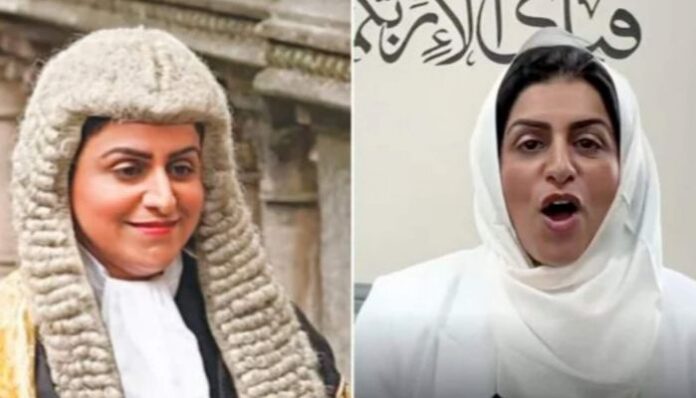
UK Home Secretary Shabana Mahmood has defended her controversial early-release scheme, saying she had little choice but to include some killers, rapists and child sex offenders because prisons in England and Wales were running out of space.
Shabana Mahmood, who designed the scheme when she was Justice Secretary, said the prison system was close to collapse when she took charge of the Ministry of Justice. She described the decisions taken at the time as “unpalatable”, arguing that the government had to act to prevent the entire criminal justice system from being affected.
Shabana Mahmood: prison crisis forced my hand on early release scheme https://t.co/jm3hy9nV6o
— Times Politics (@timespolitics) August 21, 2026
Under the original plan, around 6,000 prisoners, including some violent and sexual offenders, were due to qualify for early release from September. Some prisoners would have been released after serving half of their sentence instead of two-thirds, while others could have been released after serving one-third rather than 40%.
The scheme has since been reviewed and changed, with around 1,000 rapists and sex offenders being excluded. Its launch has also been delayed until October.
Mahmood: Prisons were close to collapse
Defending the policy, Mahmood said the situation she inherited left the government with very few options.
“I know how difficult those judgment calls are in the prison system. When I arrived in the Ministry of Justice (MoJ), the system was on the point of almost total collapse,” she told The Times.
She said that during her first week in the job, there were fewer than 80 prison places available across England and Wales. “The choices when you are about to run out are very different and none of these are palatable choices,” Mahmood said. She added that no government would want to release prisoners earlier than planned, but argued that allowing prisons to completely run out of space would create an even bigger crisis.
“What we’re always trying to do is avoid the worst possible outcome,” she said.
According to Mahmood, that worst-case scenario would be the complete collapse of the prison system, which could affect the police and courts as well. “If you run out of prison places entirely you will see the collapse of the criminal justice system, the police won’t be able to make arrests and of course there won’t be a trial and that is not a thing that any government can allow to happen,” she said.
6,000 prisoners were initially eligible
The original “earned progression” scheme was designed to create more room inside overcrowded prisons. However, the plan faced strong criticism because it could have allowed serious offenders, including rapists, killers and violent criminals, to leave prison earlier than expected.
The issue became particularly controversial after reports that two men convicted over the killing of PC Andrew Harper could be eligible for early release. Prime Minister Keir Starmer has since promised to do everything possible to prevent their release.
The government is also considering whether other prisoners convicted of unlawful killing should be excluded from the scheme.
An initial review by Andy Burnham has already resulted in around 1,000 rapists and sex offenders being blocked from early release. The scheme’s start has consequently been pushed back from September to October.
Prison overcrowding remains a major problem
Despite the changes, the pressure on the prison system has not disappeared. Men’s prisons are currently operating at around 98% capacity, with 83,036 prisoners against a capacity of 84,819.
Across England and Wales, the total number of men, women and young offenders in custody stood at 86,722 this week, leaving only around 2,199 spaces against an overall capacity of 88,921.
Ministry of Justice officials have previously warned that prisons could run out of space unless the government takes measures such as the early-release scheme.
One senior prison service official described the situation as “extremely tight” and said there was “very little room for manoeuvre”.
Mahmood has argued that the decisions taken during her time at the Ministry of Justice were aimed at moving the system away from an immediate crisis and towards a more sustainable position.
“I had to make choices that were about getting the system away from collapse and trying to get to a more sustainable position in the future,” she said.
Mahmood’s past comments on India drew criticism
Mahmood’s defence of the prison policy comes against the backdrop of her long record of publicly speaking about international issues, particularly India and Jammu and Kashmir. She was appointed Justice Secretary and Lord Chancellor by the Labour government in July 2024 and later moved to the Home Office.
Mahmood has repeatedly spoken about Kashmir since becoming an MP in 2010. Her position has often been critical of the Indian government, particularly over its policies in Jammu and Kashmir.
In 2015, ahead of Prime Minister Narendra Modi’s visit to the UK, Mahmood and several other British MPs wrote to him with a number of demands concerning Jammu and Kashmir. These included calls for changes relating to the presence of Indian security forces, the Armed Forces Special Powers Act, prisoners and movement in the region. The letter also referred to a UN-backed referendum in Jammu and Kashmir, a position India has rejected.
Our letter to the Prime Minister about Kashmir & Modi visit – supported by 30+ Lords and MPs #APPG #Kashmir pic.twitter.com/hQIFbsrKyt
— Shabana Mahmood MP (@ShabanaMahmood) November 12, 2015
In a 2017 speech in the House of Commons, Mahmood described Kashmir as a long-standing dispute between two nuclear-armed countries and called for greater international attention.
“This is a very long-standing dispute between two nuclear-armed powers in one of the world’s most heavily militarized regions,” she said.
Criticism of Article 370 decision
Her criticism of India became particularly visible after the Narendra Modi government removed Jammu and Kashmir’s special constitutional status under Article 370 in August 2019.
Soon after the decision, Mahmood said she was “deeply concerned” about the move and described it as “truly shocking”.
Deeply concerned about the Indian Government's decision to abolish #Article370, removing #Jammu and #Kashmir's existing level of autonomy.
— Shabana Mahmood MP (@ShabanaMahmood) August 5, 2019
The escalation we have seen by the Indian Government in recent days is truly shocking and it simply must stop. Human rights must be upheld.
She also said the move represented what she called “an absolute betrayal of the people of Kashmir” and expressed concern about its consequences.
Mahmood later joined protests in Birmingham against the Article 370 decision. In 2020, she also said she had briefed then Labour leader Keir Starmer about the situation in Kashmir.
Her last major public comments on the issue came around the first anniversary of the Article 370 decision in August 2020, when she described the move as “an unjust and unilateral action”.
Pro-Palestine activism also part of her public record
Mahmood has also been publicly active on the Israel-Palestine issue. She has supported the Palestinian cause for years and participated in protests over the situation in Gaza.
In 2014, she was pictured at a pro-Palestine demonstration carrying a sign calling for a “Free Palestine, End Israeli Occupation”. She has also faced criticism over her past association with positions supporting the Boycott, Divestment and Sanctions (BDS) movement against Israel.
Her political record on India, Kashmir and Israel has therefore remained a subject of debate. Meanwhile, in her current role, Mahmood is facing a very different challenge at home: managing an overcrowded prison system while dealing with growing criticism over the government’s decision to allow some offenders to leave prison earlier than originally planned.
