

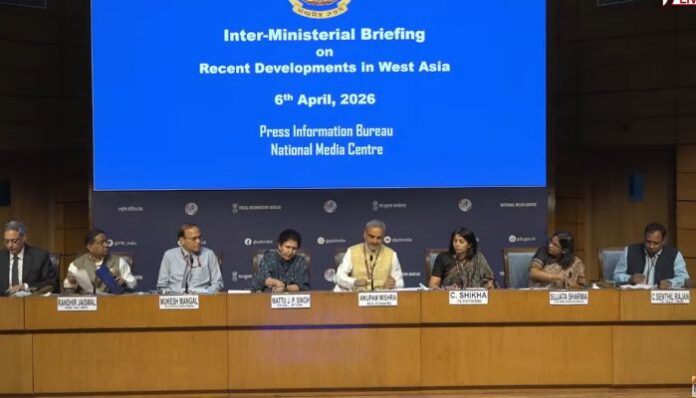
Amid the ongoing conflict in the Middle East and its growing impact on global trade and energy supply, the Government of India, on Monday, 6th April, held a regular inter-ministerial briefing to share updates on its response. Representatives from the Ministry of External Affairs, the Ministry of Petroleum and Natural Gas, and other departments outlined the steps being taken to protect Indian citizens abroad and manage the possible impact of the crisis on essential supplies back home.
The government said it is closely monitoring the situation, especially in Gulf countries and Iran, while also preparing to deal with any disruptions in global energy and supply chains.
Food supply remains stable, govt assures
One of the key concerns addressed during the briefing was food security. Officials reassured citizens that there is no shortage of essential commodities in the country.
Anupam Mishra, Additional Secretary in the Ministry of Consumer Affairs, said, “The Ministry of Consumer Affairs is keeping a close watch on food security, ensuring supply of food grains and keeping a vigil under the Essential Commodities Act 1955 against hoarding and black marketing.”
#WATCH | Amid the West Asia conflict, @jagograhakjago is closely monitoring food security through price tracking, supply management, and action against hoarding. Prices of 40 essential commodities are tracked daily across 528 centers, with no unusual volatility observed so far.… pic.twitter.com/CtOuLjTUWh
— DD News (@DDNewslive) April 6, 2026
He added that production of pulses is higher this year, and a sufficient buffer stock is being maintained. The output of key vegetables like onion, potato, and tomato is also almost similar to last year, which helps keep supply steady.
To prevent any misuse of the situation, the government is actively coordinating with state governments. “The Ministry is in constant touch with the state governments to sensitise them on taking action against black marketing and hoarding. We have set up a control room to have a seamless interaction with states and monitor prices of essential commodities. The 1915 consumer care helpline is available across 17 languages, where citizens can lodge their grievances,” Mishra said.
Officials from the Food Department further confirmed that India has a strong buffer stock of grains. C Shikha, Joint Secretary, said, “We have an adequate buffer stock of both wheat and rice, three times the buffer stock norms, which is there. For wheat, we have around 222 LMT. For rice, we are having around 380 LMT. So, put together, around 602 LMT of food stocks are available with us.”
#WATCH | We have adequate buffer stock of both wheat and rice, three times the buffer stock norms, which is there. For wheat, we have around 222 LMT. For rice, we are having around 380 LMT. So put together, around 602 LMT of food stocks are available with us. This is quite enough… pic.twitter.com/PtQM9abiq9
— DD News (@DDNewslive) April 6, 2026
She added that this stock is sufficient for the public distribution system as well as any emergency needs. Edible oil and sugar supplies are also stable, with retail prices largely unchanged.
Fuel and LPG supply under control
With the conflict affecting global oil markets, the government has placed special focus on fuel supply. Officials said that despite disruptions for over a month, there is no shortage of petrol, diesel, or LPG in the country.
Sujata Sharma, Joint Secretary in the Petroleum Ministry, said, “Despite over 35 days of the Middle East crisis affecting supplies, the government has ensured adequate LPG availability, with additional cargo secured.”
#WATCH | Despite over 35 days of the Middle East crisis affecting supplies, the government has ensured adequate LPG availability, with additional cargo secured. Strict monitoring is underway, senior officials are conducting field inspections and coordinating with states to… pic.twitter.com/92tXqseZqX
— DD News (@DDNewslive) April 6, 2026
She noted that around 50 lakh LPG cylinders are being supplied daily, reaching nearly 18 crore households in the last five weeks. Online booking has reached 97%, and 90% of deliveries are now verified using OTP systems to ensure transparency.
Addressing concerns around smaller cylinders, Sharma said, “There is sufficient stock, and consumers can purchase a 5 kg cylinder from their nearest LPG distributor using a valid ID; no address proof is required.” Over 5,500 awareness camps have been organised in recent days, where thousands of cylinders were distributed.
#WATCH | Reports regarding the 5 kg LPG cylinder have been addressed, with several steps taken to ensure availability. There is sufficient stock, and consumers can purchase a 5 kg cylinder from their nearest LPG distributor using a valid ID, no address proof is required. Over the… pic.twitter.com/Zk1K4UQBGK
— DD News (@DDNewslive) April 6, 2026
Crude oil supplies and refinery operations are also stable. The government has taken steps such as diverting additional components to boost LPG production and adjusting duties to protect consumers from price shocks. Petrol pumps across the country continue to function normally with no reported shortages.
#WATCH | To ease LPG pressure, PNG is being promoted with 100% supply ensured for domestic users, along with full supply for CNG vehicles. Fertilizer plants are receiving 70–75% gas, now being increased to ~90% from today, while CGD networks get an additional 10% supply. 17… pic.twitter.com/UomG10g5gG
— DD News (@DDNewslive) April 6, 2026
The government has also increased commercial LPG supply by 70% to support businesses, while ensuring domestic needs remain a priority. At the same time, PNG and CNG supplies have been strengthened to reduce pressure on LPG demand.
Evacuations and support for Indians abroad
The Ministry of External Affairs shared updates on the safety of Indian nationals in the region. MEA spokesperson Randhir Jaiswal said that India has evacuated 1,777 citizens from Iran through Armenia and Azerbaijan. This includes 895 students and 345 fishermen, many of whom have already returned home.
#WATCH | India has safely evacuated 1,777 nationals from Iran via Armenia and Azerbaijan. This includes 895 students and 345 fishermen, with many already returning home, fishermen landed in Chennai on the March 4. 1,545 evacuees crossed into Armenia and 234 into Azerbaijan. India… pic.twitter.com/rqxL1wOSVT
— DD News (@DDNewslive) April 6, 2026
Aseem R. Mahajan, Additional Secretary (Gulf), said the government is maintaining constant contact with Indian missions abroad. “The Ministry of External Affairs is closely monitoring the Gulf and Middle-East situation, prioritising the safety of Indians. A 24/7 control room and helplines are active,” he said.
#WATCH | The Ministry of External Affairs is closely monitoring the Gulf and West Asia situation, prioritizing the safety of Indians. A 24/7 control room and helplines are active, with missions assisting nationals through advisories, visas, transit support, and coordination with… pic.twitter.com/3RtdqqQwOH
— DD News (@DDNewslive) April 6, 2026
Since 28th February, around 7.3 lakh passengers have travelled to India, even as flight operations remain partially affected. Alternative routes are being used to manage disruptions due to airspace restrictions in some countries.
Maritime safety and trade routes
Officials also confirmed that Indian seafarers in the region are safe. Mukesh Mangal, Additional Secretary in the Ministry of Shipping and Ports, said, “All Indian seafarers in the region are safe. No incidents involving Indian-flag vessels have been reported in the past 24 hours.”
#WATCH | All Indian seafarers in the region are safe. No incidents involving Indian-flag vessels have been reported in the past 24 hours. In the past two days, two Indian-flag vessels, Green Sanghvi and Green Asha, carrying LPG, have safely transited the Strait of Hormuz. 16… pic.twitter.com/xStiqHPbNv
— DD News (@DDNewslive) April 6, 2026
He added that two Indian vessels carrying LPG recently passed safely through the Strait of Hormuz, and 16 Indian-flagged ships with over 400 Indian crew members are currently operating in the region without issues.
