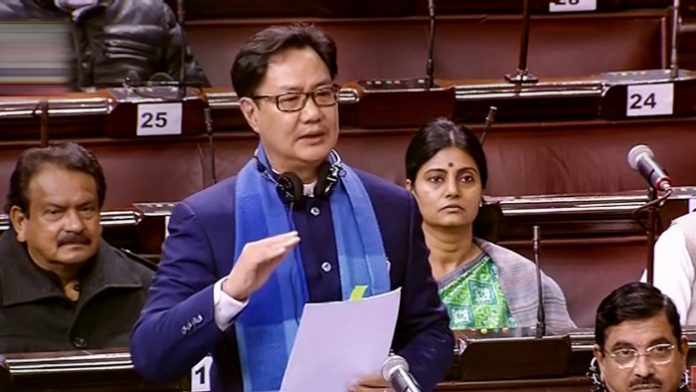
Union Minister of Law and Justice Kiren Rijiju on Thursday informed the Rajya Sabha in a written reply that the Supreme Court has been working an average of 222 days in a year.
The Minister said that number of working hours, working days and vacations of the courts are prescribed as per rules framed by the respective courts.
The Supreme Court Rules, 2013, inter-alia, provided that the period of summer vacation shall not exceed seven weeks and the length of the summer vacation and the number of holidays for the court and the offices of the court shall be such as may be fixed by the Chief Justice and notified in the official Gazette so as not to exceed one hundred and three days, excluding Sundays not falling in the vacation and during court holidays, the Minister said.
The Supreme Court of India, in the exercise of the powers conferred on it under Article 145 of the Constitution of India, makes rules for regulating the Court’s practice and procedures which includes its sittings and vacations, etc. Accordingly, the Supreme Court has framed the ‘Supreme Court Rules, 2013 which was notified on May 27, 2014. Order II of Part I of the Supreme Court Rules, 2013 provides for sittings of the Supreme Court, length of summer vacation and the number of holidays of the Court and also the Benches of the Hon’ble Judges during summer vacation and winter holidays, Rijiju said.
The Central Government has no role in fixing the minimum number of compulsory working hours and working days for courts. Further, there is no proposal at present to increase the number of working days or working hours of the Supreme Court. However, the Government is fully committed to the independence of the judiciary and constantly endeavours to provide a conducive environment for judges to discharge their judicial functions smoothly, stated the Law and Justice Minister in Parliament.
(This news report is published from a syndicated feed. Except for the headline, the content has not been written or edited by OpIndia staff)