

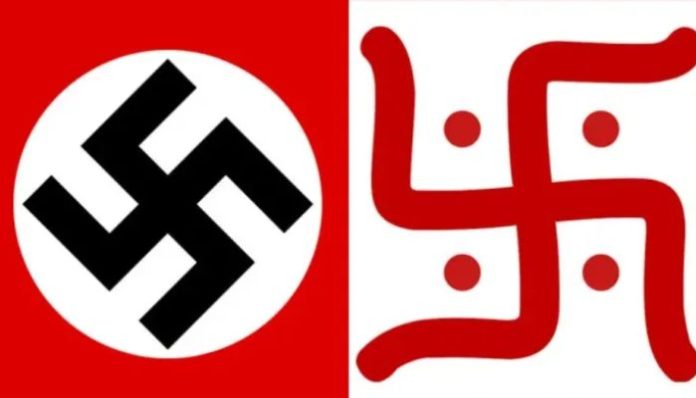
In what was a major victory for the Hindu community living across the United States and the world over, in 2021, the Oregon Education Department officially recognised the distinction between the sacred religious symbol, Swastika, and the Nazi’s ‘Hakenkreuz’.
According to the official website Oregon.gov, the Education Department had released an official communication titled, “Every Student Belongs — Learning the difference between symbols”.

In the release, the Oregon Education Department described Swastika as “a Sanskrit word and is used to symbolize auspiciousness and elements of the natural world in many religions and cultures, including in Hinduism, Buddhism, Judaism, Jainism, and some Native American religions and cultures.”
It pointed out that the hooked cross image is often wrongly labelled as Swastika but in reality it is Nazi’s Hakenkreuz, notorious as a hate symbol.
The Education Department had added, “While the hooked cross image is commonly referred to as a ‘swastika,’ the actual Nazi and Neo-Nazi symbol is correctly labeled as a ‘hakenkreuz’, the German word for ‘hooked cross’. Connect the dots through education and clarification about the terminology.”
Hindu Swastika and Nazi Hakenkreuz are not the same
There is a huge difference between the two symbols – the sacred religious symbol – Swastika and the Nazi hate symbol – Hakenkreuz.
Notably, when translated from its Sanskrit root, Swastika comprises of ‘su’ meaning ”good” and ‘Asti’ meaning ”to be”. In other words, well-being. It dates back some 6,000 years to rock and cave paintings. Scholars generally agree it originated in India.
It has also meant a symbol of good luck, prosperity, and all things auspicious for other ancient cultures, including the Vikings and Greeks, besides Hindus, Buddhists, and Jains.
A religious symbol for Hindus, the Swastika was first mentioned in the Vedas. It symbolises many things like Surya (the sun) and Brahma, the creator. It is seen as a power symbol and is also the emblem of Ganesha, the god of good luck. In both Hinduism and Jainism, the Swastika is used to mark the opening pages of account books, doors, and thresholds.
In fact, it is found that the Swastika was also used in Ancient Greece and can be found in the remains of the ancient city of Troy, which existed 4,000 years ago. The ancient Druids and the Celts also used the symbol. It was used by Nordic tribes and even early Christians used the Swastika as one of their symbols, including the Teutonic Knights, a German medieval military order, which became a purely religious Catholic Order.
Furthermore, the American Jewish Committee, one of the country’s oldest Jewish advocacy organizations, released a leaflet clarifying the distinction between the Swastika used for millennia by Hindu, Jain, and Buddhist cultures and the deformed Nazi version of it.
However, out of ignorance, cultural insensitivity, and deliberate intentions, many conflate the two symbols, furthering Hinduphobia which has been rampantly observed throughout the world. A notable case recently surfaced from Australia where Uber had de-platformed a Hindu woman from their portal for 5 months because her name was Swastika. But she later won after she fought against this decision.
*Previous information in this article was based on reports that appeared in the media. It has been amended to reflect the factual position after clarification by Coalition of Hindus of North America (COHNA)


