

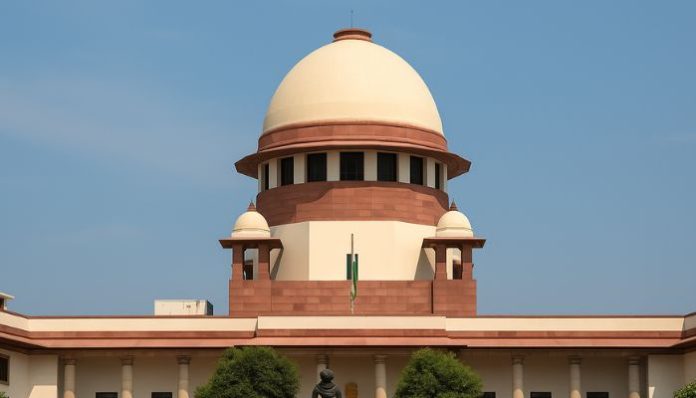
On 22nd July, in a landmark ruling that aimed at protecting families from the abuse of criminal law in matrimonial disputes, the Supreme Court of India upheld and enforced the Allahabad High Court’s 2022 guidelines on arrests under Section 498A of the Indian Penal Code (IPC). The apex court, while deciding the case of Shivangi Bansal vs Sahib Bansal, approved a mandatory two-month “cooling-off” period before any arrest can be made under the said provision.
The judgment was authored by a two-judge bench comprising Chief Justice of India B R Gavai and Justice Augustine George Masih. The bench invoked Article 142 of the Constitution to dissolve the marriage between the parties and quashed all civil and criminal proceedings filed against each other. The bench also made a scathing comment on how the misuse of Section 498A can destroy the very sanctity of marriage.
OpIndia accessed both Supreme Court and the Allahabad High Court judgments.
Background of the case – 7 years and 25 cases
The parties, Shivangi and Sahib Bansal, got married in December 2015. They got separated in October 2018. Following the separation, around 25 cases were filed across Delhi and Uttar Pradesh, ranging from FIRs under Sections 498A, 406, 376, and 307 IPC to domestic violence, custody, defamation, and tax notices. While both parties alleged harassment, the husband spent 109 days in jail and his father 103 days due to complaints filed by the wife.
In the court, the couple finally agreed to settle all disputes amicably. As per the terms of the settlement, Shivangi will retain custody of their daughter, forego alimony and child maintenance, and transfer disputed land to the husband. The Supreme Court directed both parties to withdraw all existing litigation and barred them from filing further cases related to the matter.
Furthermore, the wife, who is serving as an IPS officer, has been ordered to issue an unconditional apology, both in print and on social media, for the trauma caused to her husband’s family.
SC confirms no arrest for 2 months in 498A cases
At the heart of the judgment, the Supreme Court endorsed the Allahabad High Court’s guidelines from the 13th June 2022 judgment. The guidelines were framed by Justice Rahul Chaturvedi to prevent the automatic arrests of husbands and in-laws in dowry-related cases without prior scrutiny. The apex court ruled that these directions must now be followed across the country and circulated to all District Judges and Police Chiefs by the Registrar General of the Allahabad High Court within a month.
A detailed look at the Allahabad HC’s guidelines
In the June 2022 judgment, the Allahabad High Court had highlighted the growing trend of false and exaggerated complaints under Section 498A IPC and called for a structured approach to prevent misuse while preserving the rights of genuine victims.
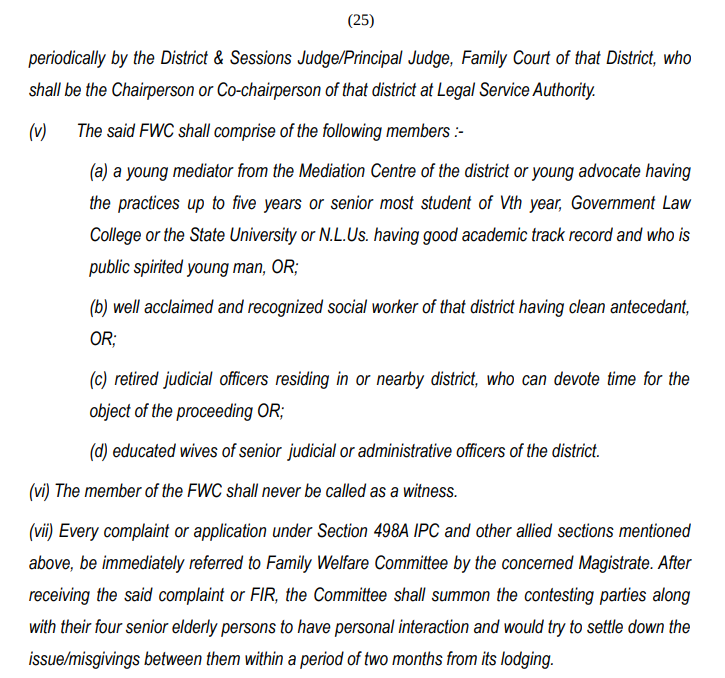
The court issued a blanket restriction on arrests for a minimum of two months after the FIR is registered. During this time, the complaint must be forwarded to a specially constituted Family Welfare Committee (FWC) in each district. These committees will be set up under the District Legal Services Authority and must consist of at least three members including retired judicial officers, trained mediators and social workers or legal professionals. Notably, any of the members cannot have any connection to the parties involved.
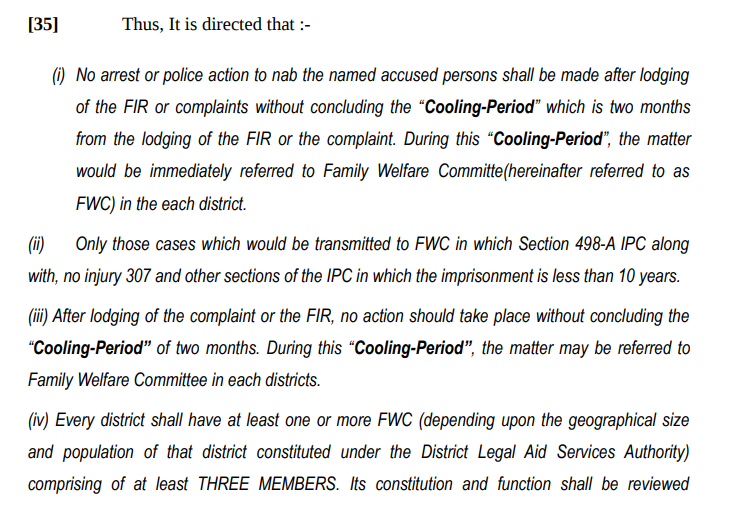
The FWCs are expected to engage with both parties and four elder members from each side. They will then submit a report within two months. Their findings are not to be used as evidence but will guide the Magistrate and police in deciding if coercive action is warranted. The police must refrain from making any arrest before receiving the report. Furthermore, the Magistrate has been directed to defer any proceedings under Section 498A IPC until the report is available.
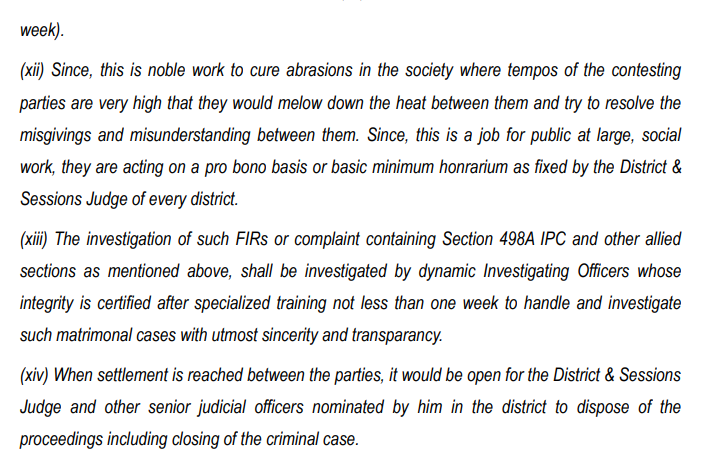
In addition, all investigating officers handling such cases are to be specially trained in matrimonial dispute resolution and are expected to act with “utmost sincerity and transparency”.
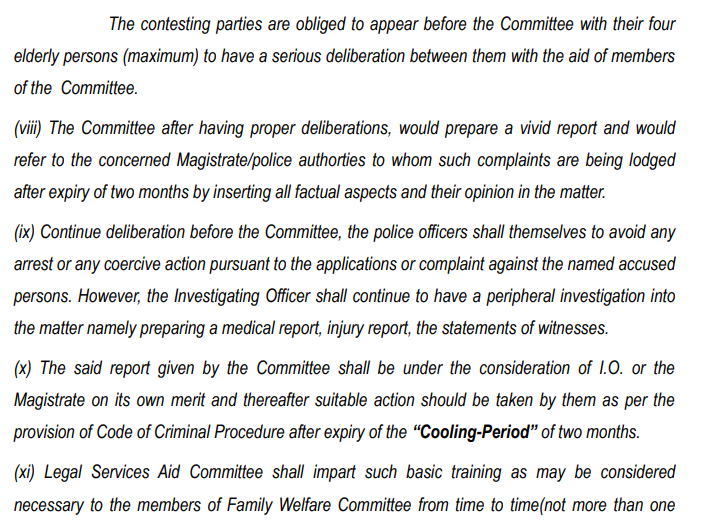
Where a settlement is achieved, the matter may be closed at the district court level, and necessary support including logistics and coordination may be facilitated by the District Legal Services Authority.
Most importantly, these safeguards only apply to cases involving Section 498A IPC or related non-heinous offences where the maximum punishment does not exceed 10 years. These safeguards will not involve cases under Sections like 307 or where grievous injury is reported.
Settlement terms and constitutional powers invoked
In the judgment, the apex court invoked its powers under Article 142 of the Constitution to dissolve the marriage between the parties. Custody of the minor daughter was granted to the mother. The father received supervised visitation rights. The court permitted him to meet the child on the first Sunday of every month at her school, and during half of the vacation period, provided no obstruction was created by either side.
The court has ordered the wife, who is serving in the IPS, to bear all expenses of the child and waived her claim to any maintenance or alimony. The Supreme Court also quashed a prior order directing the husband to pay ₹1.5 lakh per month in child maintenance.
A piece of land in Aligarh owned by the wife’s mother was agreed to be transferred to the husband by way of gift. Though litigation over the property is pending, the court recorded that the husband would assume all future responsibilities, costs, and legal proceedings relating to it. The parties also agreed to de-link from each other’s personal and professional lives, with a binding undertaking not to interfere in any future matter, directly or indirectly.
The court also ordered the wife and her parents to tender an unconditional apology to the husband and the family. The apology must be published in one English and one Hindi national newspaper. Furthermore, it has to be shared across all major social media platforms. The apex court clarified that this apology was not an admission of liability and could not be used against her in any future forum. The court provided a fixed format to the wife to be published in papers and social media.
The court quashed all criminal and civil proceedings between parties and restrained them from filing any further cases in future directly or through proxies. Social media posts, interviews and statements by either side must be deleted, and both parties were directed to refrain from making disparaging public remarks going forward.
Finally, the court issued a stern direction prohibiting the wife from misusing her official position as an IPS officer or utilising the influence of her colleagues or superiors against the husband or his family. Any breach of the agreed conditions would amount to contempt of court.
Observations on the misuse of matrimonial laws
The apex court took note of the impact of false criminal cases, observing that prolonged litigation causes deep emotional trauma and destroys the possibility of amicable reconciliation. It observed that arrest and harassment under Section 498A, without proper scrutiny, can “evaporate the traditional fragrance of our age-old institution of marriage.”
Though the judgment provides recourse for aggrieved families, the court made it clear that it does not dilute the legal remedies available to genuine victims of dowry harassment or domestic abuse. The emphasis is on procedural fairness, not denial of justice.


