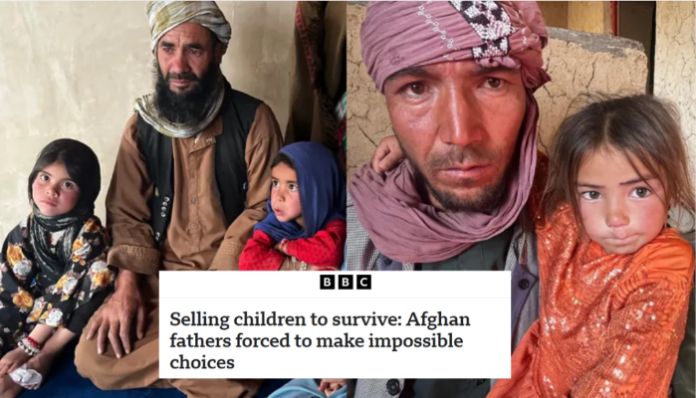
Afghanistan has been grappling with a catastrophic and multi-faceted crisis, marked by a dire humanitarian emergency that comprises egregious human rights abuses, especially against females of all ages, under the authoritarian Taliban regime. The last thing these girls and women need is an effort to downplay their suffering instead of demonstrating empathy and comprehension of their harrowing realities. Yet, the British Broadcasting Corporation (BBC) has again managed to achieve the undesirable and trivialised their pain with its overtly misdirected sympathy.
On 19th May (Tuesday), the media house released an article about the inveterate issue of child brides, titled “Selling children to survive: Afghan fathers forced to make impossible choices” by Yogita Limaye. It highlighted the tremendous hunger problem that millions of citizens are experiencing in the backdrop of rising poverty, widespread unemployment and a critically isolated economy undergoing serious depletion of its resources.
The article referenced conversations with Afghan men who claimed deep worries about their escalating financial problems and acute shortage of food. “The country is now facing record levels of hunger, with 4.7 million – more than a tenth of Afghanistan’s population – estimated to be one step away from famine. Ghor is one of the worst-affected provinces. The men here are desperate,” it stated.
The author pointed out that the men were in despair as their children and families were going to bed suffering from the pangs of hunger. This certainly illustrated a very grim and poignant image of the stark disparities in the intensity of struggles encountered by different people in separate parts of the world.
The appalling act of downplaying an atrocious practice
The piece then transitioned to an uncanny course, which intended to depict the trade of young girls and minors by their fathers as if they were mere products rather than human beings, as a necessary evil.
“I’m willing to sell my daughters. I’m poor, in debt and helpless. I come home from work with parched lips, hungry, thirsty, distressed and confused. My children come to me saying ‘Baba, give us some bread’. But what can I give? Where is the work? If I sell one daughter, I could feed the rest of my children for at least four years. It breaks my heart, but it’s the only way,” it quoted Abdul Rashid Azimi who has many kids including 7-year-old twins Roqia and Rohila.
The BBC, which often likes to paint itself as a defender of human rights, showcased an unexpected compassion for the men sentencing their own girls to a tragic existence, instead of confronting the horrific practice that is not only accepted but has been part of a tradition for decades.
The media outlet was not as understanding towards the prey of this radical tyranny, who are far more vulnerable and bear considerably worsened circumstances compounded by the oppressive infringements on their rights and the suffocating restrictions slapped by the Islamist government.
“The choice to sell daughters over sons, is because culturally sons are widely seen as future breadwinners, and here in Afghanistan, with the Taliban’s restrictions on education and work for women and girls, it is even more pronounced. Additionally, there is a tradition in which a marital gift is given to the family of the girl from the family of the boy during marriage,” Limaye wrote explaining the rationale behind these profoundly misogynistic and otherwise criminal conduct which is allowed in Sharia-bound Afghanistan.
The article featured interview with another man, Saeed Ahmad who sold his 5-year-old daughter to pay for her treatment after she developed appendicitis and a liver cyst. Now, she has to marry a relative’s son at the tender age of 10 after the agreement between the two parties. He ended her daughter’s medical issue only to thrust her into another predicament.
Limaye asserted that Ahmed confessed to be anxious to distract from the real victims who are neither mentally nor physically prepared to assume the responsibilities of marriage or a husband. However, their consent is neither acknowledged nor considered in the Islamic patriarchal society.
“The practice of underage marriage remains widespread in Afghanistan and is increasing due to the Taliban government’s bar on education for girls,” she conveyed. Interestingly, the burden of providing basic needs for a family has been placed on the shoulders of girls rather than boys as they are compelled to carry this weight at the expense of their health, future and even their lives.
According to the piece, the financial difficulties have been aggravated by the drastic reduction in United States funding and exacerbated by the devastating drought. It added that the Taliban’s policies, primarily those that discriminate against women, are also a major factor contributing to the decline in foreign donations.
Afterwards, the author explored the glaring scarcity of medical facilities and resources, such as medicines, which further contribute to the misery of women, as the mortality rate has reached as high as 10% with several child deaths reported within a single day.
The BBC clearly outlined the various issues plaguing Afghanistan, with the exception of the one that required the most sensitivity and pertained to the marginalised fairer gender. The custom targeting underage girls, who are even pushed to marry men in their 50s, 60s and sometimes even older, was only mentioned to evoke pity for the fathers who doom them to such a life.
Netizens call out BBC
Social media users promptly criticised the national public service broadcaster of the United Kingdom for their objectionable approach to the sensitive subject in relation to the sale of child brides. Community notes emphasised that the girls could be as young as 5 years old as these actions have deep cultural roots in some areas of the nation and further remarked that the platform focused on the distress of fathers concerning the fates of the girls (rape).
Selling children to survive: Afghan fathers forced to make impossible choices https://t.co/dQ1YJdElHX
— BBC News (World) (@BBCWorld) May 18, 2026
Tommy Robinson denounced the BBC for trying to represent Afghan fathers as “victims” for giving their girls to old men. “This is normal practice amongst these cavemen. Legacy media are the enemy of truth,” he charged.
The BBC trying to make Afghans look "victims" of selling their daughters to older men.
— Tommy Robinson 🇬🇧 (@TRobinsonNewEra) May 19, 2026
This is "normal" practice amongst these cavemen.
Legacy media are the enemy of truth. https://t.co/SuzZTfeJ7h
An individual “fixed the headline for BBC,” responding that Afghan men choose to sell their daughters instead of seeking employment.
Fixed it for you BBC pic.twitter.com/EQ5Bvcv41E
— Andy (@PositivFuturist) May 19, 2026
A netizen referred to the article as just another attempt by the “legacy media”to promote sympathy for people who don’t deserve it and added, “Note the father didn’t sell his boy, just the girls. BBC are disgusting. We dint hate them enough.”
Another case of the legacy media reframing something to gain sympathy for people who don't deserve. Note the father didn't sell his boy, just the girls. BBC are disgusting. We dint hate them enough.
— Galaxis Show (@GalaxisShow) May 20, 2026
The piece was awful even by the abysmal standards of the outlet’s “journalism,” according to another person who demanded, “The BBC should not be privatised, it should be shut down.”
This article is terrible even by the terrible standards of BBC 'journalism'. The BBC should not be privatised, it should be shut down.
— Managed Decline (@ManageDecline) May 20, 2026
An account highlighted BBC’s hypocrisy and stated, “Child sex slavery is okay when Muslims do it.”
"child sex slavery is okay when Muslims do it"
— Sensurround (センサラウンド) (@ShamashAran) May 19, 2026
–The BBC https://t.co/4xa2ikXOSD
A common practice rendering little girls at the mercy of hardline men in the name of satisfying “basic family needs”
Afghanistan is regarded as one of the world’s most dangerous places for women due to many factors involving gender-based violence, absence of education, low access to healthcare, restrictions on stepping outside and other prohibitions. Moreover, forced child marriage has substantially accelerated the suffering in their already bleak existence.
Economic conditions could serve as an excuse for the heinous actions, but it is noteworthy that these incidents have transpired regularly in the country in the past. Many displaced Afghan families reportedly sold their barely adolescent daughters to men 4-5 times their age after Kabul fell in 2021.
Some Afghan women have also resorted to adopt such measures. A mother did the same with her one-and-a-half-year-old for 30,000 Afghani (about INR 24,850) to treat her other 13-year-old daughter, who required urgent medical attention. “My husband said if we don’t give away our daughters, we will all die because we don’t have anything to eat,” another woman voiced after selling her 6-year-old and 18-month-old children. Moreover, same scenes unfolded in the 1990s under the Taliban government of the time.
Henrietta Fore who was UNICEF (United Nations International Children’s Emergency Fund) Executive Director at that time stated, “I am deeply concerned by reports that child marriage in Afghanistan is on the rise. We have received credible reports of families offering daughters as young as 20 days old up for future marriage in return for a dowry.”
She mentioned, “Even before the latest political instability, UNICEF’s partners registered 183 child marriages and 10 cases of selling of children over 2018 and 2019 in Herat and Baghdis provinces alone. The children were between 6 months and 17 years of age. UNICEF estimates that 28 per cent of Afghan women aged 15-49 years were married before the age of 18.”
“Traditionally, Afghanistan has a patriarchal society and child marriage is considered an internal family matter that is dictated by religious and cultural codes. Religious leaders such as mullahs and imams play a significant role in shaping community perceptions on child marriage as they are trusted members of the community and play a key role in performing the marriages,” reported international non-governmental organisation (NGO) Girls Not Brides.
According to a 2017 Human Rights Watch research, when a girl is married off, her sister frequently has to look after household chores, which causes her to drop out of school and puts her at risk for child marriage. Some girls are even ordered to drop out of school due to the prospect of marriage. Girls are regarded as an excellent source of domestic labour and financial value for their future families.
There is also a considerable economic motive as marriage is transactional, incorporating a transfer of goods and money. These are also used as an instrument to resolve conflicts and cement relationships between opposing families (baad). The NGO pointed out, “Girls have little say in this and often face serious physical and emotional abuse. When they try to escape, they are sometimes arrested for zina (running away) which is seen as a moral crime. Baadl is the exchange of daughters in marriage between families, either before birth or as young as two.”
The girls are driven into sexual exploitation, abuse and domestic slavery and even misused as a means for their families to settle disputes. It is impossible to escape and if someone dares to take the risk, then the results are even more horrifying.
Conclusion
It is indisputable that Afghanistan is beset by a multitude of problems, with the foremost being the crippled economic as people have to spend their lives in miserable conditions. However, the apparent goal of the BBC article does not seem to only report on the gravity of the ground realities but sanitise the ordeal of the little girls as ordinary while presenting the men as the actual sufferers who have to make such decisions.
However, the children who are pushed into these relationships which far exceed their physical or psychological capabilities do not receive any mention in the article. The utter disregard for consent and the adverse effects of this practice on the victims is likewise ignored. The unprecedented breach of human and child rights almost went unnoticed by the British media house.
Interestingly, the BBC, which does not hesitate to admonish other countries, especially India, on human or women’s rights over frivolous complaints, appeared to have no concern for the same in Afghanistan and instead provided a cover to the problem. The media house’s outrage seems to have a region, and more importantly, a religion bias.