

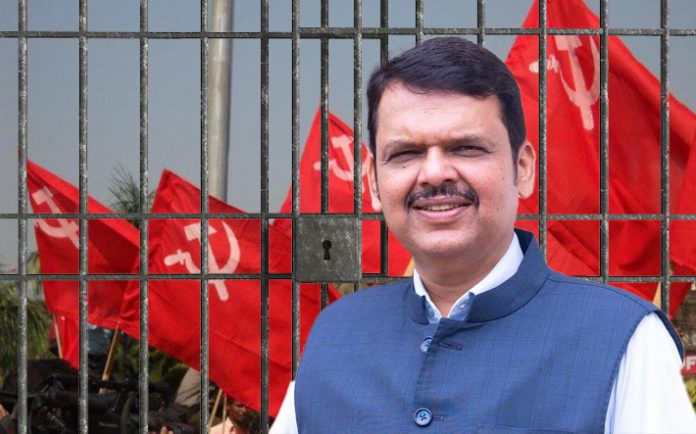
The Maharashtra government has introduced a law to check the spread of Maoist ideology in the state. The Bill, titled the Maharashtra Public Security Bill 2024, was passed in the state Assembly on Thursday (10th July) through a voice vote as some opposition members opposed the Bill.
CM Devendra Fadnavis tabled the Bill in the Assembly, which intends “to provide for effective prevention of certain unlawful activities of left-wing Extremist organisations or similar organisations and matters connected therewith or incidental thereto”.
Introduced the ‘Maharashtra Special Public Security Bill 2024’ which aims to eradicate Naxalism evolved from left-wing extremism..
— Devendra Fadnavis (@Dev_Fadnavis) July 10, 2025
‘कडव्या डाव्या विचारसरणीतून’ उद्भवलेल्या नक्षलवादाचा समूळ नायनाट करण्यासाठी ‘महाराष्ट्र विशेष जन सुरक्षा विधेयक 2024’ ..
(विधानसभा, मुंबई | दि. 10… pic.twitter.com/lXv3rIZesB
The Bill was presented in the Assembly after being reviewed by 25-member Joint Committee headed by Revenue Minister Chandrashekhar Bawankule and included several senior leaders. CM Fadnavis said that the Bill has been finalised after considering the suggestions from the public. “We studied over 12,500 suggestions and objections from the public before finalizing the draft. It is a balanced and progressive law more advanced than similar laws in states like Telangana, Andhra Pradesh, Odisha, and Jharkhand,” the CM said. He highlighted that around 64 left-wing organisations are currently active in Maharashtra, which is the highest number across all states.
Opposition raises concerns about the Bill
The lone CPI (Marxist) MLA in the Assembly, Vinod Nikole, opposed the Bill, saying that the law would be misused. “I am the only MLA from the Left party. Violent action should be curbed. There is MCOCA and UAPA. The CM has ended Naxalism in Gadchiroli, but I am opposing this Bill as it can be misused,” Nikole said. Amongst others who opposed the Bill were Rohit Pawar (NCP-SP), Bhaskar Jadhav and Varun Sardesai (Shiv Sena UBT), and Vishwajeet Kadam (INC). They registered opposition regarding some clauses in the Bill, including the term ‘urban naxal’. They claimed that some of the suggestions of the joint select committee were not included in the revised bill.
Highlights from the Bill
Allaying the concerns of the opposition, CM Fadnavis said that the Bill is not aimed at targeting Left parties or those criticising the government. The CM assured that the state government recognised dissent and citizens’ right to protest, and that the Bill is meant to punish those who wish to overthrow the established institutions of the country. “Some members have expressed apprehensions, but this Act is not against any left-wing political party. This is against those organisations which are inciting people to overthrow the Indian Constitution. This is for the internal security of the country. It is not against left-wing parties like CPI or CPI (M). We, in fact, respect them even though we have different ideologies. It is against those organisations whose motive is to demolish the established institutions of our country. They will face action,” Fadnavis said.
Explaining the reasons that led to the introduction of the Bill in the Assembly, Devendra Fadnavis said that the influence of the Maoist ideology is growing in the urban and rural areas of the state, particularly in districts like Gadchiroli and Konkan. He said the Maoists, who are facing extinction, are “trying to brainwash the youth of urban areas and make them stand up against the democratic system”.
The Bill seeks to ban individuals and organisations indulging in or promoting violence, guerrilla warfare, or attempting to destabilise the government through unlawful means. Justifying the legislation, Fadnavis said that the existing laws like the Unlawful Activities (Prevention) Act (UAPA) come into effect after the unlawlful activities has taken place, but the Bill includes preventive measures such as early intervention before the erruption of violence.
The Bill penalises any ‘unlawful activity’, which is defined as “any action taken by an individual or organization whether by committing an act or by words either spoken or written or by sign or by visible representation or otherwise, (i) which constitute a danger or menace to public order, peace and tranquility; or (ii) which interferes or tends to interfere with maintenance of public order; or (iii) which interferes or tends to interfere with the administration of law or its established institutions and personnel”. The punishment for an unlawful activity ranges from 2 to 7 years of imprisonment. To ensure fair and transparent implementation, the Bill provides for the constitution of a three-member authority, comprising a sitting or retired High Court judge, a district magistrate, and a public prosecutor, to oversee case reviews before prosecution.
Elaborating on the ambit of the legislation, the Chief Minister said that cases of violence during protests will be dealt with by the BNS and that the Bill will only be invoked when an organisation tries to “defy the Constitution or Constitutional authorities”. He added that the Bill targets organisations inspired by extreme Left ideologies which aim to challenge constitutional governance through armed struggle. Citing the example of the CPI (Maoist), Fadnavis said, “These groups reject democratic institutions and seek to replace them”.
Naxalism on the verge of eradication
The menace of Naxalism is nearing its end in the country after the consistent efforts of the government and the security forces. The Maoist cadre are staring at an invevitable end with dwindling numbers of footsoldiers and depleting leadership as a result of collaborative efforst of the central forces and the state police.
The Indian government has resolved to uproot Naxalism from the country by March 2026. To achieve this end, the government has adopted an aggressive military approach to counter Naxal terrorism which entered its last phase under Operation Kagar which was launched by the government in January 2024.
Under the operation, around 1 lakh para-military troops, including the Central Reserve Police Force (CRPF), its elite CoBRA units, District Reserve Guards DRG), and state police, equipped with modern technology, have been deployed in the left-wing terrorism affected areas to completely uproot the naxal terrorism from its last remaining strongholds. Since the inception of the operation, the security forces have eliminated over 400 naxal terrorists so far while more than 800 Maoists have surrendered. From 2019 to 2025, the central forces, in collaboration with state police, have established a total of 320 camps in Naxal-affected states, including 68 night-landing helipads. The number of fortified police stations, which was 66 in 2014, has now increased to 555.


