

On 7th July, the Delhi High Court denied bail to Athar Khan, one of the accused in the 2020 anti-Hindu Delhi riots larger conspiracy case. While the denial of bail is significant, it is the secondary part of the judgment. The more important part is that the judgment records material showing that discussions about road blockade and inciting violence were taking place as early as 17th February 2020.
This material evidence directly damages the narrative pushed for years by the Left-liberal and Islamist ecosystem that the violence began because of Bharatiya Janata Party (BJP) leader Kapil Mishra’s speech on 23rd February 2020. The judgment, in effect, records that the conspiracy and violent intent existed much before that date, a stand which OpIndia has maintained for the past six years.
The order was passed by a Division Bench of Justice Prathiba M Singh and Justice Madhu Jain in Athar Khan’s appeal against the trial court’s rejection of his second bail plea on 29th January 2026. Khan is an accused in FIR No 59/2020, registered at Crime Branch Police Station in Delhi. The FIR was registered against several accused, including Umar Khalid, in connection with the larger conspiracy behind the anti-Hindu Delhi riots of 2020 under provisions of the IPC, UAPA, Arms Act and Prevention of Damage to Public Property Act.
What was Athar Khan’s role
According to the judgment accessed by OpIndia, Athar Khan had actively participated in the Delhi Protest Support Group (DPSG) WhatsApp group, United Against Hate group and CAB Team. The court referred to the earlier finding that on the night of 22nd February, Khan attended a meeting at Ayaz’s basement in Chand Bagh. The meeting reportedly led to coordinated attacks.
The judgment also recorded that on 23rd February 2020, another meeting took place at Mukhtyar’s house in Chand Bagh. DPSG members, including Khan, attended the meeting. According to the court, there was coordination over the destruction and disablement of CCTVs and mobilisation on a large scale for violent outbreaks.
The High Court noted that Khan’s role was active. He could not be treated as a casual participant. He was stated to have attended various meetings, including those on the intervening night of 23rd and 24th February. The court had also noted that he conspired to destroy government property with other co-accused.
The protected witness statement
One of the most serious parts of the judgment concerns the statement of protected witness ‘Pluto’. The prosecution relied on this statement to argue that Khan was not merely part of a protest network but had a direct role in pushing violence.
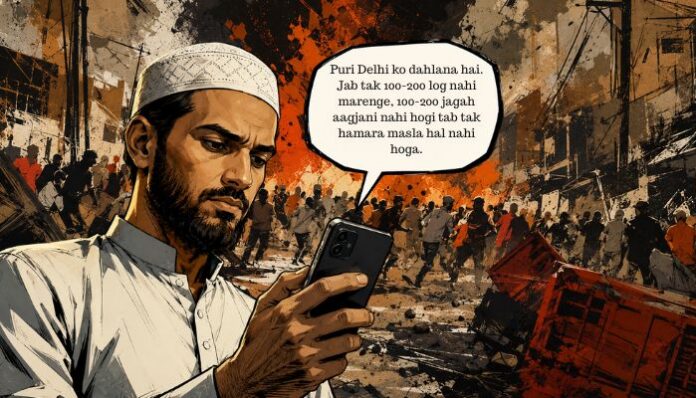
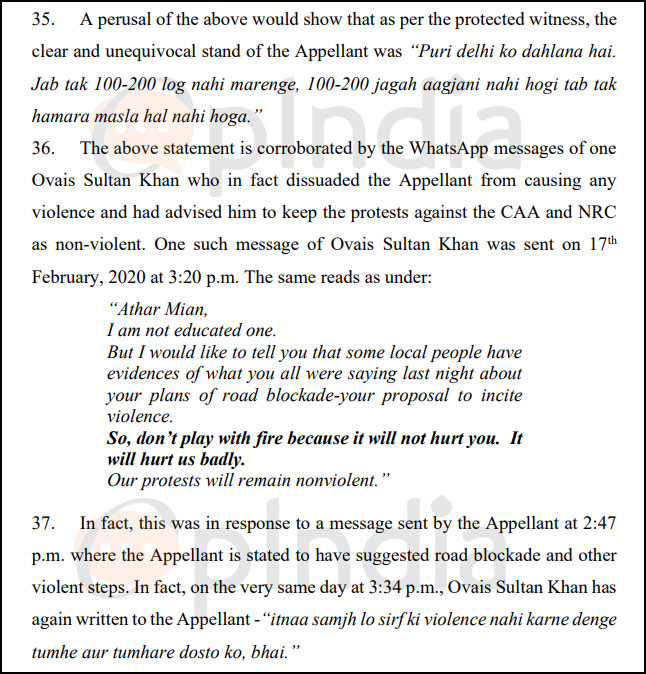
As per the judgment, the witness stated that Khan had said, “Puri Delhi ko dahlana hai. Jab tak 100-200 log nahi marenge, 100-200 jagah aagjani nahi hogi tab tak hamara masla hal nahi hoga.”
In English, the statement means that “Delhi had to be shaken and unless 100-200 people died and arson took place at 100-200 places, their issue would not be resolved”. The court treated this as extremely serious material at the bail stage.
The witness statement also referred to preparations involving weapons, petrol and money. Another person, Rizwan, was stated to have said that shooters had been called from Uttar Pradesh and that Delhi had to be destroyed. These are matters that will be tested during trial, but the court made it clear that at the bail stage, the material could not be brushed aside.
17th February chats and the Kapil Mishra narrative
The most important part of the judgment is the 17th February 2020 WhatsApp message. The court held that the protected witness statement was corroborated by messages sent by one Ovais Sultan Khan to Athar Khan.
Ovais Sultan Khan had warned Athar Khan against violence. In a message sent on 17th February 2020 at 3:20 pm, he told Khan that some locals had evidence of what had been discussed the previous night about road blockade and the proposal to incite violence. He then warned, “Don’t play with fire because it will not hurt you. It will hurt us badly. Our protests will remain nonviolent.”
This message was sent six days before Kapil Mishra’s speech on 23rd February 2020. This is why the judgment is significant beyond the bail issue. For years, Kapil Mishra was blamed by the Left and Islamist ecosystem for triggering the riots. However, the court has now recorded material showing that conversations about road blockade and inciting violence existed on 17th February itself.
The court further noted that the message was in response to a 2:47 pm message sent by Khan, where he was stated to have suggested road blockade and other violent steps. On the same day, at 3:34 pm, Ovais Sultan Khan again messaged him and said that violence would not be allowed by him and his friends.
The High Court said these WhatsApp chats confirmed Khan’s intention. It also said the chats supported the statement of protected witness Pluto, where Khan was accused of exhorting others to cause deaths and damage public property.
What the investigators found
The prosecution argued that Khan had instigated violent protests despite opposition from his own group. It relied on WhatsApp chats, protected witness statements and earlier findings against him.
The court said the WhatsApp chats of the DPSG group showed that Khan had repeatedly sent messages and actively participated in the riots. It further noted that some of his messages were extremely incriminating. According to the court, they showed an active role not only in causing riots and destruction of property but also in deaths caused during the riots.
The court also said that any evidence pointing to Khan’s role in deaths during the riots would make him a core conspirator, not merely an executor at the ground level.
This distinction became important because Khan’s defence argued that he was only a local-level facilitator and should get parity with other accused who had been granted bail.
Why parity with other accused was rejected
Athar Khan sought parity with co-accused Shadab Ahmad and Gulfisha Fatima, who had been granted bail by the Supreme Court in the Gulfisha Fatima case. His counsel argued that his role was similar and that he had already spent around six years in custody.
The High Court rejected this argument. It noted that Khan had not challenged the earlier Delhi High Court order of 2nd September 2025 before the Supreme Court. Therefore, his detailed role was not considered by the Supreme Court while deciding the case of other accused.
The court also referred to the Supreme Court’s distinction between core conspirators and field-level operators. In the case of Shadab Ahmad, the Supreme Court had treated him as a site-level executor. In the case of Gulfisha Fatima, the Supreme Court had held that she did not have independent command or strategic oversight.
However, in Khan’s case, the Delhi High Court said the material was different. It noted that the 17th February meeting, the WhatsApp chats and the protected witness statement showed that Khan persisted with violent protests even when others asked him to remain non-violent.
Court rejects bail
The High Court concluded that Khan could not be treated as a mere local-level operator. It said he was one of the main conspirators who conspired to cause deaths during the riots. The court held that his role was clearly distinguishable from other co-accused who were granted bail.
The court also said that if Khan was released at this stage, he could threaten witnesses and disrupt the trial. It added that he was likely to pose a flight risk and influence witnesses whose evidence was yet to be recorded.
The court upheld the trial court order and dismissed his appeal. The court, however, clarified that its observations were only for deciding the bail application and should not influence the trial on merits.
Anti-Hindu Delhi riots of 2020
On 24th and 25th February 2020, the anti-Hindu Delhi riots took place in Northeast Delhi. The violence erupted amid anti-CAA protests. It soon spread across several areas. 53 people lost their lives and over 100 people were injured.
The dead included Head Constable Ratan Lal, Intelligence Bureau official Ankit Sharma, Dilbar Negi, Rahul Solanki, Vinod Kumar and many others. Over 1,500 public and private properties were damaged during the violence. Homes, shops, vehicles, religious places and public infrastructure were attacked.
The riots left large parts of Northeast Delhi under fear for days before normalcy returned. The Crime Branch of Delhi Police registered FIR No 52/2020 to probe the larger conspiracy behind the violence. According to the prosecution, the riots were not spontaneous but part of a deep-rooted conspiracy carried out under the cover of protests against CAA and NRC.
Umar Khalid, Sharjeel Imam, Tahir Hussain, Khalid Saifi, Ishrat Jahan, Gulfisha Fatima, Natasha Narwal, Devangana Kalita, Athar Khan, Safoora Zargar, and others were named in the FIR. The trial in the case is yet to begin as the accused, including Umar Khalid, have used different tactics to delay the trial indefinitely.


