

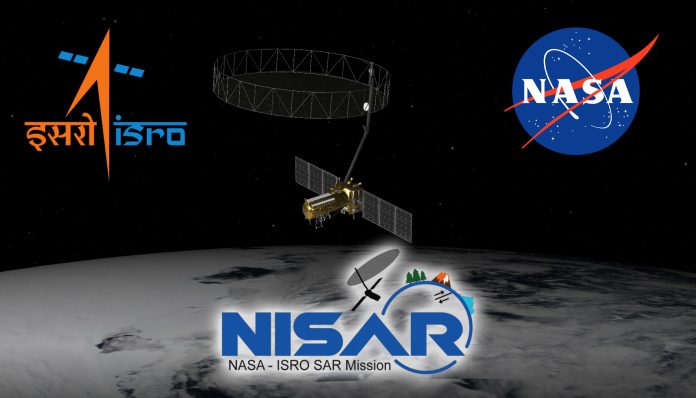
The historic collaboration between the United States and India in space science is finally set to launch its mission on July 30. The NASA-ISRO Synthetic Aperture Radar, also known as NISAR, will be the first ever Earth-observing satellite built in partnership of NASA and ISRO. This mission will mark a huge game-changing moment for India as it can fight climate change.
NISAR is scheduled to launch from Satish Dhawan Space Centre, Sriharikota, at 17:40 IST, on a GSLV Mark II rocket. The launch vehicle will take the satellite to low earth orbit. The NISAR satellite will scan nearly all of Earth’s land and ice surfaces twice every 12 days to measure changes in the planet’s ecosystems, growth and retreat of its land and sea ice, and deformation of its crust. Information provided by NISAR will help with such tasks as infrastructure monitoring, disaster response, biomass assessment, and agricultural management.
To provide more comprehensive earth surface data, it carries both L-band (24 cm wavelength) radar by NASA and S-band (≈9 cm wavelength) radar by ISRO, enabling dual-frequency imaging. It is a first-of-a-kind dual-band radar satellite that will measure land deformation from earthquakes, landslides, and volcanoes, producing data for science and disaster response.
Each instrument can collect measurements day and night and see through clouds that can obstruct the view of optical instruments. The L-band instrument will also be able to penetrate dense vegetation to measure ground motion. This capability will be especially useful in areas surrounding volcanoes or faults that are obscured by vegetation.
With its SweepSAR technology, NISAR will be able to capture a wide swath of 240 Km across with 5-10 m resolution. The technology will allow for scanning nearly all land and ice surfaces every 12 days or roughly every 6 days with combined ascending and descending passes.
Another key objectives of this is it can effortlessly detect deformation on earth’s surface of just a few millimeters. This will make it invaluable for monitoring earthquakes, landslides and volcanic activity, in day or night, through clouds and vegetation.
The mission will also track melting glaciers, changes in ice sheets and sea ice, and monitor shifts in forests, wetlands, and agricultural biomass, offering insights into climate change and carbon cycles. It will track how much glaciers and ice sheets are advancing or retreating and it will monitor growth and loss of forests and wetlands for insights on the global carbon cycle.
NISAR will measure changes in planet’s surfaces, which takes place all the time, with each pixel capturing an area about half the size of a tennis court. Taking imagery of nearly all Earth’s land and ice surfaces this frequently and at such a small scale — down to the centimetre — will help scientists put the pieces together into one coherent picture to create a story about the planet as a living system.
As magma shifts below Earth’s surface, the land can bulge or sink. The NISAR satellite will help provide a fuller picture for why a volcano deforms and whether that movement signals an eruption.
Together with complementary measurements from other satellites and instruments, NISAR’s data will provide a more complete picture of how Earth’s surface moves horizontally and vertically. The information will be crucial to better understanding everything from the mechanics of Earth’s crust to which parts of the world are prone to earthquakes and volcanic eruptions. It could even help resolve whether sections of a levee are damaged or if a hillside is starting to move in a landslide.
Data from the satellite will give researchers insight into which parts of a fault slowly move without producing earthquakes and which sections are locked together and might suddenly slip. In parts of the world that aren’t monitored regularly, NISAR measurements could reveal new earthquake-prone areas.
Not just natural features, the NISAR will also measure movements of man-made structures like levees, aqueducts, dams etc, using continuous measurements over years. For example, it will able to tell if a dam has changed after an earthquake.
NISAR’s data will be freely available to the public, typically within one to two days of collection, and within hours during emergencies, helping global research and policymaking. With a total estimated cost of $1.5 billion, including a major $1.118 billion investment from the US, it is the most expensive Earth-imaging project ever and reflects growing space collaboration between India and the US. The mission is planned for three years, though it carries supplies for up to five. NISAR will enhance our understanding of Earth’s ecosystems, ground changes, and ice systems, focusing strongly on disaster readiness and climate research.
Featuring dual-frequency synthetic aperture radar (SAR), it can collect consistent data in any weather or lighting conditions. This will revolutionize how scientists and policymakers track climate change, infrastructure stability, agricultural conditions, and natural disaster risks. By making its data openly accessible worldwide, the mission empowers researchers and communities across the globe.


