

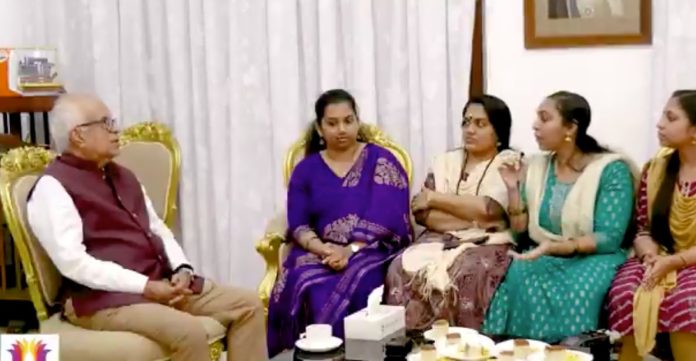
Renowned Indic scholar and author Rajiv Malhotra recently hosted a powerful discussion with four Hindu women who had once been drawn into Islam under subtle pressure and influence, but who later chose to reclaim their dharmic identity. A section of their accounts was shared online, which revealed not only the systematic psychological tactics used to lure vulnerable women but also the silent erosion of cultural confidence among Hindus, which leaves many unprepared to resist such narratives.
I recently had a riveting conversation with the girls of Aarsha Vidya Samajam at Thiruvananthapuram, Kerala.
— Rajiv Malhotra (@RajivMessage) August 25, 2025
Their stories of conversion to Islam and back to their roots have some important lessons for the Hindu society. Their stories highlight the importance of PurvaPaksha that… pic.twitter.com/Xr7X00s6mq
One of the most compelling testimonies came from Anagha, who became Ayma Amira and subsequently reverted back to Hinduism with the help of Arsha Vidya Samajam. Anagha candidly shared how her Muslim college roommates persistently ridiculed Hinduism while glorifying Islam. Over time, their conversations chipped away at her cultural confidence. She revealed that she began adopting Islamic practices on her own, even choosing to wear the burqa, despite not being formally asked to.
This change, she admitted, was not born out of genuine conviction but the gradual internalisation of the narrative that Islam was superior and Hindu traditions were backward. Along with this, she developed a sense of disdain for non-Muslims, a stark transformation brought about solely through peer influence and targeted indoctrination.
The other women echoed similar experiences, showing how brainwashing often happens quietly, under the radar, and not always through organised missionary networks. Instead, self-motivated individuals such as classmates, friends, or hostel mates, act as everyday agents of conversion, gradually weaning Hindu women away from their roots while immersing them in Islamic theology, which involves supremacist beliefs and deep contempt, almost bordering on hatred, for non-Muslim.
These chilling narratives were strikingly reminiscent of what was portrayed in the controversial film “The Kerala Story.” The movie dramatized real cases of Hindu and Christian women in Kerala being deceived into converting to Islam and then trafficked to conflict zones like Syria to serve as ISIS wives.
While the cases in Malhotra’s discussion did not escalate to such extremes, the underlying methods were hauntingly similar: isolating vulnerable women, ridiculing their heritage, glorifying Islam, and steering them toward complete cultural alienation. The fact that such grooming continues in ordinary campuses and hostels shows how widespread, and often invisible, this trend remains.
The urgent need for Hindus to employ ‘Purva Paksha’ and fight subtle indoctrination attempts
Placing these personal stories in a larger framework, Malhotra emphasised the urgency of reviving the Indic tradition of “Purva Paksha”, the practice of deeply studying rival worldviews in order to engage them critically. He explained that historically, Hindu scholars were not content with merely defending their traditions in isolation. They mastered the doctrines of Buddhists, Jains, Christians, and Muslims, exposing inconsistencies and challenging claims on philosophical grounds. This intellectual armour ensured Hinduism could withstand centuries of ideological contestation.
Malhotra stressed that Hindus today must adopt the same approach. When targeted proselytisers question Hindu practices as superstition or backwardness, it is not enough to respond emotionally or retreat into silence. Instead, Hindus must be prepared to ask hard questions in return such as about contradictions in rival faiths, about historical injustices, and about theological exclusivism. Without this, he warned, young Hindus will continue to fall prey to one-sided narratives, lacking the intellectual tools to defend their identity.
The larger lesson emerging from the discussion was clear: ignorance of one’s own heritage is the greatest vulnerability. Modern education rarely equips Hindu youth with knowledge of their dharma, leaving them spiritually unmoored and susceptible to ideological manipulation. At the same time, proselytisation often comes packaged not as overt coercion but as friendship, empathy, or casual debate. By the time doubts set in, the individual is already drifting away from their cultural roots.
Malhotra’s conversation with these four women was both a warning and a call to action. It demonstrated that the phenomenon depicted in The Kerala Story is not a distant or isolated problem but a lived reality affecting ordinary families and communities. Yet it also showed that recovery is possible, once individuals recognise the manipulation and reconnect with their traditions.
In closing, Malhotra urged Hindus to view Purva Paksh not as aggression but as self-defence through knowledge. Only by reclaiming intellectual confidence and cultural grounding, he said, can Hindus prevent the silent erosion of identity that continues to unfold in classrooms, hostels, and homes across India.


