

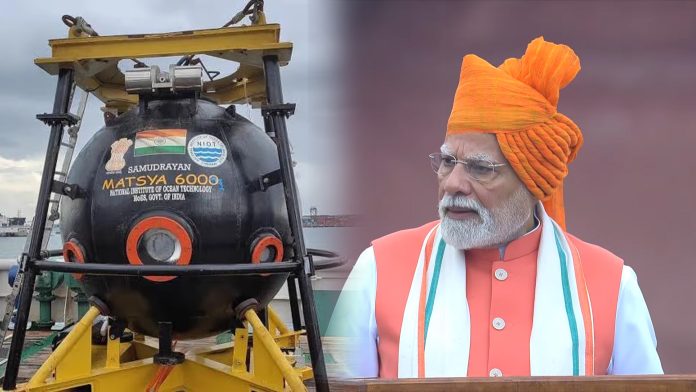
During his Independence Day speech from Red Fort today, PM Narendra Modi announced the National Deep Water Exploration Mission, aiming to explore oil and gas reserves in the deep sea. He termed it “Samudra Manthan,” saying that the initiative will be executed in Mission Mode, highlighting India’s accelerated push for energy self-reliance.
PM Modi said, “We are now also heading towards ‘Samudra Manthan’. Taking this forward, we aim to operate in Mission Mode to explore the oil and gas reserves in the sea. So, India is about to launch the National Deep Water Exploration Mission.”
He added, “advancing this endeavour, we aim to explore oil and gas reserves beneath our oceans in mission mode. It is our significant announcement to become independent on energy.”
We are now moving forward towards 'Samudra Manthan'. Bharat is going to start 'Deep Water Exploration Mission'. Advancing this endeavour, we aim to explore oil and gas reserves beneath our oceans in mission mode. It is our significant announcement to become independent on energy… pic.twitter.com/KuAIR6i77b
— PIB India (@PIB_India) August 15, 2025
The Ministry of Earth Sciences has launched the National Deep Water Exploration Mission, which includes developing a manned submersible vehicle as part of the Samudrayan Project, India’s first manned Deep Ocean Mission. The plan is to send three humans 6-km below the ocean surface in a submersible named ‘MATSYA 6000’. ‘Matsya’ is the Sanskrit word for fish.
The submersible is being developed at the National Institute of Ocean Technology in Chennai, and this will include a suite of scientific sensors for ocean exploration and observation. This will position India among a select group of six nations with the technological prowess to undertake such an ambitious endeavour. The manned submersible will allow scientific personnel to observe and understand unexplored deep sea areas by direct interventions. Further, it will enhance the capability for deep-sea man-rated vehicle development.
The manned submersible Matsya 6000 is expected to be realised by 2026. The technologies developed under the Deep Ocean Mission will expand the country’s capability for deep-sea man-rated vehicle development and pave the way for sustainable deep-sea exploration and harnessing of deep-sea living and non-living resources.
The entire initiative is based on indigenous technology, developed and manufactured entirely in India, showcasing the nation’s self-reliance in cutting-edge science. Various other underwater instruments such as Autonomous Coring System (ACS), Autonomous Underwater Vehicle (AUV), and Deep Sea Mining System (DSM) for the exploration of deep-sea have also been developed.
The mission also aims to enhance understanding of deep-sea ecosystems, contributing to sustainable fisheries and biodiversity conservation. The deep-sea exploration includes biodiversity, survey and mineral resources. Apart from the benefits of scientific research and technological empowerment, this mission has immediate spin-offs in underwater engineering innovations, asset inspection and the promotion of ocean literacy.
Under the Deep Ocean Mission, the manned submersible Matsya 6000 is being developed to house a 2.1-metre internal diameter Titanium alloy personnel sphere for safely carrying humans to a 6000 m depth. The Titanium alloy personnel sphere is being integrated in collaboration with ISRO.
The manned submersible is to be equipped with subsystems for buoyancy management enabling descent/ascent, power, and control systems, maneuvring propellers, subsea intervention manipulators, navigation and positioning devices, data and voice communication systems, on-board energy storage batteries, as well as systems for emergency support.
It also includes a sophisticated power distribution network, cutting edge control hardware and software, along with advanced underwater navigation devices. Communication systems include an acoustic modem, underwater telephone, and VHF for surface communication, supplemented by underwater acoustic positioning and GPS for precise surface location tracking.
It is designed to enable continuous operations at 6000 m depth for up to 12 hours with an emergency endurance of up to 96 hours for conducting deep water observation and exploration. Human Support and Safety System, which is a critical need for three humans, has been realized for the acclimatization and usage during routine and emergency scenarios.
The deep-sea activities, exploration of deep-sea living and non-living resources, are being undertaken in accordance with the guidelines of UN governing bodies. The development of ocean climate change advisory services relies on robust data acquisition and analysis for deriving projections of sea level change, intensity of cyclone, storm surge, and waves and their impacts on associated coastal erosion and inundation in the projected climate.


