

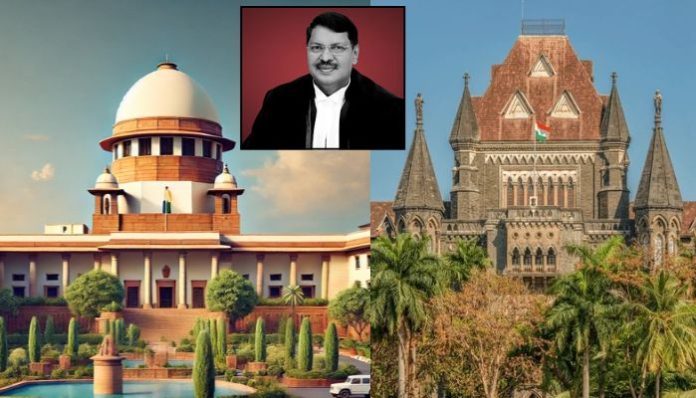
The Supreme Court Collegium has suggested 14 lawyers to be appointed as judges of the Bombay High Court on Tuesday, 26th August. One of them is Raj Damodar Wakode, who is reportedly related to Chief Justice of India (CJI) Bhushan R. Gavai.
Wakode is the son of the CJI’s cousin and is often described as his nephew. However, according to media reports, Dr. Rajendra Gavai, the CJI’s brother, said that Wakode should be seen as a “distant relative.”
Even so, his inclusion in the list has triggered fresh debate about how judges are appointed in India, the role of family connections, and the lack of reforms in the Collegium system.
Background of Raj Damodar Wakode
Raj Wakode graduated under the Maharashtra Board, obtaining distinction at Class 12 in 1996. He initially did science, even securing a gold medal for MSc in 2001, before switching to law. In 2004, he obtained an LLB degree from Amravati University.
After his law degree, Wakode began his career in the chamber of Justice Nitin Sambre, who is now a judge at the Delhi High Court. Over the next two decades, he built a diverse practice, handling civil and criminal appellate cases, writ petitions before the Bombay High Court’s Nagpur bench, and cases before district courts and statutory tribunals such as the Maharashtra Administrative Tribunal and the Revenue Tribunal.
Wakode has represented several public institutions as standing counsel, including Maharashtra National Law University (Nagpur), the Maharashtra State Electricity Distribution Company, the Union of India, the Union Public Service Commission, and the municipal corporations of Amravati and Nagpur. He has also served as the legal advisor to the National Co-Operative Consumers Federation.
Wakode has reportedly declined to comment on his name being proposed by the Collegium.
CJI Gavai recuses himself
Naturally, questions have been raised on whether CJI Gavai had any role in the recommendation of his relative. Supreme Court sources have explained that the CJI recused himself from Collegium meetings where candidates related to him were being considered. Still, Wakode’s name, along with those of two other lawyers who had previous professional links with the CJI, figured in the final list.
It is not the first time that family members of judges have reached the upper judiciary. Examples include Justice YV Chandrachud and his son, Justice DY Chandrachud, both of whom became Chief Justices of India, Justice HR Khanna and his nephew, Justice Sanjiv Khanna, and Justice ES Venkataramiah and his daughter, Justice BV Nagarathna, who is set to become India’s first woman CJI in 2027.
The bigger issue: Nepotism in Judicial appointments
Even when candidates such as Wakode are qualified and experienced, the true outrage is elsewhere: judicial appointments seem to mostly originate from a restricted set of families and networks. This creates the perception that the judiciary operates like a closed club.
The critics are of the view that the system tends to keep at bay those lawyers who do not have family connections in the profession, particularly those with less powerful and small-town backgrounds. This has drawn allegations of the higher judiciary gradually becoming a dynasty much like in politics. The lack of transparency in the manner in which names are shortlisted and recommended only fuels further criticism.
How the collegium system came into being
The present system of appointing judges is referred to as the Collegium system. Surprisingly, it was never a part of the original Constitution. Rather, it developed through three significant Supreme Court judgments, the First Judges Case (1981), Second Judges Case (1993), and Third Judges Case (1998).
Here, judges of the Supreme Court are appointed by a committee of the five senior-most judges of the Court. For the high courts, the three seniormost judges of the Supreme Court along with the senior-most judges of the relevant high court make the suggestions.
In reality, this means into sitting judges having the dominant voice in which individual to promote to the higher courts. The government has no choice other than to raise an objection or refer back a name for reconsideration. If the Collegium reaffirms its decision, the government is obligated to agree with it.
NJAC: A reform effort that has been rejected by the judiciary
The Supreme Court upheld the collegium system for judicial appointments in the case of Supreme Court Advocates-on-Record Association v. Union of India (2015), also referred to as the Fourth Judges Case. The proposed National Judicial Appointments Commission (NJAC) would have been in charge of hiring, appointing and transferring judges, attorneys and other legal staff under the Indian government as well as all of its state governments.
The commission was created by amending the Indian Constitution by the 99th Constitutional Amendment Act 2014, also known as the Constitution (Ninety-Ninth Amendment) Act 2014, which was approved by the Rajya Sabha on 14th August 2014 and the Lok Sabha on 13th August 2014.
It would have established a new mechanism for the nomination of judges in place of the collegium system, which the Supreme Court had activated through judicial fiat. The Indian Parliament passed the act in addition to the Constitution Amendment Act to govern the National Judicial Appointments Commission’s functions.
The Constitutional Amendment Bill and the NJAC Bill were approved by 16 Indian state governments before being enacted into law by Indian President Pranab Mukherjee on 31st December 2014. On 13th April 2015, the Constitutional Amendment Act and the NJAC Act went into effect.
Why the NJAC was struck down
Shortly after its inception, the NJAC was assailed in court by the Supreme Court Advocates-on-Record Association. In what became the Fourth Judges Case, a five-judge bench invalidated the NJAC in October 2015 by a 4:1 margin.
The majority ruling contended that the NJAC subverted judicial autonomy, which forms part of the Constitution’s Basic Structure. It was a significant worry that two “eminent persons,” who weren’t even required to be legally qualified, could vet the choice of the Chief Justice and senior judges. The Court referred to this situation as “outrightly obnoxious.”
The other concern was the inclusion of the Law Minister because the Union government is party to most cases in front of the courts. Judges claimed this was a conflict of interest in the most direct sense. The Court also lamented the lack of specificity in the manner in which “eminent persons” would be selected, placing too much authority in the hands of politicians.
CJI rescual is not enough, judiciary is lacking transparency in India
While CJI Gavai’s rescual may have followed procedure, it doesn’t resolve the larger trust deficit surrounding judicial appointments. The judiciary demands transparency and accountability from all other institutions but has resisted reforms in its own selection process.
Many people believe that the judiciary is the last stronghold of accountability, justice, and equity. However, this claim has always been disputed due to instances of corruption, self-preservation and a lack of transparency.
When an inquiry is commenced, it is carried out by other judges based on a framework they have set up, resulting in lingering uncertainties and a severe lack of desired impartiality and transparency. This privilege is not extended to anyone else. The judiciary requires and enforces standards of transparency and integrity from everyone except itself.
Moreover, efforts to address the problem, such as the NJAC Act or the accountability bill, never proceed to a logical conclusion which only exacerbates the issue. Several attempts to alter the collegium have been met with resistance from the judiciary, which is frequently denounced as self-empowerment but is justified as defending independence.
Due to the collegium’s opaque operations, decisions are not made public and no formal criteria are revealed and hence the collegium system has been accused of nepotism and bias, with arguments that it shields a judicial elite that is exclusive.


