

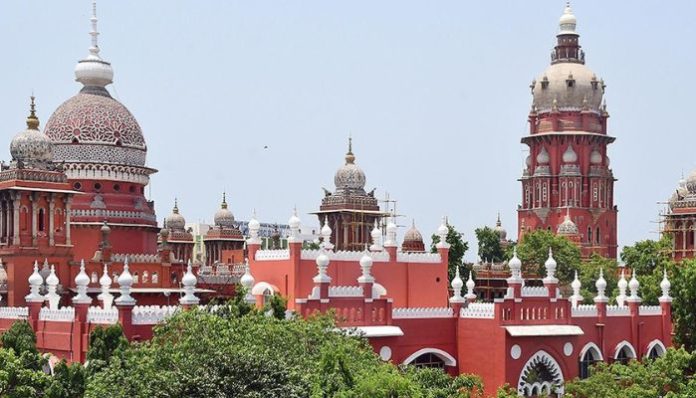
The Madras High Court has put a stop to the Tamil Nadu government’s plan to use temple money for building marriage halls. The court said this move was completely against the law because temple funds can only be spent on religious purposes, not for commercial projects.
On 19th August, a division bench of Justice SM Subramaniam and Justice G Arul Murugan repealed five government orders approving the construction of marriage halls on temple property.
These orders were issued between 2023 and 2025 and pertained to temples such as the well-known Arulmigu Dhandayuthapani Swami Devasthanam at Palani, Petitioner Rama Ravikumar had filed the case, challenging that the government was misusing temple assets.
In the Tamil Nadu State Assembly, HR&CE Minister P.K. Sekarbabu had announced that the state would construct marriage halls in 27 temples. The project was estimated to cost Rs. 80 crore, taken from surplus temple funds. The plan was that these halls would later be rented out.
But the petitioner objected strongly, saying that temple money cannot be diverted for such purposes. According to the HR&CE Act, 1959, temple resources can only be used for maintaining temples, conducting festivals, feeding the poor, or helping needy devotees. Using the money for halls meant for rent, he argued, was like running a business with funds given by devotees for religious reasons.
He also pointed out that in some cases, the halls were planned more than 100 km away from the temples that provided the money, and that the projects didn’t have the proper statutory approvals. This, he said, reduced space for devotees and violated the basic idea of how temple resources should be managed.
State government’s defence
The Tamil Nadu government, however, defended its move. The Additional Advocate General told the court that marriage is a religious activity in Hinduism, and so the construction of halls from temple funds should be considered a religious purpose. He also argued that these halls would help Hindus conduct weddings at a lower cost, and said that loans taken from temple funds would be repaid according to rules.
High court’s judgement
The High Court was not convinced. The judges said that while marriage may be a sacred bond, it cannot automatically be called a “religious purpose” under the HR&CE Act. They also pointed out that there was no element of charity in the project since the halls were meant to be rented out for a fee.
The court stressed that temple funds are not government property. Devotees give money, jewellery, and land to temples with the belief that it will be used for maintaining the shrine and performing rituals. Using this money for government-driven projects, the judges said, was a clear misuse.
The bench also reminded that the utilisation of Surplus Funds Rules, 1960, had been ignored. These rules require a transparent process, including public objections and strict limits on how much money can be diverted.
Declaring the government’s actions “illegal and unconstitutional,” the court cancelled all five orders. It also said that any loss or misuse of temple money should be recovered from the officials responsible.
The court cited previous decisions, such as a 2025 Supreme Court ruling prohibiting the use of temple funds for shopping complexes, to clarify that such a commercial venture cannot be justified as “religious purposes.”


