

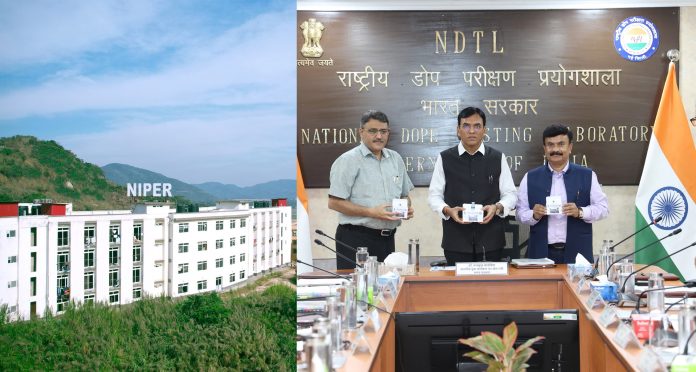
In a significant step towards strengthening anti-doping efforts in sports, the National Institute of Pharmaceutical Education and Research (NIPER) Guwahati, under the Department of Pharmaceuticals, in collaboration with the National Dope Testing Laboratory (NDTL), New Delhi, has successfully developed a rare and high-purity Reference Material (RM) – Methandienone Long-Term Metabolite (LTM).
The Reference Material was formally launched today by Dr. Mansukh Mandaviya, Union Minister for Youth Affairs & Sports and Minister of Labour & Employment, during the 22nd Governing Body Meeting of NDTL, in New Delhi. The event was attended by senior officials from the Ministry of Youth Affairs and Sports, Department of Pharmaceuticals, and representatives from NIPER Guwahati and NDTL.
Reference Materials (RMs) are the most highly purified and scientifically characterized forms of drug substances or their metabolites, essential for accurate analytical testing. In the context of anti-doping, they are crucial for the detection of over 450 substances that are currently prohibited by the World Anti-Doping Agency (WADA).
MADE IN BHARAT, FOR THE WORLD ??
— Dr Mansukh Mandaviya (@mansukhmandviya) September 4, 2025
Under the dynamic leadership of PM Shri @narendramodi ji, India is rapidly emerging as a global hub for sports science and innovation.
Proud to share that NDTL has developed a new reference material “methandienone long-term metabolite” to boost… pic.twitter.com/7X0gZl9nzp
Due to their specialized application in dope testing, these RMs are produced by only a few manufacturers globally, approximately 4–5, making them scarce and often expensive. The National Dope Testing Laboratory (NDTL) and NIPER-Guwahati are collaborating to produce 22 such Reference Materials, which are not commercially available worldwide for Anti-Doping analysis.
Since 2020, 12 RM out of 22 has been synthesized by NIPER Guwahati and delivered to NDTL with Methandienone LTM being the latest one. As of now, Methandienone LTM is not commercially available globally. At present scenario, the best targets to track doping misuse in sports are those eliminated in urine over extended times. These are usually referred to as long-term metabolites (LTMs).
These metabolites help in identifying athletes who have used Methandienone, even if they ceased usage months or years prior to testing. This leads to an increase in the number of positive tests, reflecting improved detection capabilities and serving as a deterrent for athletes considering the use of anabolic steroids like Methandienone.
The use of this new reference material “Methandienone LTM” will help in enforcing transparency and integrity in sports by protecting clean athletes and acting as deterrents for use of prohibited substances. This reference material may be shared with all 30 WADA accredited laboratories worldwide as India’s contribution to the world anti-doping community.


