

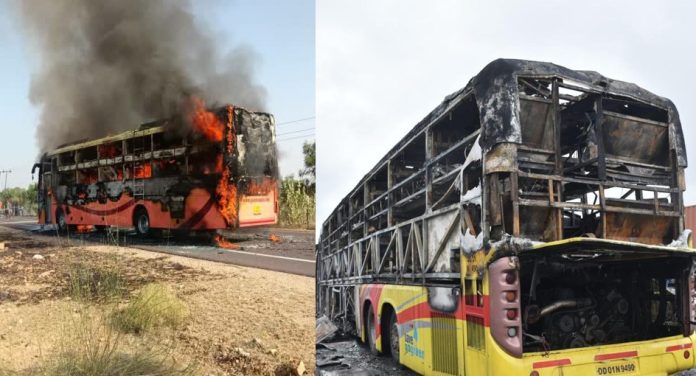
In the early hours of October 23, 2025, a horrifying accident took place on National Highway 44 near Kurnool in Andhra Pradesh. A private sleeper bus traveling from Hyderabad to Bengaluru collided with a motorcycle, sparking a massive fire that claimed at least 25 lives. Charred bodies were pulled from the wreckage, and survivors described a frantic scramble for escape as flames engulfed the vehicle in minutes.
Just nine days earlier, on October 14, another similar tragedy struck near Jaisalmer in Rajasthan. A bus travelling from Jaisalmer to Jodhpur burst into flames, killing 22 passengers, many of whom were trapped inside due to a jammed emergency door. Both these incidents took place in just one month, and several such accidents of large number of causalities in bus fires have taken place in recent times.
While buses, like any other vehicles, do meet with accidents, it has been observed that casualty numbers are unusually high in case of night service luxury and sleeper buses, compared to day service buses. Common wisdom says that when fire starts in a bus, it will be immediately spotted, the vehicle will be stopped and the passengers will come out quickly. In fact, that is what happens with buses that run in the day, even though daytime buses carry more passengers as they often take standing passengers, but things get complicated with night service buses.
One of the obvious reason is the time, during the day, most people in a bus are awake, and therefore they are able to spot fire as soon as it starts, enabling fast evacuation. In contrast, as most passengers remain asleep in night service buses, it is often too late when the fire is spotted, resulting in higher number of deaths and injuries. However, that is not the only reason. There are some very important differences between luxury sleeper buses and the basis buses that run for shorter distances during the day, and these factors contribute to such higher casualties.
Fewer Escape Routes, Tight Spaces
The interiors of basic day-service buses often feel open and more spacious, while the sleeper and luxury buses feel like cramped in the inside, even though they are actually often taller and longer. In a standard day bus, there are two main doors for passengers, one at the front and one at the rear, apart from emergency exit doors. Standard non-luxury buses also have sliding windows, which can be easily opened, and can be used to evacuate in case of fire or other accidents. These buses are built for short daytime trips, therefore they have basic seats, making it simpler to stand and move.
But on the other hand, sleeper and luxury buses are designed for comfort, as they are made for longer overnight journeys. One big compromise in these buses is the lack of the back passenger door. These buses have just one passenger door at the front. They includea or two emergency exits in the back, but they are not easily accessible. In the Jaisalmer fire, that single emergency door was jammed, trapping dozens inside.
These buses also have fixed, sealed windows, meant to keep out dust and noise, and offer better climate control. However, in case of accidents, they become walls of glass. The glass needs to be broken in case of an emergency, but without something hard to hit them with, it is nearly impossible to break them with bare hands.
The openable windows in basic also play a vital role in letting the fume and smoke go out, allowing people to survive long enough to escape. In contrast, the closed nature of luxury buses traps smoke and fume, and people pass out quickly due to lack of oxygen, and then are engulfed in flames.
Another design difference is width of aisles. Luxury buses have wider recliner seats and bed bunks, leaving a narrow walkway. That space is wider in basic buses, as they feature standard seats. In case of a fire, this narrow aisle, and the lack of a backdoor, means there is a long queue to reach the front quickly. In a closed cabin filled with fume and smoke, people can’t survive long enough to cover that distance. The problem gets even more complicated for sleeper buses, as people in upper bunks need to come down evacuate, and they often can’t do it in time.
Luxury and sleeper buses are also darker inside compared to general buses, due to curtains and tinted windows, presence of sleeper bunks, and bigger seats. This makes evacuation a bigger challenge for the passengers.
Inaccessible emergency exits
Luxury buses comprise one or two emergency exits, and such exits on the right side become vital if the main door on the left side gets blocked or jammed. But these emergency exit doors are often located behind seats, and are hard to reach even in normal circumstances. Moreover, such emergency doors are often hidden behind curtains, and are not properly marked, making them difficult to locate.
As the emergency exits are not regularly opened, they often get jammed, and become difficult or impossible to open when it is needed. Unlike airlines, bus operators don’t have protocols requiring regular test to confirm that everything is working perfectly. Therefore, they find about a jammed emergency exit only in case of an emergency.
For most buses, the rear windshield is meant to be broken in case of an emergency. But the buses don’t carry hammer or such tools to break the glass. In most cases, it is the outsiders who are able to break the glass using rocks or bricks, as passengers often don’t have such hard objects.
Flammable Interiors: Curtains, Fabrics, and Fast-Spreading Fires
Luxury doesn’t always mean safer; it often means more fuel for the flames. Luxury and Sleeper buses are decked out with thick curtains to block light for sleeping, plush upholstery on seats, and thick foam mattresses on bunks for a “hotel-on-wheels” feel. These materials are often highly flammable and release toxic smoke when they burn, filling the cabin in seconds.
A spark in a sleeper bus can turn those cozy touches into a roaring blaze. Worse, the smoke isn’t just thick, it’s poisonous too. Burning plastics and foams produce cyanide-like gases that cause disorientation and unconsciousness. In day buses, open windows might vent some of it out, but sealed sleeper cabins trap it all inside.
In contrast, basic day buses stick to simpler vinyl seats and metal frames with fewer flammable soft furnishings, which means less fuel for a bad fire.
Customized Builds: Hidden Risks from Aftermarket Tweaks
There is another big difference, most basic buses today are fully built by the company in factories. They can be operated just after driving out of the dealerships, just like cars. They follow strict designs with tested wiring, fuel lines, and fire safety features baked in from the start.
On the other hand, most luxury and sleeper buses that operate in India are not factory built. They are actually custom-made coaches built on chassis bought from automobile dealerships. Bus operators purchase the basic chassis and then take it to a ‘body building workshops’ where the coach is built, including everything from the body to seats and bunks, and all other amenities.
This means drilling holes for AC units, adding bunk frames, and rerouting wires without proper checks. Faulty electrical work is a top fire starter, like short circuits from overloaded inverters, loose connections under seats, or sparks from modified exhausts. These modification to the chassis can weaken the structure too. A custom door might not seal right, or added weight could make the bus unstable, tilting it during a collision and blocking exits. Buses fully built in factories avoid this by sticking to proven blueprints.
Even though now automobile companies like Tata Motors, Ashok Leyland, Volvo, Bharat Benz etc offer fully built luxury buses, many operators still prefer the custom-built route.
Notably, till a couple of decades ago, all buses in India were such coaches made by local garages on chassis bought from companies. At that time, companies like Tata and Ashok Leyland didn’t offer fully built buses or trucks, they only sold chassis. In fact, for many decades they didn’t even make dedicated bus chassis, all of them were same truck chassis. Bus operators needed to purchase such truck chassis and get a bus coach or a truck bed built on them. This is the reason why bus journeys were not comfortable in the past, their suspension was not made for carrying people.
After opening up of the automobile sector and entry of foreign companies, automobile companies started to offer factory-built buses and trucks. Now companies like Tata Motors, Ashok Leyland, Volvo, Bharat Benz etc offer fully built luxury buses too, apart from bare chassis for buses and trucks. But despite this availability, many operators still prefer the custom-built route.
Such bus building work is done in workshops located in almost every part of the country. As this is an unorganised sector with no strict quality control, safety and quality of such custom-built buses remains a question, even though they look more luxurious and swankier. They feature additional lights and other electrical systems, putting more load on the electrical lines.
Such customised buses are also relatively taller, to fit double-decker bunks and more luggage space. If a bus tilts suddenly, reaching emergency exits or windows becomes difficult for passengers.
Countries like China banned double-decker sleepers years ago for these risks, but India still allows them with minimal checks.
These issues related to luxury sleeper buses point to one thing, there is requirement for drastic changes to their design and regulation. Instead of checking just the documents, the authorities need to check whether the buses comply with safety norms.
Regular safety audits for such buses, ensuring use of fire-proof materials by law, and heavy penalty on unauthorised modifications are required, bans on overcrowding. Rules must mandate easily breakable windows and better emergency exits, wider aisles, and mandatory installation of fire detection and fighting systems.


