

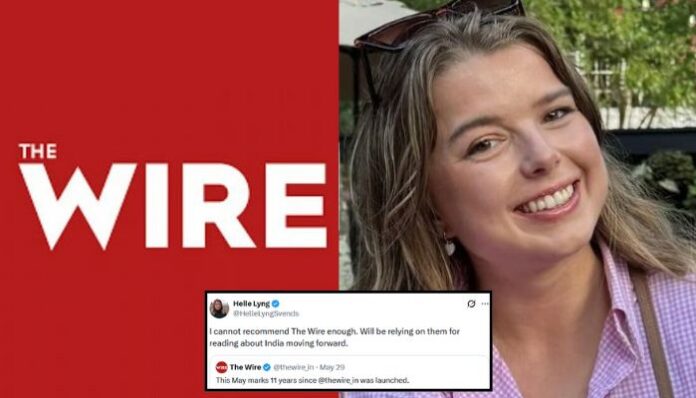
Fresh controversy has erupted online after pro-China propagandist and Norwegian journalist Helle Lyng publicly endorsed far-left propaganda portal The Wire, a platform notorious for spreading misinformation and pushing politically motivated narratives against India. The endorsement has once again triggered discussion on how India’s left-liberal media ecosystem uses foreign commentators and publications to amplify propaganda targeting India’s democratic institutions and leadership.
The latest controversy began after The Wire posted on X on Friday, 29th May, to celebrate 11 years of its existence, despite being marred with fake news and disinformation like the Tek Fog and Meta controversies. Sharing the post, Norwegian journalist Helle Lyng wrote, “I cannot recommend The Wire enough. Will be relying on them for reading about India moving forward.”
I cannot recommend The Wire enough. Will be relying on them for reading about India moving forward. https://t.co/oW39OpDY3e
— Helle Lyng (@HelleLyngSvends) May 29, 2026
The post quickly attracted attention because Lyng herself had become a controversial figure earlier this month after she attempted to publicly heckle PM Modi during his visit to Norway.
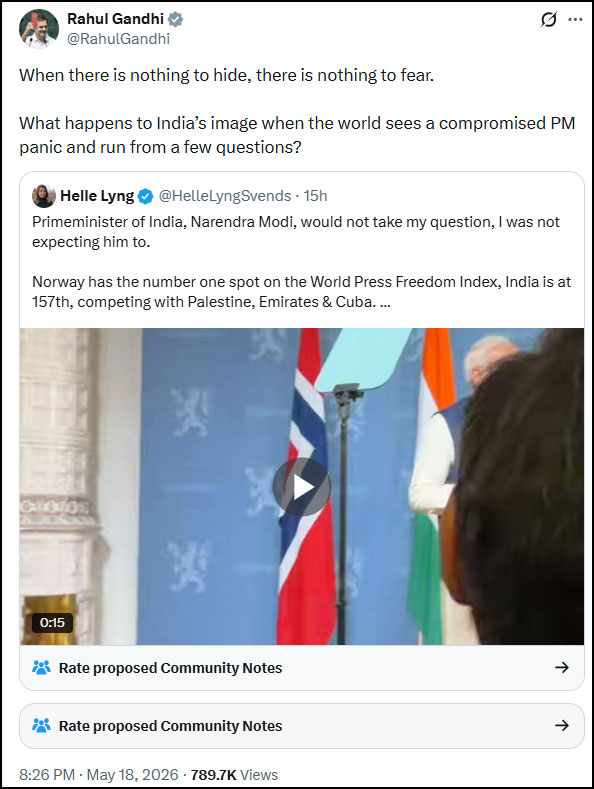
Primeminister of India, Narendra Modi, would not take my question, I was not expecting him to.
— Helle Lyng (@HelleLyngSvends) May 18, 2026
Norway has the number one spot on the World Press Freedom Index, India is at 157th, competing with Palestine, Emirates & Cuba.
It is our job to question the powers we cooperate… pic.twitter.com/vZHYZnAvev
Who is Helle Lyng, and why did she suddenly become famous?
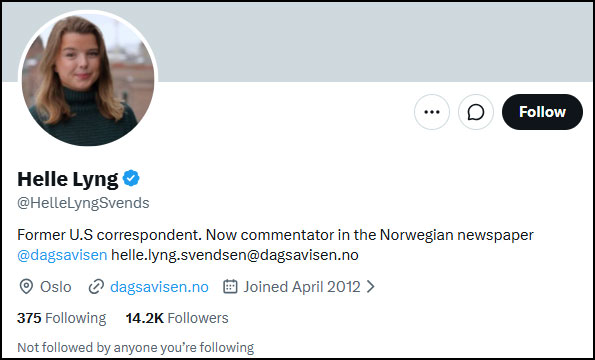
Helle Lyng, who works with Norwegian publication Dagsavisen, was largely unknown outside a limited social media circle until 18th May, when she tried to confront PM Modi during a joint India-Norway statement event.
At the time, Lyng had barely 800 followers on X, and her account had remained inactive for months. However, after she shouted questions at PM Modi regarding alleged “human rights violations” in India, clips of the incident rapidly went viral across Indian opposition circles and left-liberal social media networks.
As PM Modi walked away after the joint statement without taking questions, Lyng shouted, “Prime Minister Modi, why don’t you take some questions from the freest press of the world?” She later proudly posted online that she had not expected him to answer.
Soon after, several opposition leaders and anti-Modi commentators amplified her videos. Congress leader Rahul Gandhi shared the clip and wrote, “When there is nothing to hide, there is nothing to fear.”
TMC MP Mahua Moitra and propagandist Rana Ayyub also praised Lyng’s actions. Rana Ayyub posted, “Indian democracy on display as Prime Minister Modi visits Norway.”
Indian democracy on display as Prime Minister Modi visits Norway pic.twitter.com/QCYkP6gnj8
— Rana Ayyub (@RanaAyyub) May 18, 2026
The Indian Embassy in Norway later pointed out that the event was never meant to be an open press conference. It was a joint statement by the Prime Ministers of India and Norway, while a separate media briefing by Ministry of External Affairs officials had already been scheduled later in the evening.
Lyng comes out of the woodwork to express her sudden interest in India
Interestingly, Lyng’s own publication had rarely focused deeply on India earlier. Most of its coverage on India revolved around routine global developments such as tariffs, trade or earthquakes. Yet suddenly, during PM Modi’s visit, the publication aggressively pushed stories questioning India’s democracy and political system.
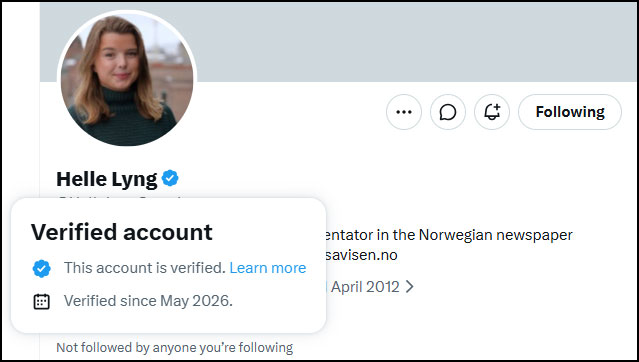
Critics also pointed to Lyng’s social media activity, noting that she had recently purchased X Premium verification in May 2026, just before the controversy exploded online. It clearly proved that the viral campaign around her was not organic and carefully amplified for political messaging. She had barely posted about India on her social media accounts before suddenly developing an intense interest in the country’s politics and democracy, fuelling speculation about who or what might be driving her newfound activism on Indian affairs.
MEA officials firmly responded to Lyng’s allegations
The Indian Embassy in Norway later invited Lyng to attend the official media briefing organised by the Ministry of External Affairs. During the interaction, Lyng again attempted to corner Indian officials with loaded questions regarding democracy and human rights.
However, MEA Secretary Sibi George firmly responded and repeatedly reminded her not to interrupt while he was answering.
“You asked me a question, let me answer it,” George said.
When Lyng continued interrupting, he added, “Please don’t interrupt me. This is my press conference.”
George defended India’s democratic credentials by pointing to India’s constitutional framework, massive voter participation and the country’s global contributions during the Covid pandemic and G20 presidency.
“We are proud that we are a civilisational country of 5,000 years old,” he said.
He also criticised those who form opinions about India through selective reporting and “ignorant NGOs.”
“People read one or two news reports published by some godforsaken, ignorant NGOs and then come and ask questions. Don’t worry about it. We are proud to be a democracy,” George remarked.
By the time George completed his detailed response, reports suggested that Lyng had already left the room.
The Wire’s long history of peddling fake news and narrative building
Lyng’s endorsement of The Wire has also revived criticism of the publication’s own journalistic track record. Over the years, The Wire has repeatedly faced accusations of publishing misleading reports, half-verified claims and politically charged narratives targeting the Indian government and Hindu organisations.
The platform often prioritises narrative-building over factual reporting, especially in sensitive communal or political issues. The publication has previously faced legal notices, defamation cases and public rebuttals over several controversial reports.
One of its most high-profile controversies involved a report targeting Jay Shah, son of Home Minister Amit Shah. The report led to a ₹100 crore defamation case against The Wire.
In another major editorial failure, the platform published an investigative piece alleging significant financial misconduct by Union Minister Piyush Goyal regarding his investments with the Piramal Group, claiming he kept the PMO completely in the dark. The Piramal Group immediately issued an official statement calling the report ” completely “baseless” and “devoid of merit.” Independent media watchdogs later dismantled the financial premises of the report, exposing significant structural irregularities in the writing. The portal targeted Goyal again in a piece written by Rohini Singh regarding a defaulting company named Shirdi Industries, but basic fact-checks revealed that the corporate loans in question were taken years before Goyal ever assumed public office.
The Central Board of Excise and Customs (CBEC) had also publicly criticised The Wire in the past over what it described as “factually and legally incorrect” reporting regarding the Adani Group.
The platform has also repeatedly faced criticism for the conduct and reporting style of some of its associated journalists and commentators.
The publication also has a predictable routine of prioritising narrative-building over objective reporting, especially when it involves heinous crimes committed by members of the Muslim community. For years, the organisation has consistently worked to whitewash such incidents, often flipping the script to portray the perpetrators as victims and the actual victims as the aggressors.
This pattern is not new; from downplaying the 2002 Godhra carnage and the 2020 anti-Hindu Delhi Riots to the brutal murder of Kanhaiyalal in Udaipur, The Wire has a track record of framing reactionary Hindu outrage as a greater threat than the Islamist attacks that caused the outrage in the first place.
Questions over coordination and global narrative-building
The latest endorsement by Helle Lyng has once again raised broader questions about how certain international propagandists, so called journalists and sections of leftist Indian media like The Wire and Newslaundry, frequently amplify anti-India narratives together.
During the Norway controversy, Lyng’s content was rapidly promoted by opposition politicians, left-liberal influencers and media figures who are often critical of PM Modi and the BJP government.
Questions were also raised over the visible coordination between some Indian journalists and Lyng during the Norway visit. While Lyng shared videos involving the Hindu journalist Suhasini Haider, Haider also amplified Lyng’s clips online.
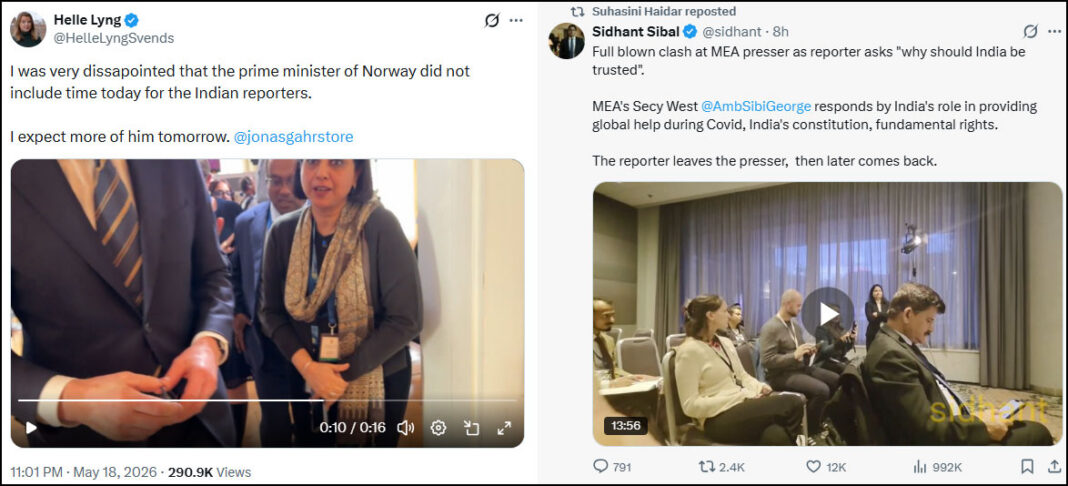
Such incidents show how global anti-India ecosystems increasingly rely on selected Indian media platforms to reinforce narratives portraying India as authoritarian or anti-democratic.
Outlets like The Wire and some similar digital platforms frequently become reference points for foreign commentators who wish to target India at the Global stage.
The controversy surrounding Lyng’s endorsement has therefore gone beyond a simple social media post. It reflects a larger ecosystem where foreign commentators, opposition politicians, activist journalists and ideological media platforms work together to create global narratives against India’s image and institutions.


