


On 5th November, Rahul Gandhi claimed that “vote chori” or theft of votes happened in seats where Congress led in postal ballots but lost in the final results. His claims were based on a simple fact that on some seats, Congress was ahead of the Bharatiya Janata Party (BJP) in the postal ballot counting, but when counting for the voting that happened via Electronic Voting Machine (EVM) occurred, BJP defeated Congress. If his claims were true, this phenomenon must have been repeated on all seats. However, the truth is far from what Rahul Gandhi claimed.
OpIndia examined the final results of all the assembly seats for the Haryana state elections 2024 and found that there were four seats where BJP took the lead in postal ballots but lost the final tally.
According to the data available on the Election Commission’s website, in Julana, Hathin, Nangal Chaudhry and Adampur, BJP was ahead of Congress in postal ballots. However, the party eventually lost the final count to Congress.
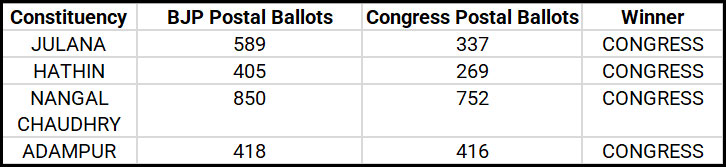
While considering the claims of Rahul Gandhi, choosing only those examples where Congress led in postal ballots and ignoring where it trailed, as Rahul Gandhi did, reflects Postal ballots are not a reliable base for final result analysis.
Postal ballots are not a reliable base for final result analysis
Now, as Rahul Gandhi’s claims have fallen flat, it is essential to understand why postal ballots cannot be used as the base for analysing the final results. During the press conference, he claimed, “The other thing that was surprising was that for the first time in Haryana, the postal votes were different from the result. In postal ballots, Congress got 73 seats while the BJP got 17 seats.”
First of all, in most assembly constituencies, the number of postal ballots is negligible compared to the total votes polled. The number is even less than 1% in the majority of cases. Hence, they have little statistical impact on the overall results unless there is a minuscule difference between the winner and the first runner-up.
For example, in the Guhla seat, the total number of postal ballots was 589, while the total number of EVM votes was 1,33,287, which makes postal ballots only 0.44% of the EVM votes. Congress’s Devender Hans won the seat by a margin of 22,880 votes, defeating BJP’s Kulwant Ram Bazigar. Suggesting that postal ballots could have played a significant role in such seats would be absurd.
Secondly, postal ballots are cast mainly by service voters, government staff on election duty, and members of the armed forces. These officials belong to a demographic that does not represent the general electorate’s sentiments.
Thirdly, Postal ballots are counted first, but they do not reflect the ground-level voter turnout patterns or late surges in booths where local factors heavily influence the results.
The flawed narrative of ‘vote chori’
By overlooking such counterexamples and the nature of postal ballots, Rahul Gandhi’s “vote chori” narrative appears politically motivated rather than fact-based. The same data points he cites can easily be used to demonstrate the opposite, making his argument statistically hollow.


