

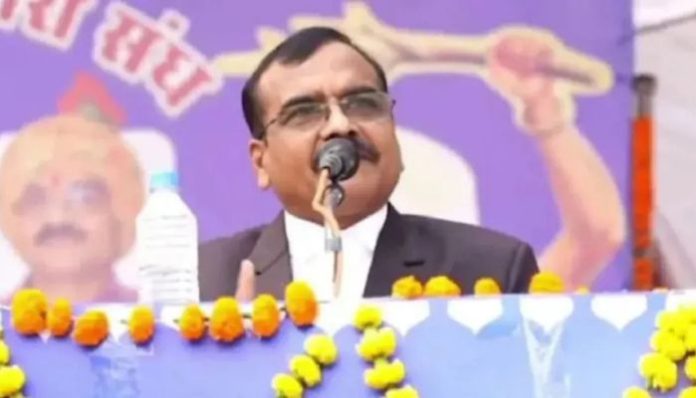
Bhopal witnessed a major controversy on Sunday, 23rd November, after senior IAS officer Santosh Verma, who was recently elected as the state president of Anusuchit Jati Evam Janjati Adhikari Evam Karmachari Sangh (AJAKS), made an extremely objectionable and casteist remark during a public event. The comment, made at the Ambedkar Maidan in the state capital, quickly snowballed into a statewide outrage, raising questions on his intentions, the organisation’s image, and the growing caste tensions in the political environment.
Verma said that reservation in India should continue until a Brahmin gives his daughter to his son in marriage or forms a relationship with him. A video of this statement went viral within hours, and the reaction was immediate, intense, and in many cases, deeply worrying.
Speaking on whether reservation should be granted on economic basis he said, “until a Brahmin donates his daughter to my son or has a relationship with him, reservations should continue.”
Many people have called the remark casteist, misogynistic, and deliberately provocative. Others believe it is part of a dangerous narrative that fuels division rather than strengthening social harmony. At a time when reservation is already a sensitive issue, this kind of statement has raised alarms across communities.
This report looks at what exactly happened, how different groups reacted, and why Santosh Verma’s past is also being discussed again after this latest controversy.
Where the controversial statement was made
The incident took place during the provincial convention of AJAKS, held at Ambedkar Maidan in Tulsi Nagar. The organisation represents SC-ST employees and officers working in various government departments, and its events usually discuss issues like reservation, promotions, workplace harassment, and representation.
During his speech, Verma started talking about economic reservation and social discrimination. But within minutes, his tone changed, and he made the remark that has now caused a political storm.
In the viral video, Verma is seen saying that reservation should continue until upper-caste families, especially Brahmins, accept SC communities as equals in social relationships. The way he framed it, “until a Brahmin donates his daughter to my son or forms a relationship”, has been widely condemned.
? IAS Santosh Verma: “Reservations should stay until a Brahmin gives his daughter to my son.”
— Megh Updates ?™ (@MeghUpdates) November 25, 2025
? How can someone in public service speak with such a backward, caste-obsessed mindset…? pic.twitter.com/bnwNVwO3Pw
The reference to “donating a daughter” struck many as insensitive, patriarchal, and totally out of place in modern society. Several women’s groups have questioned the mindset behind such a statement, saying it treats women as objects rather than individuals with agency.
People are also asking whether reservation, a constitutional tool meant for social justice, should ever be discussed in terms of personal relationships or caste revenge.
Anger from Brahmin organisations and demand for action
The president of the Akhil Bharatiya Brahmin Samaj, Pushpendra Mishra, called the comment “highly condemnable” and demanded immediate action from Chief Minister Dr Mohan Yadav.
Mishra said that Verma’s remarks insulted the entire Brahmin community and that legal action should be taken against him under relevant sections. If the government failed to act, he warned of a state-wide agitation.
Similarly, Dr Shailendra Vyas, head of the Brahmin Sabha Madhya Pradesh, said the remark reflected a “cheap and divisive mindset.” He said that someone holding a high administrative post should behave responsibly, not make statements that can create tensions.
He added that if the government didn’t take action, the community would be forced to take matters into its own hands. His response itself showed how quickly caste anger can escalate when provocative comments are made from public platforms.
Sharp criticism from other employee groups too
It wasn’t just Brahmin organisations that opposed Verma’s remark. Employee associations from different castes and communities also condemned it.
The president of the Ministry Employees Association, engineer Sudhir Nayak, said Verma’s words insulted the entire upper-caste community and went against the spirit of equality. He emphasised that marriage is a personal choice and that daughters are not objects that can be “donated” or exchanged.
He reminded the audience that Indian society has already changed a lot. He cited examples such as Dr B.R. Ambedkar’s marriage to Savita Ambedkar, who came from a Brahmin family, and former Union Minister Ram Vilas Paswan’s marriage to Reena Sharma. These examples, he said, show that change should be natural, not forced through provocative statements.
Another association, the Class III Employees Union, also criticised Verma. Their general secretary, Umashankar Tiwari, said that statements like these create unnecessary tension among colleagues who already come from diverse castes and religions and work together every day. He asked why a platform meant for government employees was used for divisive rhetoric.
Many employee groups expressed concern that such comments destroy the atmosphere of cooperation inside government offices. When a senior leader makes such remarks, it becomes difficult for subordinates to trust each other.
Santosh Verma’s controversial past
As the controversy grew, many people started revisiting Santosh Verma’s past. This isn’t the first time he has been accused of misconduct.
In 2021, Verma was arrested in Indore on charges of criminal intimidation, harassment of a woman, and even producing fake court documents to secure a promotion from the state cadre to the IAS cadre.
According to a report by The Times of India, Verma created two fake court orders, one a settlement order and another an acquittal order. These documents carried the date of 6th October, 2020, but the judge was actually on leave that day, raising suspicions.
A departmental inquiry confirmed that only one genuine order existed, while Verma had submitted two. When the woman involved in the case complained to the Chief Secretary, the investigation deepened, and Verma was eventually arrested after 12 hours of questioning.
He had then claimed that the woman herself provided him the documents, but this argument collapsed during the inquiry.
Apart from the forgery case, Verma’s personal conduct has also been discussed before. Several reports claim that he has had multiple affairs, even while being married, and that complaints related to inappropriate relationships have been filed against him in the past as well. His reputation, many say, has always been controversial.
This history is now being linked with his latest statement, with critics saying that someone with such a record should not be leading an organisation representing thousands of employees.
When the leader is questioned, what happens to the organisation?
Verma’s new role as the state president of AJAKS has brought additional scrutiny. AJAKS is an influential organisation representing SC-ST employees across Madhya Pradesh. People expect its leaders to speak responsibly, especially on sensitive issues like reservation and social justice.
But Verma’s comment has placed the organisation in an uncomfortable position. Many fear that AJAKS could get branded as a divisive organisation even though past presidents have never made such statements.
This is why several employees believe the matter is not just about one individual, it affects the credibility of the entire organisation. When the person leading a major association uses caste-loaded language, it spreads negativity among thousands of employees, especially at a time when caste relations are already tense in many parts of the country.
When ‘social justice’ turns daughters into bargaining chips
Santosh Verma’s remark about “Brahmin daughters” mirrors a deeply problematic pattern seen in modern social activism, where women are reduced to symbols and bargaining tools to push larger ideological agendas. Much like how certain narratives project interfaith harmony by placing Hindu women at the centre of grand social experiments, Verma’s statement treats daughters not as individuals with agency but as instruments to “prove” social equality. This kind of rhetoric wrongly shifts the burden of social reform onto women’s bodies and personal lives.
What makes the remark particularly dangerous is that it echoes a long-standing tendency to romanticise social cohesion while ignoring uncomfortable ground realities. Just as glossy narratives promote idealised versions of inter-community relationships without acknowledging real-world conflicts and vulnerabilities faced by women, Verma’s statement trivialises the lived complexity of caste relations. It converts a constitutional tool like reservation into a crude, humiliating social test centred around marriage and family honour.
At its core, Verma’s statement reflects the same flawed mindset that views women as pawns in ideological battles, whether for caste “equality,” religious “harmony,” or political symbolism. Equality cannot be built on the symbolic “sacrifice” of daughters, nor can social justice be achieved through provocative, dehumanising language. When public officials speak like this, they don’t empower marginalised communities; they deepen mistrust, harden identities, and push society further away from genuine, voluntary social change.
A statement that threatens social harmony
India is a diverse country where castes, religions, and communities live together, study together, and work together. Reservation was introduced for social justice, not for revenge or caste retaliation.
But Verma’s statement links reservation to personal relationships and caste pride, which is not just offensive but also dangerous. It sends a message that empowerment should come at the cost of social tension, which was never the intention behind reservation.
If leaders continue making such inflammatory remarks, the consequences will be felt everywhere, offices, schools, families, and even politics. The gap between communities could widen, and trust could break down.
In workplaces, upper-caste employees might start feeling targeted or suspicious. Lower-caste employees might feel emboldened by provocative rhetoric rather than constructive dialogue. And ordinary citizens will find themselves caught in the middle of unnecessary caste disputes.
When Verma’s history, fake documents, criminal intimidation, complaints from women, is viewed along with this latest statement, many see a clear pattern. His latest comment isn’t an isolated mistake. It fits into a long timeline of questionable decisions and controversial behaviour. A person who breaks the law builds his identity by dividing society. Previous AJAKS presidents have never made such statements, which shows that Verma’s thinking is personal, but its impact is collective.


