

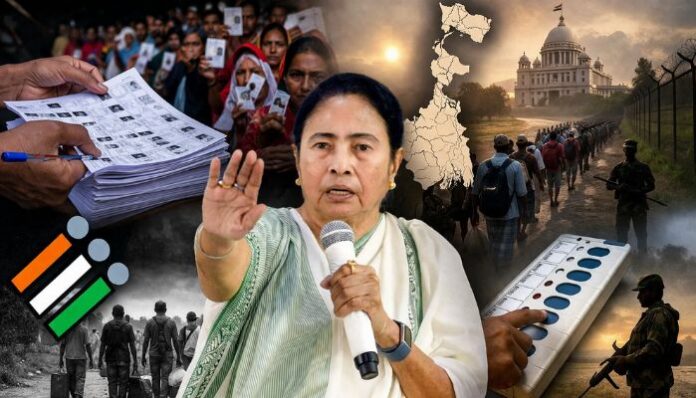
A major political debate has broken out in West Bengal after a large-scale revision of electoral rolls led to the deletion of nearly 90 lakh voter names. According to the latest data shared by the Election Commission of India (ECI) on Tuesday, 7th April, a total of 27,16,393 voters were found ineligible during the final stage of scrutiny.
A district-wise list of eligible and ineligible voters stated that of the 60.06 lakh voters marked under adjudication, 27,16,393 voters were found ineligiblehttps://t.co/p6J27fzE0n pic.twitter.com/aP8TcvbCi0
— The Telegraph (@ttindia) April 7, 2026
Initially, the EC deleted 58.25 lakh voters who were found to be deceased, absent, shifted, or had duplicate entries in the draft rolls published last December. This alone brought the total voter base down from 7.66 crore to 7.04 crore. Following this, an additional 5 lakh names were removed from the final rolls on 28th February. This takes the overall number of deletions to just under 91 lakh.
STORY | Nearly 91 lakh names deleted from Bengal electoral rolls after judicial scrutiny under SIR
— Press Trust of India (@PTI_News) April 7, 2026
Nearly 91 lakh voters' names have been deleted from the electoral rolls in West Bengal following the completion of the SIR exercise in the state, according to the Election… pic.twitter.com/kN5haeBhEs
Out of 60.06 lakh voters who were initially placed under adjudication, nearly half were found ineligible. The highest number of deletions happened in Murshidabad, a district with a high Muslim population, where over 4.55 lakh voters were found ineligible out of 11 lakh marked for adjudication. The number is obvious as the district shares a border with Bangladesh, so the highest number of illegal immigrants.
On the other side, Jhargram saw the lowest impact with only 1,240 deletions. In Kolkata, the numbers were also significant: 39,164 names were struck off in Kolkata North, and 28,468 in Kolkata South, the very district where Chief Minister Mamata Banerjee is contesting a high-profile battle against Suvendu Adhikari.
The political blame game and “targeting” narratives
As soon as these numbers hit the public domain, the Trinamool Congress (TMC) government and various media organisations immediately began spinning a narrative that the Election Commission was specifically targeting Muslim voters. Chief Minister Mamata Banerjee didn’t hold back, accusing the EC and the BJP-led central government of “targeted deletions.”
During a rally in Nadia, she charged that the authorities were deliberately excluding Matuas, Rajbanshis, and minority community members to dilute their voter base. She even questioned why this “discrimination” was happening, suggesting it was a calculated move to hurt the TMC’s prospects.
This narrative was quickly amplified by certain media organisations, too. Headlines across the country began focusing exclusively on the “lakhs of Muslim voters” being removed, framing the entire administrative exercise as an Islamophobic project.
For instance, The Siasat Daily, an Urdu newspaper from Hyderabad, published a report on Tuesday, 7th April with a striking headline: “95 pc of deleted voters are Muslims in West Bengal’s Nandigram SIR.”
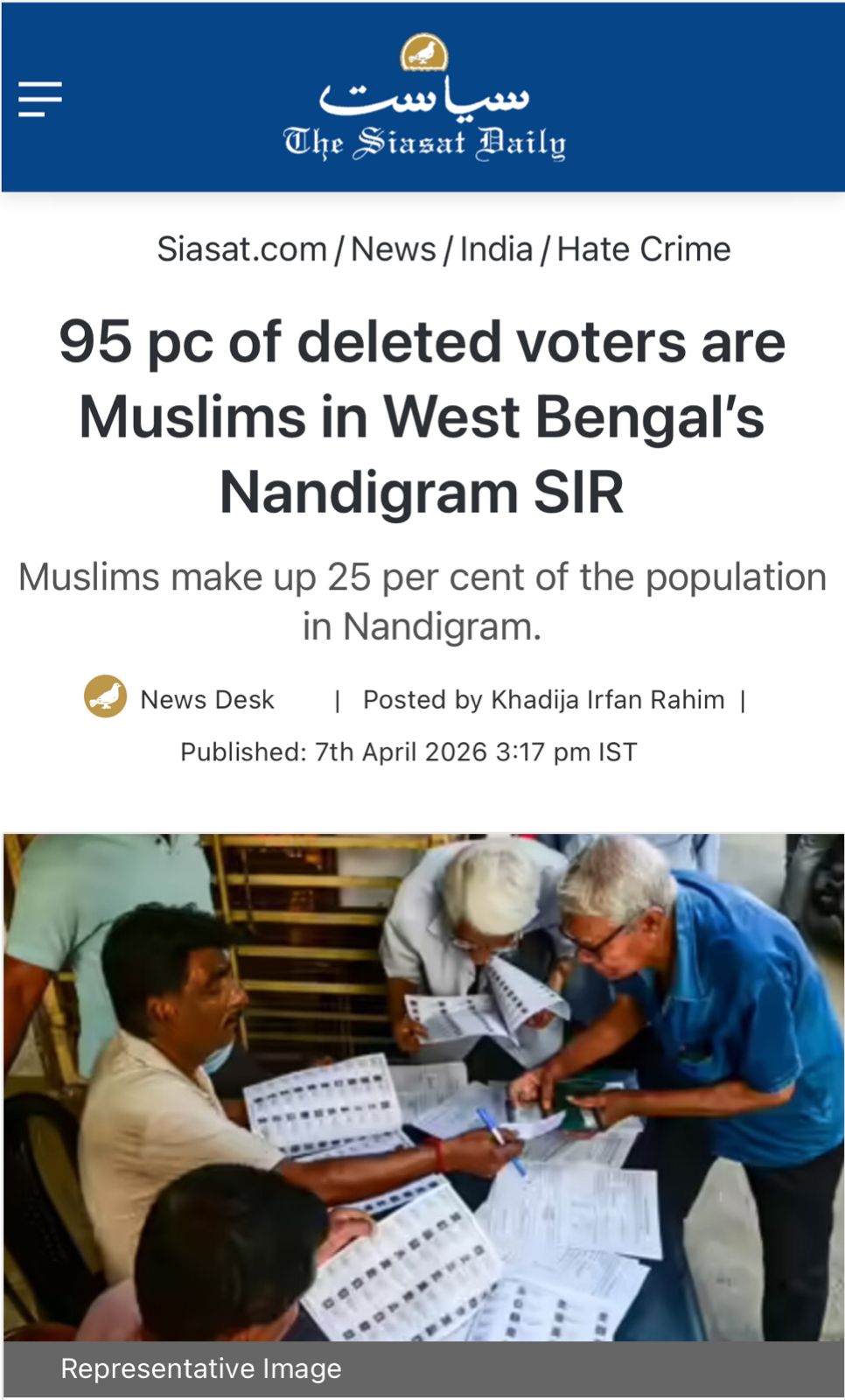
The report, citing data from a Kolkata-based research body called the Sabar Institute, claimed that in seven supplementary lists for Nandigram, Muslims accounted for 95.5% of the deletions. It pointed out that while Muslims make up only 25% of Nandigram’s population, they bore the brunt of the removals, whereas the 75% non-Muslim population saw only a 4.5% removal rate. These reports were designed to prove a “clear pattern” of targeting.
Other outlets like The Scroll followed suit, using the same Sabar Institute data to suggest that the SIR process was fundamentally biased against the minority community.

Thousands of Hindu voters also removed
However, a closer look at the data shows that the “Muslim-only” narrative is far from the full truth. In reality, thousands of Hindu names, specifically from the Matua-Namasudra community, have also been struck off the rolls, leading to a massive crisis for the BJP in its own strongholds. In the Bongaon Lok Sabha constituency, represented by BJP Union Minister Shantanu Thakur, voter deletion rates are among the highest in the state.
Across five assembly segments in the Matua belt, about 1.38 lakh names have been deleted. In one specific instance at Chandpara Gram Panchayat, a supplementary list deleted 183 out of 186 names, most of whom were Matuas.
The Sabar Institute’s own analysis noted that the Matua belt had an “unmapped rate” of 7.8%, which is nearly double the state average. This suggests that these voters failed to establish a direct documentary linkage with the 2002 electoral rolls during the scrutiny process.
Even in BJP-won seats like Bagda, Bangaon Uttar, and Gaighata, tens of thousands of voters were removed. Local BJP leaders are now struggling to answer their supporters, who are asking why their names are gone if the party is in power at the Center.
Many of these voters reportedly failed to establish proper linkage with older electoral rolls, especially the 2002 records. In some areas, deletion rates have gone as high as 7–15%, which is much higher than the state average.
Bigger issue: illegal immigration and fake voters
At the core of this entire exercise is the issue of illegal immigration and fake voter entries. India, with Bangladesh, forms a 4095 K.M long border line, West Bengal shares 2216 km, which is more than 54%, and the people of both geographical regions are linguistically and ethnically similar. So, as an Indian state, West Bengal is highly affected by Bangladeshi infiltrators. Over the years, concerns have been raised about illegal immigrants obtaining forged documents and getting enrolled as voters.
There are ten districts of West Bengal which share a border with Bangladesh, namely North 24 Paraganas, Nadia, Murshidabad, Malda, North Dinajpur, South Dinajpur, Darjilling, Koochbihar and Jalpaiguri. People on both sides of the border are often linguistically and ethnically similar, making cross-border movement historically difficult to track.
This has made West Bengal one of the most affected states when it comes to illegal infiltration from Bangladesh. Over the years, many such individuals living in these districts are believed to have managed to obtain local identity documents and get their names added to voter lists.
It is not a secret that West Bengal is among the states with the highest numbers of illegal Bangladeshi immigrants. In the last three years, over 2600 Bangladeshi nationals were apprehended and sent back to Bangladesh.
It is a simple matter of logic: if an exercise is designed to weed out people living in India illegally with fake papers, and the worst infiltration is happening in Bengal, then obviously a large number of deleted names will be those of illegal immigrants from Bangladesh.
This isn’t a “conspiracy” against a religion; it’s an administrative crackdown on a long-standing problem.
The fear factor: Illegal immigrants fleeing the border
The most telling evidence that the SIR is working isn’t found in a spreadsheet, but at the border. Ever since the ECI announced the house-to-house enumeration for the second phase of the Special Intensive Revision (SIR) in November last year, a sense of panic has gripped illegal settlements. Viral videos on social media have shown groups of people carrying bags and luggage, heading back toward the Bangladesh border at checkposts like Hakimpur (Basirhat).
Reports from DD News and social media clips show individuals who had been living in India illegally for 5, 7, or even 10 years suddenly deciding to leave. Some of them openly admitted on camera that they had no documents and were staying here illegally. One man revealed he lived in Birati, near the Kolkata airport, but had no papers and was fleeing because he feared the stricter verification process. Others were working as taxi drivers or in brick kilns, having blended into the local population with the help of forged IDs.
#NewsPunch | Following the SIR announcement, many illegal immigrants who have been living for years in West Bengal and other states are rushing to the border to return to Bangladesh.
— DD News (@DDNewslive) November 18, 2025
Watch the full show: https://t.co/JmRTIV5xil @AnchorKritika #SIR #Bangladesh #Kolkata pic.twitter.com/ULyAbqEz7l
In one such video, people openly admitted that they had been living in India without documents. When asked, one woman said, “No,” when questioned about having any papers, and confirmed she had been working in India despite being undocumented. Another man admitted, “Yes,” when asked if he was staying illegally.
Reverse exodus👇🏼 https://t.co/PvWQu0CnhX
— Abhijit Majumder (@abhijitmajumder) November 17, 2025
Many of them were reportedly working in sectors like construction, transport, and small businesses, blending into local communities over the years.
This sudden exodus proves that the fear of being caught during a door-to-door verification is real. For years, political patronage and the “secular” shield allowed these illegal residents to stay and vote. But with the EC taking a firm stand and demanding documentary proof linked back to 2002, the game is up for many.
In conclusion, while the media focuses on “targeted deletions” and political parties use the SIR to play victim, the reality is much more straightforward. The electoral rolls in West Bengal were heavily inflated by illegal immigrants and fake entries.
The current deletion of 91 lakh names is a necessary, albeit painful, surgery to ensure that only legitimate Indian citizens decide the future of the state. Whether it’s a Muslim in Murshidabad or a Matua in Bongaon, if you can’t prove your residency, your name doesn’t belong on the list. It’s about the law, not the label.


