

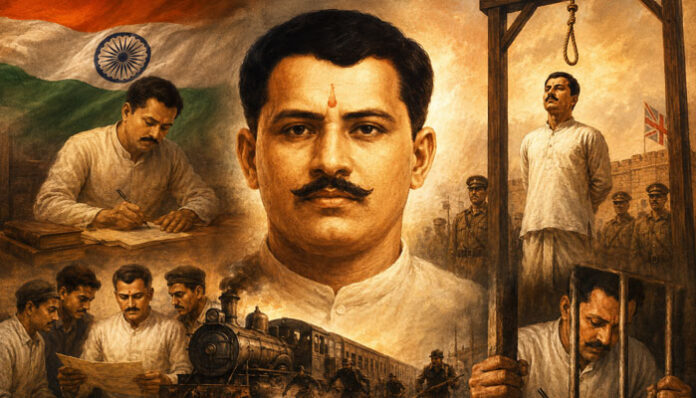
December 19, 1927. Gorakhpur Central Jail. A young man of just 30 walks calmly toward the hangman’s noose. No trembling, no tears. There was no sign of fear. No plea for mercy. As Ram Prasad walked towards the gallows, he remained committed to the cause he had dedicated his entire life to. For years, he had opposed British rule, inspired young revolutionaries, written patriotic poems, and risked everything for India’s freedom. Even in the final moments, he showed no fear.
It is said that before his execution, he spent his time praying , reciting patriotic verses, and chanting slogans in praise of Bharat Mata. The British believed that by hanging him, they would end his influence forever. There is a famous quote of John F. Kennedy: “A man may die, nations may rise and fall, but an idea lives on. Ideas have endurance without death.” Ram Prasad’s ideas turned him into a symbol of courage and sacrifice for generations to come. On that day, the British could take his life, but they could not destroy the spirit of freedom that he represented.
Nearly a century later, Ram Prasad Bismil continues to inspire Indians with his bravery, patriotism, and unwavering commitment to the nation. His life reminds us that India’s freedom came at a great cost, paid for by young men who were willing to sacrifice everything for their motherland. This article is a tribute to his legacy and to inspire all Indians to draw from his journey.
A Son of Shahjahanpur, A Descendant of Chambal
Ram Prasad was born on 11th June, 1897, in Shahjahanpur, in present-day Uttar Pradesh. But the story of the revolutionary who would one day challenge the British Empire began much earlier, in the rugged lands of Chambal. His family belonged to the Tomar Rajput community and traced its roots to Barbai village in the Morena region of present-day Madhya Pradesh. His grandfather, Narayan Lal, later migrated to Shahjahanpur, where the family settled and built a new life.
Life was not simple for the family. Like many ordinary Indians, there were economic struggles and difficulties in making ends meet. Growing up in such circumstances, young Ram Prasad witnessed both the challenges faced by common people and the deep sense of self-respect that his family carried despite those difficulties. Though he was born far from Chambal, the legacy of that remained a part of his identity.
Chambal is a land of paradoxes. Long known for producing fiercely independent people who do not bow before authority. The region’s culture was deeply rooted in tales of bravery, resistance, and honour. Pandit ‘s own life later reflected these values when he chose the path of revolution against British rule.
The boy from Shahjahanpur inherited more than a family name. He inherited a spirit of courage and defiance that would later make him one of the most celebrated revolutionaries of India’s freedom struggle.
Arya Samaj and the Making of a Revolutionary
The turning point in Ram Prasad Tomar’s life was his introduction to the Arya Samaj movement, founded by Swami Dayanand Saraswati. The movement encouraged Indians to value their culture, oppose social evils, and improve society. Seeking purpose, Ram Prasad embraced these principles. He avidly read religious and nationalist literature, especially Swami Dayanand’s Satyarth Prakash, which shaped his worldview.
Arya Samaj’s teachings taught him that India was a nation with a rich heritage, deserving freedom and respect. He believed every Indian had a duty to the nation, and that social reform and national awakening were essential for progress. The movement gave him self-respect and courage, qualities that defined his revolutionary path.
As his nationalist feelings grew stronger, Pandit became increasingly dissatisfied with British rule. He saw how Indians were denied freedom in their own land and how colonial policies kept the country politically and economically dependent. Gradually, he reached the conclusion that foreign rule was not only unjust but also harmful to India’s future. The ideas he absorbed through Arya Samaj laid the ideological foundation of his life and transformed him from an ordinary young man into a revolutionary determined to fight for India’s independence.
The Poet Called ‘Bismil’
Before he became one of India’s most feared revolutionaries in the eyes of the British, Ram Prasad Bismil was a gifted poet and writer. He adopted the pen name “Bismil”, an Urdu word meaning “wounded” or “sacrificed”. The name reflected the pain he felt while witnessing his country under foreign rule and his willingness to sacrifice everything for its freedom.
Bismil believed that words could inspire people just as powerfully as weapons. Through his poems, essays, and pamphlets, he sought to awaken patriotic feelings among Indians, especially the youth. His writings spoke of courage, sacrifice, self-respect, and the duty to liberate the motherland. When the British tightly controlled political activity, revolutionary literature became an important tool for spreading nationalist ideas and motivating people to join the freedom struggle.
Among the poems associated with Bismil, none became more famous than Sarfaroshi Ki Tamanna. The stirring lines, “Sarfaroshi ki tamanna ab hamare dil mein hai, dekhna hai zor kitna bazu-e-qatil mein hai”, captured the spirit of an entire generation that was ready to face imprisonment or even death for the nation. Such verses were not merely poetry; they were calls to action. Young revolutionaries recited them at secret meetings, protests, and gatherings, drawing strength from their message.
For Bismil, poetry was more than an art form. It was a weapon against colonial rule. His words ignited patriotic passion in countless Indians and helped transform the struggle for independence into a mass movement driven by courage and sacrifice.
From Dreamer to Organiser
Ram Prasad Bismil was not just a poet who wrote about revolution, but he worked tirelessly to build it. While his patriotic poems inspired people, he understood that India’s freedom would require more than words. It needed organisation, planning, and dedicated individuals willing to sacrifice everything for the nation.
With this goal in mind, Bismil helped establish Matrivedi, a revolutionary organisation that brought together young nationalists who were dissatisfied with British rule. He travelled extensively, meeting like-minded individuals and recruiting them into the movement. Through personal contacts and secret meetings, he built a network of committed revolutionaries across northern India.
He also used pamphlets and underground literature to spread nationalist ideas. He wrote and distributed revolutionary material that called upon Indians to rise against colonial rule. At a time when the British closely monitored political activity, these pamphlets became a powerful means of reaching people and spreading the message of freedom.
Over the years, Bismil emerged as one of the most effective organisers of the revolutionary movement. He connected activists from different regions, coordinated activities, and helped create a structure that could challenge British authority. His leadership laid the foundation for a larger and more organised revolutionary network, proving that he was far more than a poet; he was a strategist, recruiter, and nation-builder who turned revolutionary ideas into action.
Building the Hindustan Republican Association
By the early 1920s, Ram Prasad Bismil felt that isolated revolutionary activities alone would not be enough to challenge the British Empire. There was a need for a disciplined organisation with a clear vision of India’s future. In order to achieve this he joined hands with revolutionaries like Sachindra Nath Sanyal, Jogesh Chandra Chatterjee and others to form Hindustan Republican Association (HRA) in 1924.
The organisation had an ambitious aim: Not only the removal of British rule, but the establishment of an independent Indian republic based on political freedom and equal rights for its citizens. The HRA sought to unite revolutionaries from different regions and backgrounds under the common national cause and to build a coordinated movement against colonial rule.
Too many young revolutionaries of that time, armed resistance was the only option as the peaceful protests and constitutional methods had not been able to win freedom from British rule. The memory of incidents like the Jallianwala Bagh massacre and the repeated suppression of nationalist movements convinced many that the colonial government would not voluntarily relinquish power. Groups like HRA thought that organised revolutionary action was needed to confront the British state.
Under Bismil’s leadership, HRA quickly grew into one of the most important revolutionary organisations in northern India. It attracted committed young patriots prepared to risk jail, exile or even death for the cause of independence.
Kakori: The Robbery That Shook the Empire
On the 9 th August, 1925, Pandit Ram Prasad and a group of revolutionaries carried out one of the most daring operations in the Indian freedom struggle. It was done near the town of Kakori, close to Lucknow. They stopped a train carrying government funds and seized the treasury that was being transported on behalf of the British administration. The goal was not personal gain, but revolutionaries needed funds to expand their movement and challenge the colonial period. Months of planning had gone into the operation. Every detail was carefully considered, and the execution was swift and precise. For the revolutionaries, Kakori was a message to the British Empire that India’s freedom movement was organised, determined, and willing to take bold action.
The incident sent shockwaves across the country. While many Indians admired the courage of the revolutionaries, the British government was furious. A massive manhunt was launched. Dozens of suspects were arrested, and one of the largest political trials of the colonial era began. The Kakori Conspiracy Case soon became a symbol of both revolutionary courage and British repression.
Prison, Poetry and Defiance
The British believed that Bismil’s spirit would be crushed by imprisonment. Instead, it showed the strength of his character. After his arrest, Bismil was tried for a long time and sentenced to death. He knew that he was to be executed, but he was perfectly calm. He never regretted fighting for India’s freedom, nor would he ever abandon his beliefs. He continued to write while he was in prison. He wrote poems, meditated on his life and wrote his famous autobiography, giving future generations a rare glimpse into the mind of a revolutionary. He also wrote letters to his compatriots calling on them to remain united and committed to the cause of national independence.
The Final Morning
The morning of 19th December 1927 marked the final chapter of Ram Prasad Bismil’s life. Inside Gorakhpur Jail, he met his family one last time. Though the moment was emotional, he remained composed. Instead of mourning his fate, he encouraged his loved ones to remain strong and take pride in the cause for which he was sacrificing his life. As the time for execution drew near, Pandit Ram Prasad Tomar prayed, recited patriotic verses, and prepared himself with complete calmness. Witnesses recalled that he walked towards the gallows without fear, as if he had already accepted his destiny. A few moments later, the trapdoor opened.
The British had succeeded in executing one man. But they could not extinguish the spirit that he had awakened in countless others. At just thirty years of age, Ram Prasad Bismil became one of the most revered martyrs of India’s freedom struggle.
The Legacy of Ram Prasad Bismil
The death of Ram Prasad Bismil did not end the revolutionary movement he helped build. In many ways, it strengthened it. Across India, Young revolutionaries drew inspiration from his courage and sacrifice. Bhagat Singh admired the Kakori revolutionaries and carried forward the spirit of resistance that Bismil had helped cultivate. Chandrashekhar Azad continued the struggle and played a key role in reorganising the revolutionary movement after the Kakori case. Bismil’s poems, writings, and autobiography survived long after his execution. His words continued to inspire generations of Indians, reminding them that freedom required courage, discipline, and sacrifice. The Kakori Conspiracy remains one of the defining episodes of India’s freedom struggle, and at its centre stands the figure of Ram Prasad Bismil as a poet, organiser, revolutionary, and martyr.
129 Years Later: Why India Still Remembers Him
On 11 June 2026, India marks the 129th birth anniversary of Ram Prasad Bismil. Nearly a century has passed since his execution, yet his story continues to inspire Indians. He left behind no wealth, no political office, and no dynasty. What he left behind was far more valuable: courage in the face of adversity, unwavering patriotism, powerful poetry, and a willingness to sacrifice everything for the nation. His life reminds us that India’s independence was not handed over peacefully. It was won through the struggles and sacrifices of countless young men and women who placed the nation above their own lives. Ram Prasad Bismil was one of them. A son of Shahjahanpur, a revolutionary of Kakori, and a martyr whose legacy continues to live in the heart of a free India.


