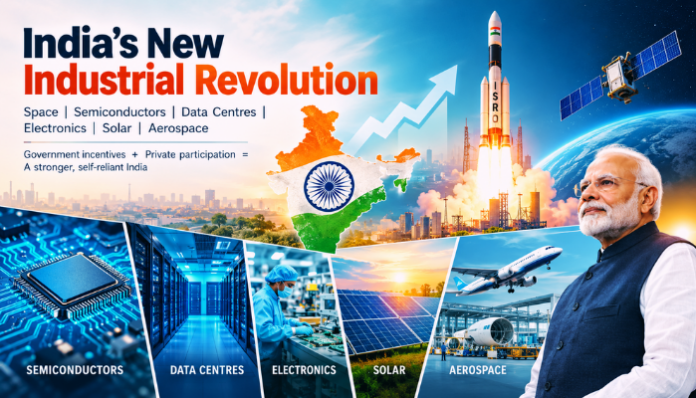
In its report titled India’s New Industrial Revolution, global investment bank Jefferies said that space, semiconductors, data centres, electronics, solar manufacturing and aerospace sectors could drive the next phase of India’s industrial growth in the coming years. This “revolution” is expected to be led by a combination of an established manufacturing base, a massive domestic market and a rising global demand for an alternative supply chain that will create opportunities in India across emerging industries.
The Jefferies report published on 8th September stated that this opportunity is being backed by the Modi government’s incentives and policy measures, particularly the schemes for semiconductors, solar manufacturing, electronics, and the opening up of the Space sector for private companies.
“Large domestic opportunity is driving private participation in emergent industries in India across Space, Semi & Electronics, Datacenters and Solar. Support from the govt. is also visible here with action such as opening up space to pvt. sector, long tax holiday for DCs, large incentive schemes for Semi, Electronics & Solar, localisation requirements, GPU purchases etc,” the report reads.
Opening the space sector to private players is a game-changer
The Jefferies report highlighted the Modi government’s decision to open up India’s Space sector for private companies in 2020. It highlighted that since the space sector was opened for private participation, “Startups are advancing from early innovation to commercial execution with companies such as Skyroot (orbital launch in July), Pixxel (high-res observation satellites), Agnikul (3D-printed rocket engine) & Digantara (surveillance satellites).”
Notably, the Modi government’s push to bring private companies into the space sector began explicitly in 2020 as part of the broader economic reforms announced during the Covid-19 pandemic.
In May 2020, the fourth tranche of the Atmanirbhar Bharat package was announced by Finance Minister Nirmala Sitharaman. The minister said that the government wanted private companies to become partners in India’s space journey.
The Central government had announced that private companies would be allowed to use ISRO facilities and other relevant assets to improve their capabilities. The government’s intent was never to fully privatise ISRO but to make better use of India’s existing space infrastructure and allow startups and private companies to develop their own capabilities under ISRO’s guidance.
For private participation, IN-SPACe was created as a regulatory and facilitation mechanism, while NewSpace India Limited (NSIL) has a commercial role in taking ISRO-developed technologies and systems to industry.
Later in 2023, the Indian Space Policy allowed private companies a wider role across the space value chain, including the development and operation of space systems.
India’s semiconductor ambitions are moving from policy intent to execution
The Jefferies report highlighted India’s pivot in recent years, from policy to execution in the semiconductor sector. It noted India’s creating an ecosystem and has pumped around $20 billion in investment, has a chip fab under construction and has multiple OSAT projects starting production. A further ~$13 billion incentive plan is also set to boost the ecosystem. Jefferies opines that India is building the foundations of a “credible” semiconductor ecosystem.
“Creating an ecosystem. India’s semiconductor aspirations are moving from policy intent to execution with ~$20bn of investments, including a chip fab under construction and several OSAT projects starting production. A new ~$13bn incentive plan should further expand the ecosystem and boost value addition, including chip design. While supply chain depth, talent, and global competition remain challenges, we believe India is building the foundations of a credible semiconductor ecosystem,” the report reads.
In recent years, the Modi government has, through its policy interventions, attempted to make India self-reliant in the semiconductor sector. India is rapidly expanding and bolstering its semiconductor chip design ecosystem. The Modi government launched the India Semiconductor Mission
In 2021, with Rs 76,000 crore in incentives. The Mission approved at least 10 projects worth Rs 1.6 lakh crore across six states. The initiative is aimed at attracting global manufacturers, building fabs, packaging units and a local supply chain to reduce reliance on imports.
In May 2025, the Union Cabinet approved India’s sixth semiconductor manufacturing unit in Jewar in western Uttar Pradesh, for establishment through a joint venture between the HCL Group and Taiwanese electronics giant Foxconn.
To support indigenous startups, the Modi government launched the Design Linked Incentive (DLI) Scheme in 2022 to ensure venture capital investment in this sector by curbing upfront risk through financial support, access to advanced EDA tools, IP cores, etc. and greater ecosystem awareness of semiconductor chip design.
In November 2024, the Centre approved C2i Semiconductors for financial support and access to advanced chip design tools under the DLI Scheme.
In the Union Budget 2026-27, the Modi government announced the India Semiconductor Mission 2.0 with Rs 1,000 crore allocated to bolster domestic semiconductor capabilities. In its new phase, the Mission will focus on the production of semiconductor equipment and materials in India. Designing full-stack Indian semiconductor intellectual property and fortifying both domestic and global supply chains will remain in focus.
“5x capacity in 5 years”: India’s data centre space is becoming a strategic digital infrastructure segment
The Jefferies report noted that the colocation capacity of India’s data centre has increased fivefold in five years. This growth is driven by cloud adoption, digitisation and data localisation requirements.
“We expect capacity to grow another 5x to ~10GW over the next five years, supported by favorable cost economics, policy support and rising hyperscaler demand. We calculate this expansion represents a US$9bn revenue opportunity for data center operators and a US$45bn investment opportunity across power, cooling, construction and network infrastructure,” the report states.
Pertinently, the Modi government is aggressively building data infrastructure to boost AI and cloud growth. In the Union Budget 2026-27, the Centre announced a long-term tax holiday framework designed to attract foreign investment while preserving India’s domestic tax base.
In consequence of India’s policy shift, there has been a significant surge in foreign investment in this sector. In December 2025, Microsoft CEO Satya Nadella announced a US$17.5 billion investment to expand India’s AI infrastructure, develop advanced skills, and strengthen sovereign technological capabilities. In October 2025, Google announced its plans to develop India’s largest AI data centre campus in Andhra Pradesh with an investment of $15 billion over five years. Around $95 billion in investments were pledged between 2019 and 2025 alone.
From assembly to domestic value addition: India’s electronics ecosystem entering the next phase of growth
Jefferies described the electronics sector as a key driver of India’s next phase of growth. It noted that India is focusing on domestic value addition and component manufacturing. The global investment banking company highlighted that Central government initiatives like the Electronics Component Manufacturing Scheme (ECMS) and Mobile Phone Manufacturing Scheme (MPMS) aim to deepen backward integration and reduce import dependence.
The Jefferies report forecasted that the ECMS will cover 50% of mobile component value versus 20% now.
“From assembly to value addition. India’s electronics ecosystem is entering the next phase of growth with a greater focus on domestic value addition and component manufacturing. Electronics exports have grown sharply, while schemes such as ECMS (components scheme) and MPMS (Mobile 2.0) aim to deepen backward integration and reduce import dependence. We forecast ECMS to cover ~50% of Mobile component value (BOM) over the next 6-Y vs <20% now. PCB (both HDI + Multi-layer) is a focus area for Components, with $5bn TAM, 85-90% imports,” it stated.
The Electronics Component Manufacturing Scheme (ECMS) was launched by the Modi government in July 2026 to deepen the domestic supply chain ecosystem and develop a robust electronics component ecosystem in the country. The scheme is designed to attract investments across key components such as Printed Circuit Boards (PCBs), passive components, electro-mechanical components, sub-assemblies, camera modules, optical transceivers, and capital goods required for electronics manufacturing.
As per the Central government, the approved investment under ECMS has increased to ₹69,548 crore, up from the ₹59,350 crore investment originally envisaged under the scheme.
Meanwhile, the Mobile Phone Manufacturing Scheme (MPMS), with a budgetary outlay of Rs 62,500 crore, aims to scale up production, deepen domestic value addition, strengthen supply chain resilience, and enhance global competitiveness.
90% of the solar manufacturing value chain to be localised by 2030
The Jefferies report stated that India is now the world’s second-largest solar PV manufacturer, having 35 GW of cell capacity operational and another 100 GW under construction. Jefferies expects 90% of the value chain to be localised by 2030.
“India is the 2nd largest solar PV manufacturer. India has emerged as the world’s second-largest solar PV manufacturer, with ~35GW of solar cell capacity already operational and another ~100GW under construction. Policy measures such as ALMM (Approved list of Models and Manufacturers, a regulatory quality register), domestic content requirements and PLI (Production-linked incentives) are accelerating backward integration across cells, wafers and ingots. We expect ~90% of the solar manufacturing value chain to be localised by 2030,” it stated.
Notably, by the end of March 2026, India had crossed 150 GW of solar capacity. OpIndia reported earlier that in just 11–12 years, India’s solar capacity has grown nearly 50 times. Nearly 10% of India’s total electricity now comes from solar energy sources.
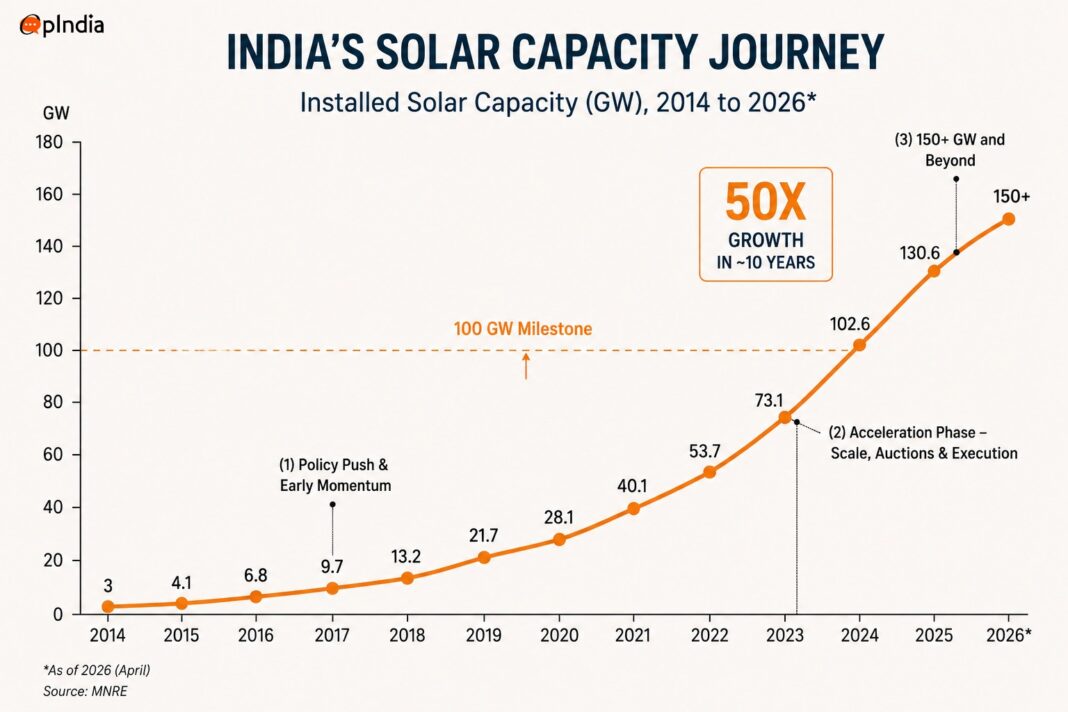
The remarkable growth was achieved by the Modi government in three phases. During the first phase, from 2014 to 2018, the Central government set aggressive targets, pushed the National Solar Mission and introduced larger solar parks.
In the second phase (2018 to 2022), solar became cheap, with tariffs coming down from around 7-8 rupees per unit to under 2 rupees. Result? Solar energy became not only clean but cheap energy, attracting private sector investment and driving the rise of massive solar parks in Rajasthan, Gujarat, and Karnataka.
In the third phase, from 2022 to 2026, manufacturing push, Rooftop solar expansion, and better grid readiness were brought together. Solar moved beyond big projects—now homes, farmers, and industries are all part of the system. With this, India added a record 44+ GW of renewable energy in just one year (FY26), the highest ever.
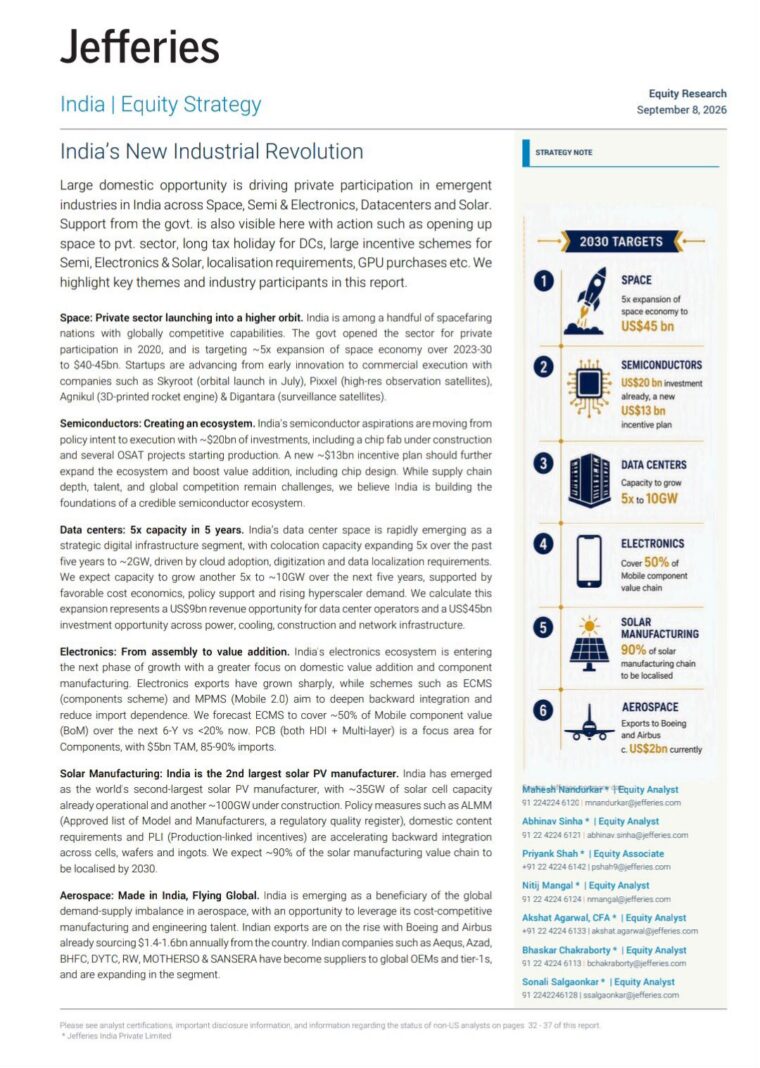
Aerospace: Made in India, Flying Global
The Jefferies report described India as a “beneficiary” of the global demand-supply imbalance in aerospace. It said that India has an opportunity to leverage its cost-competitive manufacturing and engineering talent.
“Indian exports are on the rise with Boeing and Airbus already sourcing $1.4-1.6bn annually from the country. Indian companies such as Aequs, Azad, BHFC, DYTC, RW, MOTHERSO & SANSERA have become suppliers to global OEMs and tier-1s, and are expanding in the segment,” the report states.
Overall, the Jefferies analysis suggests that India is not just adding more factories, but building new industrial ecosystems in sectors that cater not only to the domestic economy but also to global markets.