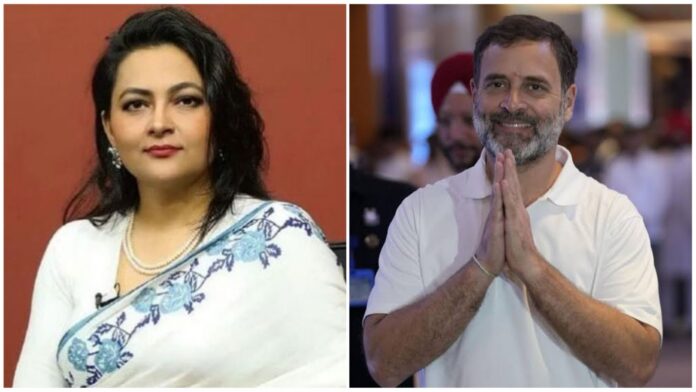
“What’s the problem with Rahul Gandhi? Apni hi Sarkar ke khilaaf bol rahe hain,” Sherwani wrote, before bringing up the Centre’s response to the July 20 protests in Delhi. She argued that PM Modi had remained silent for over 50 days before allegedly asking Union Education Minister Dharmendra Pradhan to resign and complained that neither Modi, his Home Minister nor the Delhi police commissioner had apologised to students over the July 20 crackdown.
What’s the problem with Rahul Gandhi ? Apni hi Sarkar ke khilaaf bol rahe hain.
— Arfa Khanum Sherwani (@khanumarfa) August 10, 2026
Modi kept quiet for over 50 days before he asked Pradhan to resign.
Neither him, his Home Minister nor his police commissioner ever apologized to the students for July 20 brutality. https://t.co/A6bgIH4Ke2
For the unversed, July 20 witnessed a violent confrontation in Delhi, with Delhi Police personnel bearing the brunt of the unrest. So-called student protesters resorted to stone-pelting during their march towards Parliament, injuring several police personnel and breaching barricades, leading to widespread chaos and mayhem. Yet, Ms Sherwani compares it with peaceful protests in Jharkhand because the false equivalence offers her a convenient way to deflect from the uncomfortable reality that the two situations were fundamentally different: one involved violence and stone-pelting against police personnel, while the other involved students protesting against issues concerning examinations and recruitment.
By placing them in the same bracket, she appears less interested in whether the use of force was justified and more interested in who is politically responsible for it.
On the face of it, demanding accountability from governments for excessive use of force against students sounds perfectly reasonable. The problem is what Sherwani’s argument reveals when applied to the Jharkhand episode.
Rahul Gandhi had condemned the use of force against students protesting over irregularities in recruitment examinations in Jharkhand. The protests in Ranchi have been going on amid allegations surrounding examinations conducted by the Jharkhand Public Service Commission and Jharkhand Staff Selection Commission. On August 10, police used water cannons, tear gas and lathicharge as thousands of students and job aspirants marched towards the state Assembly.
And here lies the awkward question for Sherwani: why should the identity of the government responsible for the alleged excesses matter?
Congress is a constituent of the ruling alliance in Jharkhand, led by the Jharkhand Mukti Morcha. It is a junior partner in the state government. Therefore, when students allege that they have been subjected to excessive force while raising concerns about examination irregularities, Rahul Gandhi calling out the state administration should ordinarily be welcomed as an example of political accountability.
Instead, Sherwani appears disappointed that he did so.
That is precisely where the moral argument begins to collapse.
If lathicharge, tear gas or the alleged use of pellet guns against protesters is wrong when the BJP is in power, it cannot suddenly become politically inconvenient when the government in question is backed by the Congress. The principle cannot be “violence against protesters is unacceptable unless condemning it embarrasses an ally”.
The July 20 Delhi protests and the Jharkhand protests are not identical situations. The July 20 demonstration involved stone-pelting and vandalism, and more than 100 police personnel were reported injured.
That makes the distinction between peaceful protesters and violent elements important. But it also makes consistency even more important.
If Sherwani believes the Modi government must answer for police action against protesters, then the JMM-Congress government must answer for police action against students in Ranchi. If she believes the use of force against peaceful protesters deserves condemnation, then that principle must apply irrespective of whether the government in question sits in Delhi or Ranchi.
Instead, her criticism of Rahul Gandhi risks creating the impression that political loyalty comes before the rights of protesting students.
And that is the real problem.
The Left-liberal ecosystem has spent years demanding that governments be held accountable whenever students, farmers, activists or other protesters face police action. Yet the moment accountability threatens a political ally, the language changes. Suddenly, the question becomes: Why is Rahul Gandhi attacking “his own government”?
But why should it be “his own” government at all when the victims are students demanding answers?
Students do not become less deserving of sympathy because their protest embarrasses the Congress party. Nor does a government become immune from scrutiny because its survival depends on an opposition party’s alliance.
Rahul Gandhi’s intervention may have political implications for the JMM-Congress alliance. It may even allow the BJP to attack the Jharkhand government. But if the price of avoiding that political embarrassment is silence over allegations of excessive force against students, then what exactly is the point of all the grandstanding about student rights?
A genuine commitment to civil liberties requires one simple standard: condemn excessive force wherever it occurs, irrespective of who controls the government.
Otherwise, “justice” becomes nothing more than a partisan instrument.
And Sherwani’s reaction to Rahul Gandhi has inadvertently exposed precisely that uncomfortable hypocrisy and shameless moral bankruptcy.