

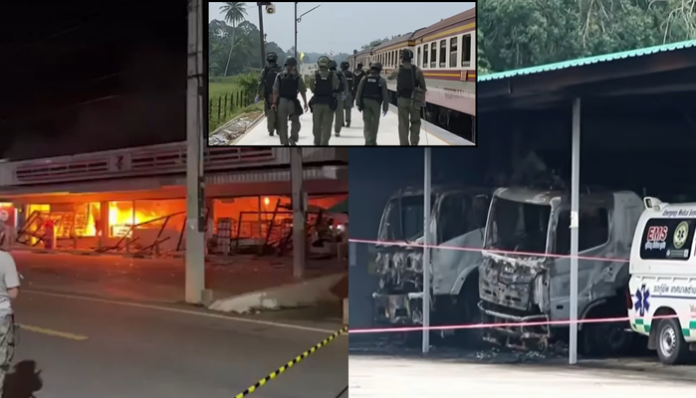
A wave of coordinated attacks jolted southern Thailand over the weekend (22nd and 23rd August), leaving three people injured and causing massive property damage. According to some reports, around 51 coordinated attacks were carried out in 21 districts of three Muslim-dominated, insurgency-hit provinces of Pattani, Yala, and Narathiwat. Some other reports stated that the attacks were over 70 in number and were spread across four provinces of Pattani, Yala, Narathiwat and Songkhla.
The attacks included bombings, warning shootings, attacks on local government offices, and arson targeting telecommunications infrastructure, CCTV cameras, vehicles, and property. The majority of the attacks reportedly happened in Narathiwat province, where three people were injured, followed by Yala and Pattani.
“Multiple coordinated incidents aimed at creating unrest occurred in various locations across the southern border provinces”, a statement by the Thailand military’s Internal Security Operations Command (ISOC) reportedly said. The attacks were followed by an explosion at a convenience store in Mayo district, Pattani, on Monday.
Polis Diraja Malaysia (PDRM) menerima permintaan daripada polis dan tentera Thailand bagi membantu mengesan pergerakan individu atau ejen yang mempunyai kaitan dengan kumpulan Barisan Revolusi Nasional (BRN) susulan beberapa kejadian letupan di tiga wilayah selatan Thailand,… pic.twitter.com/lglcUbmvpK
— BERNAMA (@bernamadotcom) August 26, 2026
Following the attacks, Thailand’s Prime Minister Anutin Charnvirakul held an urgent meeting with high-level security officials on Sunday to review the situation. Thai security forces have been deployed at the sites of the attacks, where they are engaged in the task of collecting evidence and nabbing suspects. The attacks have also led to increased security on the country’s borders to prevent any attempts at infiltration amidst the internal chaos.
A curfew was reportedly imposed in Narathiwat province from Saturday night till Sunday morning. The attacks caused major damage to buildings and vehicles. The Thai military had intelligence about the attacks but was not sure of the time and place. “We had intelligence reports for about two months that there would be attacks on local offices,” Commander of the Thai army in the southern region, Lieutenant General Norathip Poinok, was quoted as saying.
This is the first major attack since July 2026, when Thai soldiers were attacked by around 10 attackers who opened fire at them and threw pipe bombs at a security checkpoint in Narathiwat. Five paramilitary soldiers were killed and six civilians, including a 10-year-old boy, were wounded in the attack, which happened when the Thai government was holding negotiations with the BRN.
Islamic separatist group suspected to be behind the attacks
No insurgent group has claimed responsibility for the attacks. However, it is suspected that Islamic separatist groups like the Barisan Revolusi Nasional (BRN), which are known to have the capacity to carry out attacks of this scale, might be behind the attacks. The BRN is active in the three Muslim-dominated provinces of Pattani, Yala, and Narathiwat. The Islamic insurgent group has a long-standing demand to create an Islamic state by merging the three southern provinces and separating them from the Buddhist-majority country.
The three states have a history of insurgent activities, which date back to the 1960s, when insurgent groups, including the BRN, started the fight for an independent Islamic nation. The Islamic insurgent groups have been threatening the unity and sovereignty of Thailand. They refuse to be associated with the rich cultural heritage of Thailand and want to create a separate nation for their co-religionists. For about two decades, they have been attacking Thai security forces to pressure the Thai government into fulfilling their demand for a separate Islamic nation.
The provinces of Pattani, Yala, and Narathiwat were officially recognised by the British as part of Thailand in the early 1990s under the Anglo-Siamese Treaty, which demarcated the existing political border between Thailand and Malaysia. The treaty was signed between Thailand (then the Kingdom of Siam) and the United Kingdom in 1909.
Under the treaty, the Siamese kingdom relinquished its claim over the territories of the northern Malay states of Kedah, Kelantan, Perlis, and Terengganu in favour of the British colonisers but retained its control over regions including Pattani, Yala, Narathiwat, and Satun. The three provinces were already being ruled by the Siamese kingdom, and the treaty merely recognised it. Before the treaty, the three provinces were part of the former Malay-Muslim Patani sultanate. It is based on this piece of Thai history that the insurgents have been calling for a separate Islamic nation.
The current conflict began in 2004 when the insurgents raided an army base in Narathiwat province and killed several soldiers and stole weapons. The attack triggered a chain reaction of attacks and counterattacks between the insurgents and the Thai security forces. Over 7,800 people have reportedly been killed across three provinces since 2004.
Thailand is not the only country where Islamic insurgent groups have demanded a separate Islamic state based on Muslim-majority demographics; similar demands have been witnessed in several parts of the world. The Partition of India in 1947 was also preceded by religion-based political demands made more than 80 years ago, the consequences of which continue to shape India’s political and social landscape.


