

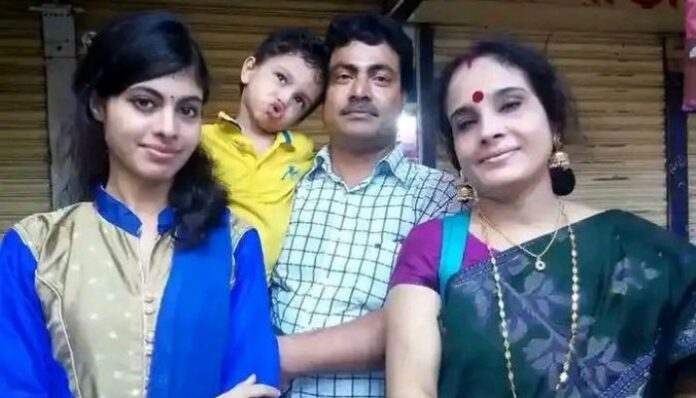
The investigation into the gruesome killing of four members of a Hindu family in Rangpur city, Bangladesh, has officially been transferred from the Kotwali Police Station to the Detective Branch (DB) of the police.
Police officials stated that this transition was executed to ensure absolute transparency and to facilitate a swift submission of the charge sheet in court. The former Investigating Officer (IO), Inspector (Investigation) Milon Kumar Chatterjee of Kotwali Police Station, formally handed over all relevant case files, collected evidence, and detailed information to the newly appointed IO, Zinat Ali, who serves as the Officer-in-Charge of the Metropolitan Detective Branch.
The police appear determined to simplify the case and mislead the public, but the transfer comes amid widespread protests that continue to brew across Rangpur as residents and civil society members firmly reject the narrative presented by the police.
Social media platforms in Bangladesh are currently buzzing with intense discussions, heated debates, and sharp questions regarding the two Hindu youths arrested in connection with the horrific murder of Ganapati Chakraborty, a retired schoolteacher, and his entire family in this northern district.
The questions have become more intense because police moved quickly from recovering the bodies to arresting two local youths and presenting a specific explanation for the killings. The families of the arrested youths, as well as relatives of the victims, have challenged parts of that account.
Four decomposed bodies found inside locked house
The case came to light on the night of 22nd August, when police recovered the decomposed bodies of four members of the same Hindu family from their two-storey house in the Kamalkashana-Machuapara area of Rangpur city. The victims were retired Rangpur Zilla School teacher Ganapati Chakraborty Jewel, 65, his wife Pritilata Chakraborty, 50, their daughter Agami Chakraborty, around 25, and their 12-year-old son Priyam.
Hindu school teacher along with other family members killed in Bangladesh!
— Salah Uddin Shoaib Choudhury (@salah_shoaib) August 22, 2026
Police have recovered the bodies of four people, including a retired school teacher, his wife and children, from a locked house in Rangpur. They are Ganapati Chakraborty Jewel (65), his wife Pritilata… pic.twitter.com/e71rhX8VHH
The house was locked from outside. Neighbours and relatives became suspicious after noticing that no one from the family had been seen for some time and a strong foul smell was coming from inside. Pritilata’s younger sister, Puja Chakraborty, said she had last spoken to the family by phone on Thursday night, August 20. When she could not contact them on Saturday, she went to the house with her husband at around 9 pm and found the main gate locked. She contacted Bangladesh’s emergency number 999, following which police arrived and broke open the lock.
The bodies were found in different parts of the property. Ganapati’s body was found on the roof; the bodies of Pritilata and their daughter were found around the staircase, while Priyam’s body was found inside a room, under a bed.
Ganapati had retired from Rangpur Zilla School in December last year. After retirement, he was reportedly providing homoeopathic medical services from a chamber at Rangpur Cooperative Market. His daughter had completed her master’s degree from Carmichael College, while Priyam was a Class V student at Rangpur Zilla School.
Police arrest two Hindu youths, claim confessions
Police subsequently arrested two young Hindu men, Mugdha Das and Siddhartha Das, from the Machuapara area on Sunday night, 23rd August. Police identified them as residents and alleged that they were involved in the killings. According to police, both later gave confessional statements before Rangpur Chief Metropolitan Magistrate Court Judge Md Rafiqul Islam under Section 164 of the Code of Criminal Procedure. They were subsequently sent to jail.
Police have said the two youths were consuming yaba on the roof of Ganapati’s house when the retired teacher confronted them. According to the police version, the confrontation escalated, and the family members were killed. Police have also suggested that the crime may initially have been connected to robbery or an attempt to make the incident look like a robbery.
However, the case is nowhere near as simple as the police are making it out to be before the media. Local observers and human rights defenders strongly suspect that law enforcement is attempting to build a convenient narrative to quickly wrap up the case, cover up critical lapses, and shield the real perpetrators behind this heinous crime, which carries a communal angle similar to previous targeted attacks on Bangladeshi Hindus in recent years by Islamists.
‘This was a planned murder’: family rejects police narrative
Directly rejecting the police claim, Puja Chakraborty, the younger sister of slain Pritilata Chakraborty, voiced strong scepticism regarding the official storyline. She publicly stated, “We are sceptical about the police’s claim regarding the motive for the murder. We cannot understand anything. Police are saying that two yaba addicts allegedly killed four people one after another.”
She further revealed a horrifying detail that police had initially kept hidden: “When we received the bodies in the evening, we found that their faces had been burned. Earlier, police did not allow us to go near the bodies.” Emphasising her conviction, she asserted, “This was a planned murder.”
The angle of a planned killing has also been echoed by Ganapati’s elder brother Gopinath Chakraborty, who said a larger group could have been involved. He also questioned the circumstances surrounding the crime and demanded that the actual perpetrators be identified and punished.
Erased evidence and mounting questions over a mystery shirt
It is not just the family suggesting that this was a premeditated hit. A series of glaring discrepancies, altered crime scene conditions, and erased evidence strongly suggest that authorities are actively attempting to obscure the potential communal or organised angle.
Suspicion deepened when photos of one of the arrested suspects went viral on social media. The shirt worn by the detainee during his presentation to the media appeared virtually identical to a shirt frequently worn by a senior police officer in Rangpur, leading the public to question how an officer’s clothing ended up on an accused person.
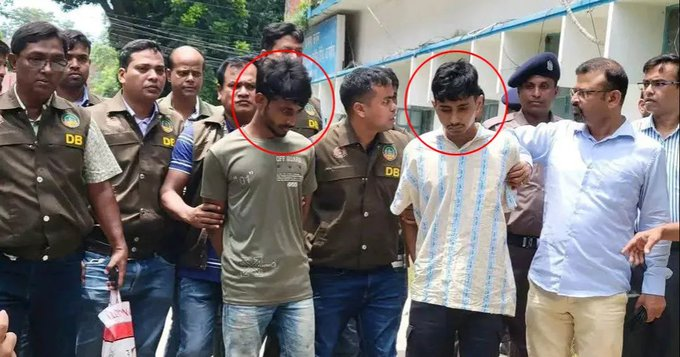
Deputy Commissioner of Rangpur Detective Branch Sanatan Chakraborty has dismissed the allegation that the shirt belonged to him. He told BBC Bangla that the shirt was a common one and said, “That same shirt is owned by me and at least two hundred other people in Rangpur. My shirt is right here with me. Purposeful mispropaganda is being spread regarding this.”
How did the police dress end up on the accused??
— Sagar Debnath (@sagor_dn556) August 24, 2026
The shirt that the police were looking for the accused wearing last night is now seen on the accused. The administration's drama over the killing of four people in Rangpur seems to be continuing. pic.twitter.com/0IjwE08xWj
Yet, this explanation was directly contradicted by Binoy Das, the father of accused Siddhartha Das, who openly challenged the official version of events. Speaking to reporters, Binoy Das stated, “On late Saturday night, a large crowd including the police gathered at Ganapati’s house. Later, late that night around dawn, police came to my house looking for Siddhartha. I woke him up from his uncle’s house and handed him over to the police. He was wearing a T-shirt at the time. But later, when the police brought him before the journalists, I saw him wearing a shirt. Whose shirt is that? I have never seen him wear that kind of shirt before.”
The statement of the parents of Siddharth, accused in the brutal murder of four members of the same family in Rangpur, is very significant and heartbreaking. pic.twitter.com/tESuwebHNv
— Sagar Debnath (@sagor_dn556) August 24, 2026
The families of both arrested youths have also said the men were away from the crime scene at the relevant time, contradicting the police account. Those claims will need to be tested against phone records, CCTV footage, forensic evidence and other independent material rather than accepted or rejected solely based on competing statements.
There are further questions about the electricity supply to the house. The new investigating officer reportedly said the accused had told investigators that they cut the electrical wire near the meter. However, a local electrician who later repaired the connection told The Daily Star that the line had actually been severed from the electric pole. Such differences are important because they can help establish whether the suspects’ account matches the physical scene.
Autopsy raises another layer of questions
The troubling discrepancies do not end with clothing. Major contradictions have emerged between the police statements and the actual autopsy findings.
Police said the four victims were strangled, and the autopsy later confirmed that strangulation/asphyxiation was the cause of death. However, when the bodies were finally handed over to relatives after autopsies at Rangpur Medical College Hospital around 7:00 PM on Sunday, family members and doctors discovered that the faces of all four victims had been severely burned with a flammable substance or chemical.
Disturbing video footage from the scene showed bloodied liquid pooled on the floor, with young Priyam lying dead on the bedroom floor, his face visibly scorched.
This directly conflicts with the earlier account from relatives who said the faces appeared burned and with an initial CID statement suggesting that a flammable substance may have been poured on the victims’ faces. CID Rangpur official Sumit Chowdhury had said investigators would collect samples and send them to the forensic department to determine what substance, if any, had been used.
The disagreement makes the forensic evidence especially important. If a chemical or flammable substance was used, laboratory testing should establish it. If the facial changes were instead caused by decomposition, as the autopsy doctor said, that should also be clearly documented. The final forensic and laboratory reports therefore matter far more than competing claims circulating on social media.
Questions have also been raised about the missing mobile phones, the electricity supply, the movements of the accused and the police explanation of how the suspects allegedly accessed the rooftop. These issues need to be checked through objective evidence, including call records, digital data, DNA testing, fingerprints and other forensic material.
A disputed claim over sexual assault
Adding to the mystery is a severe conflict regarding potential sexual assault. In a conversation recorded on a hidden camera, a mortuary attendant (dom) who assisted during the autopsies stated there were clear signs of sexual assault on the mother and daughter. However, the official forensic physician who conducted the autopsy flatly denied these claims, stating that physical examinations and lab samples showed no such evidence and dismissing the worker’s statements as entirely incorrect.
🚨 Bangladesh authorities hide crucial information in autopsy report!
— Salah Uddin Shoaib Choudhury (@salah_shoaib) August 25, 2026
Although the dom issued a statement stating that two female members of the Hindu family, Pritilata Chakraborty, wife of school teacher Ganapati Chakraborty, and daughter Agami Chakraborty, candidate, were… pic.twitter.com/HTyZ1UgNUy
How this stark contradiction between an on-ground mortuary worker and the official medical report will be resolved remains unclear, especially since police completely ignored this sensitive matter during their initial media briefings.
Police washed the house and destroyed the evidence
In another chilling revelation, the family of the arrested Hindu youth wept before cameras, asserting that their sons were being framed as convenient scapegoats to protect influential figures. The accused’s family revealed that officers altered the crime scene, saying that the house was washed and cleaned under police supervision, effectively destroying critical forensic evidence. Instead of securing the perimeter, officers were seen repeatedly entering and operating inside the residence before full forensic mapping.
🚨 BREAKING : In the Rangpur Hindu family murder, an on-duty officer allegedly washed away the crime-scene evidence with water at night before the DB probe even started.
— Voice Of BD Hindus 🇧🇩 (@HinduUnityBD) August 26, 2026
The family of the arrested Hindu youth is weeping before cameras, saying police framed their son. They… pic.twitter.com/CHhHkQ17bK
The scale of the crime itself makes the questions difficult to ignore. Why was an entire family killed, including a 12-year-old child? If the police theory is that the killings began after a confrontation over yaba consumption, investigators must establish how that confrontation allegedly led to four deaths and whether the evidence independently supports the suspects’ statements.
"Police tried to destroy all evidence by washing Ganapati Chakraborty's house with water in the dead of night" pic.twitter.com/UWwRKQGbOp
— Sagar Debnath (@sagor_dn556) August 26, 2026
Similarly, if robbery was involved, investigators must establish what was stolen, whether there were signs of forced entry, whether money or valuables were missing and whether forensic evidence connects the arrested men to the house. If investigators rule out a communal motive or the involvement of additional people, that conclusion should also be based on evidence rather than assumption.
Ultimately, one central question hangs over the case: Was this truly a casual, spontaneous crime committed by two young men just to buy drugs, or was it a planned, sinister execution designed to liquidate another Hindu family and instil fear across the minority community?
The fact that the victims were Hindu makes the communal angle an important possibility to examine, particularly given concerns among minority communities in Bangladesh and recent cases of Bangladeshi Hindus being murdered by Islamists. This is an important angle that the police appear to be downplaying and keeping from the public.
Demand for judicial investigation
A judicial investigation into the killings was demanded at a human chain and protest rally organised by the Bangladesh Sanatan Party (BSP) in front of the National Press Club in Dhaka on Wednesday, 26th August. Several organisations, including Bhakta Sangha Society Bangladesh, World Hindu Federation, Bangladesh Deshwali Samaj, Bangladesh Sanatan Kalyan Jote and Bangladesh Loknath Foundation, joined the programme.


