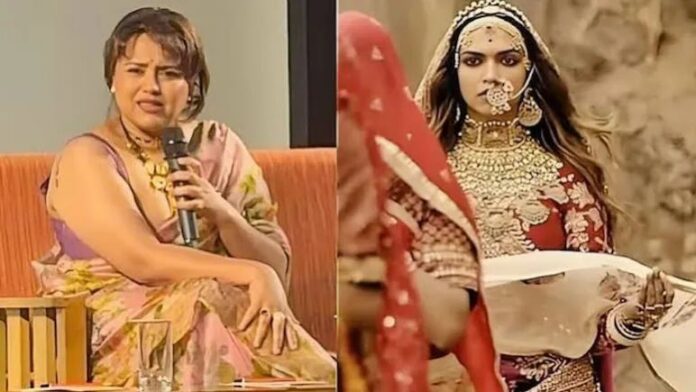
Swara Bhasker appears determined to win an argument against Jauhar by changing the argument itself. Days after describing the portrayal of jauhar in Padmaavat as “cowardice”, Bhasker has now doubled down on her attack on Jauhar by drawing a false equivalence and invoking the tragic 1987 Roop Kanwar case.
In a post responding to critics, she accused those defending the historical context of Jauhar of “chamka-o-ing” their politics and described the practice as “the most gruesome, brutal, painful and grotesque culture sanctioned; society celebrated violence that can happen to a woman.”
“Women’s agency” @PoojaPriyam_ @priyankac19 @bainjal @Shubhrastha & all other Jauhar apologist nuance finding women..
— Swara Bhasker (@ReallySwara) September 4, 2026
SHAME ON ALL OF YOU for chamka-o-ing your rajneeti, analysis and hot takes on the most gruesome, brutal, painful and grotesque culture sanctioned, society… https://t.co/gMUOkiGbuR
The problem is that nobody in this debate is arguing that women in the 21st century should burn themselves alive.
That is a straw man Swara has created to deflect criticism for her remarks on Jauhar at a recent event, where she referred to the act of committing Jauhar as “cowardly” without explaining the context in which the women were forced to make that decision.
The question being raised is considerably more straightforward: why is it intellectually honest to condemn Jauhar without acknowledging the circumstances in which Rajput women historically believed it to be preferable to capture following defeat against invading Islamic armies?
What did the Islamic armies do that Hindu women chose an immensely painful death over living under them?
And that is precisely where Bhasker’s invocation of Roop Kanwar falls apart.
Roop Kanwar was a tragedy. But it was not jauhar.
Roop Kanwar was an 18-year-old woman who died on her husband’s funeral pyre in Deorala, Rajasthan, on September 4, 1987. The incident triggered national outrage and eventually led to the enactment of the Commission of Sati (Prevention) Act, 1987, which specifically sought to prevent sati and its glorification.
There is no need to sanitise what happened to Kanwar. If she was coerced, as accounts and subsequent reporting alleged, then she was the victim of a horrific crime. The fact that people allegedly participated in, facilitated or glorified her death makes the episode even more disturbing.
But what does that have to do with Jauhar?
Very little. And Swara’s ad hominem attack against her critics proves it. It had nothing to do with Jauhar and everything to do with how she could get back at her critics. But as usual, she has, once again, failed.
Nevertheless, Sati and Jauhar are not interchangeable terms. Conflating the two is plain dishonesty.
Sati traditionally referred to the immolation of a widow on her deceased husband’s funeral pyre. Jauhar, in the Rajput historical context, referred to collective self-immolation by women when a fort was facing imminent defeat and capture, particularly in circumstances where the women feared a lifetime of enslavement, sexual violence or forced concubinage after the fall of the fort.
The historical circumstances surrounding both practices can certainly be debated. But pretending that they were the same phenomenon simply because both involved fire is not serious historical analysis.
Bhasker has taken a modern criminal case involving the death of a young widow and placed it beside medieval accounts of women facing the consequences of a defeated fortress.
That is not contextualisation.
It is conflation.
Nobody is asking women today to commit Jauhar
This is perhaps the most important point Bhasker seems unwilling to engage with.
The people criticising her remarks are not campaigning for the revival of Jauhar. They are not asking modern Indian women to kill themselves rather than survive sexual violence. They are not suggesting that a rape survivor has lost her dignity or her right to live.
In fact, the opposite is obvious.
A woman subjected to sexual violence today has every right to live, recover, seek justice and rebuild her life. There is no legitimate argument for suggesting otherwise. In fact, comparing what Rajput women went through and equating them with rape survivors itself deserves closer scrutiny and criticism, for judging a historical atrocity from a modern prism.
But that modern moral principle does not magically erase the historical context in which Jauhar occurred.
The controversy began because Bhasker passed a judgment on women living under radically different circumstances. While speaking about the Padmaavat sequence, she said that if she were a rape survivor, she might feel like a “coward” for not having killed herself to preserve her honour. Her remarks have since been clarified by her, with Bhasker insisting that she did not call Rani Padmavati or the women who performed jauhar “cowards” and that her words had been misrepresented.
That clarification, however, does not resolve the underlying historical question.
The movie didn’t glorify Jauhar. It paid tribute to hundreds, if not thousands, of Hindu women and their determination to endure a painful death rather than be reduced to sexual slaves, concubines of Islamic invaders.
The issue is not whether suicide should be encouraged today.
The issue is why women in a particular historical setting believed death, and that too a painful one undertaken through Jauhar, was preferable to capture.
Those are two entirely different questions.
The uncomfortable historical context Bhasker avoids
Across the history of Islamic conquest, the capture of women was a grim reality. Be it India, Iran, or Afghanistan, the invading Muslim armies treated women of the losing kingdom as war booty. Non-Muslim women were subjected to unspeakable atrocities. They were enlisted in harems, trafficked off to the Middle East in perpetual sexual slavery.
The Islamic conquests were extraordinarily brutal, and defeated populations often faced a fate that is difficult for modern audiences to comprehend. It is precisely this uncomfortable historical context that Swara Bhasker appears to strip away when she reduces Jauhar to an act of “cowardice”.
That context is important.
If women in a besieged Rajput fort believed that defeat would expose them to capture and sexual exploitation, then their decision to enter the fire cannot honestly be analysed as though they were sitting in a modern room with access to a police station, a court, a women’s shelter and a constitutional guarantee of bodily autonomy.
Their world was not ours. It was their agency to choose death, and in the form of Jauhar, to escape a lifetime of atrocities under an Islamic invader.
And that distinction is precisely what Bhasker’s argument fails to confront.
And this is where Roop Kanwar becomes a convenient distraction
The Roop Kanwar case is horrifying precisely because it demonstrates what happens when a society turns a woman’s death into an instrument of custom, coercion, prestige and even economic or political interest.
There is absolutely nothing to defend in such a crime.
But using Kanwar to settle the jauhar debate is like using a modern murder case to explain why soldiers historically chose to die rather than surrender during a war.
The fact that both involve death does not make the circumstances identical.
Kanwar’s case happened in independent India in 1987, under a modern legal system. Indeed, the law specifically criminalised the commission and glorification of sati.
Jauhar belongs to a radically different historical context: siege warfare, Islamic atrocities on a predominantly Hindu India, and the anticipated consequences of military defeat.
The distinction is fundamental.
And yet Bhasker uses the 1987 case to suggest that those defending the historical context of jauhar are somehow defending violence against women.
They are not.
They are saying that historical actors deserve to be understood within their historical circumstances before they are judged through the assumptions of the present.
That is not glorification of Jauhar. It is respecting and acknowledging the circumstances that led to it. It is context.
The double standard in the debate
There is another question Bhasker’s intervention raises.
Why is there such reluctance to discuss the Islamic barbarity that created the conditions in which jauhar became imaginable?
When Padmaavat depicts the women of Chittor choosing death as the fort falls, the conversation frequently becomes an indictment of the women, their society and their concept of honour.
But what about the military conquest by invading Islamic armies that forced women to commit Jauhar? Swara conveniently remains silent on it because the context adds meaning to the sacrifices made by those women and renders her argument weak.
One can disagree with the film’s artistic treatment.
But calling the women who made such a choice “cowardly”, or then issuing a convoluted clarification saying the words weren’t meant for the women but what she would have felt if she had committed the same act, or creating the impression that their decision can be evaluated without examining the circumstances surrounding it, is something else altogether.
It strips the act of its historical meaning and context.
That is particularly important when dealing with practices as horrific and complicated as sati and jauhar.
Modern India has rightly outlawed sati. It has rightly criminalised its glorification. No woman should ever be coerced into such an act.
But acknowledging that does not require pretending that jauhar and sati were identical. Nor does it require pretending that medieval women made decisions in circumstances remotely comparable to those available to women today.
Swara is free to criticise Padmaavat. But she is not free to criticise choices made by women 600 to 700 years ago in the face of a lifetime of sexual slavery and torture, after stripping away the context in which those choices were made. Any assessment of history to determine what forced Hindu women to commit Jauhar would instantly attract cries of ‘Islamophobia’ by the same set of people who are passionately criticising Jauhar and insulting those who committed it.
She is free to argue that modern cinema should be careful not to romanticise self-immolation.
But if she wants to enter a debate about history, she cannot selectively remove historical circumstances and context around it.
The tragedy of Roop Kanwar should be remembered as a warning against coercion and the glorification of a woman’s death.
The women who performed jauhar should be understood in the context of the Islamic brutality of the times, the treatment of women as war booty, and the mass conversion violence that followed after the conquest.
These two truths can coexist.
What cannot withstand scrutiny is the attempt to use one tragedy to erase the context of another.
And that is ultimately what makes Bhasker’s latest intervention so disingenuous: she argues against a position nobody is actually taking, while avoiding the historical question her critics are raising.