

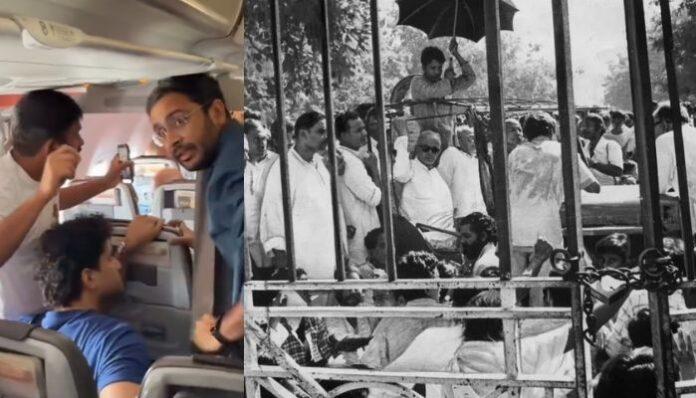
Cockroach Janta Party (CJP) founder Abhijit Dipke and fellow party leaders Saurav Das and Ashutosh Ranka were detained by Delhi Police shortly after their flight landed at Indira Gandhi International Airport on Saturday, 10th October. The police team boarded their flight shortly after it touched down in the national capital to take the leaders into custody. Right before the police stepped in, Dipke recorded a video inside the aircraft and posted it on social media.
A team of Delhi Police entered the plane in which Cockroach Janta Party founder Abhijeet Dipke landed in Delhi on Saturday morning. Dipke went live on his instagram as cops entered the plane and detained him amid high in-flight drama ahead of the CJP’s planned protest at Jantar Mantar. Dipke posted the video showing Delhi Police team entering the flight as he alongwith other CJP members, Saurav Das and Ashutosh Ranka were detained from the flight itself.
— NDTV (@ndtv) October 10, 2026
In his video statement, Dipke targeted the government, alleging that police were picking up young leaders to block a protest. Raising slogans like “Inquilab Zindabad,” he claimed, “Picking up 30-year-olds straight off the plane is something even Indira Gandhi didn’t do during the Emergency.” He called the police action a clear sign of fear within the ruling dispensation and went on to describe it as a “dictatorship”.
Abhijeet Dipke was detained in view of the protest called by the Cockroach Janta Party at Jantar Mantar, which had not been permitted. During the day, information was received about the death of Abhijeet Dipke’s grandmother. The information was immediately shared with him sensitively, and he was informed of the funeral time. He was also offered possible assistance with his journey to his hometown on humanitarian grounds: Delhi Police
— IANS (@ians_india) October 10, 2026
The action against the CJP leaders came right ahead of their planned demonstration at Jantar Mantar, which had not been permitted. The protest was organised against Chief Election Commissioner Gyanesh Kumar, with the party demanding his resignation over alleged irregularities in electoral rolls during the Special Intensive Revision (SIR) and controversy surrounding Form 6 voter registrations.
Following the airport detention, CJP leaders immediately began crying foul, trying to equate basic police preventive measures with the brutal era of Indira Gandhi’s Emergency. However, drawing a parallel between routine law-enforcement checks and the state-sponsored terror of 1975 shows a severe lack of historical understanding or a deliberate attempt to gain political sympathy.
Comparing modern security precautions with the darkest chapter of Indian democracy ignores what actually happened during the Emergency. Under Indira Gandhi, civil liberties were completely suspended, press censorship was absolute, and democratic rights were erased overnight. Equating a temporary airport detention with the night of 25th June 1975, completely distorts the reality of India’s past.
The dark era of 1975: How the opposition was brutally silenced
On 25th June, 1975, Prime Minister Indira Gandhi declared a National Emergency under Article 352 of the Constitution, citing internal disturbance. This step was taken right after the Allahabad High Court invalidated her 1971 election victory and banned her from holding elected office for six years. Within hours of the declaration, opposition stalwarts were rounded up across India in late-night raids, and fundamental rights were frozen.
Indira Gandhi’s government did not spare prominent opposition leaders during the Emergency. Jayaprakash Narayan, popularly known as Lok Nayak, was among those detained. He had led a movement demanding what he called Sampoorna Kranti, or total revolution, and had become one of the most prominent voices against corruption and the Congress government’s functioning.
Atal Bihari Vajpayee and Lal Krishna Advani, both senior leaders of the Bharatiya Jana Sangh, were also arrested. Vajpayee spent nearly 19 months in prison, while Advani’s experience during the Emergency later informed his criticism of the media’s response to government pressure. His widely remembered remark was: “When asked to bend, they crawled.”
Former Deputy Prime Minister Morarji Desai was jailed as well. After the Emergency ended, he became India’s first non-Congress Prime Minister. Chaudhary Charan Singh, another prominent opposition leader, was also detained and later emerged as a major figure in anti-Congress politics.
Socialist leader George Fernandes was arrested in the Baroda Dynamite Case after organising resistance to the government. He had spent time underground before his arrest and later contested the 1977 general election from Muzaffarpur in Bihar while still in prison, winning the seat.
These arrests reflected the extent to which the government acted against its political opponents. The Emergency also weakened institutional checks on executive power and placed severe restrictions on the press. Newspapers faced censorship, while people who criticised the government risked detention.
The Maintenance of Internal Security Act (MISA) became the most abused law during the Emergency, allowing the state to jail anyone indefinitely without trial or charge. Thousands of political workers and leaders were locked away under MISA for months.
MISA became closely associated with the arbitrary detention of people who opposed the government. Political activists, opposition leaders and others were held without the ordinary protections available through a criminal trial. The law’s use during the Emergency remains one of the most criticised aspects of Indira Gandhi’s rule.
The ruthless assault on students and youth
While political leaders were locked in cells, the Indira Gandhi-led Congress government showed no mercy to innocent students either. Today, leaders like CJP founder Abhijeet Dipke often complain about Delhi Police’s routine security management, framing it as “brutality on students.”
When looking back at history, the treatment of students during the Emergency was not a matter of temporary detention; it was a campaign of state-sponsored torture, custodial abuse, and outright murder.
Instead of encouraging education and building careers, the Congress regime used the full force of police power to crush young boys and girls who stood up for democratic freedom. The government’s crackdown affected students who were part of the wider movement led by Jayaprakash Narayan. The movement had attracted young people from different political backgrounds who were demanding action against corruption, rising prices and misgovernance. Instead of treating all such protests as an opportunity for political dialogue, the authorities increasingly relied on arrests and force to control dissent.
Horrific accounts of student abuse and torture
The sheer scale of violence against student activists between 1975 and 1977 remains horrifying. Students across colleges and universities were subjected to inhuman methods of physical abuse:
The “Aeroplane” torture: In Karnataka, police regularly used a method called the “aeroplane.” A student’s hands were tied behind their back with a rope, and they were pulled high off the ground using a pulley, suspended in midair while being beaten into unconsciousness. Student leaders Puttu Swamy, Padmanabh Harihar, and Shrikant Desai in Hubli, as well as Ravi in Mysore, were subjected to this horrific treatment. Udaya Shankar, a student from Canara College in Mangalore, was dragged away without a warrant, severely beaten until his body was covered in deep bruises, denied food, and put through the “aeroplane” torture three separate times in the presence of senior officers.
Delhi University horrors: DU Union Secretary Hemant Kumar Vishnoi was picked up during a picnic at Buddha Gardens. He was hung upside down, beaten, and had burning candles applied to his bare soles, along with chili powder stuffed into his nose and rectum, all to force a fake confession. DU student Mahavir Singh was tortured so brutally that his skin peeled off at the touch of his own clothes, while Shiv Kumar Sharma was forced to inhale chili powder and beaten with rifle butts. Student leader Ashwini Kumar was made to lie flat on the floor while a police constable danced on his chest in heavy boots. Over 200 Delhi University teachers were arrested on a single day on 26th June, 1975.
JNU abuses: Jasbir Singh, a student from Jawaharlal Nehru University, was held in a police station and beaten for hours with wooden clubs and boots. The next day, he was chained to a pole between two chairs and swung back and forth until he vomited blood, while officers threatened to throw his body into the Yamuna River.
The torture of Ashwini Kumar Choubey: Even before the formal Emergency, former Union Minister Ashwini Kumar Choubey faced extreme brutality as an RSS student leader at Patna University supporting Jayaprakash Narayan. In June 1974, he was arrested, forced onto a scalding hot iron chapati pan, beaten with iron rods, and left for dead inside a sack. He survived only after fellow activists broke into the jail. During the Emergency in 1975, he was re-arrested while trying to take his B.Sc. exams and kept in a dark, mosquito-infested cell near the mentally challenged ward in Buxar Jail without adequate food or water, leading to severe kidney damage.
The movement escalation: In Bihar and Madhya Pradesh, peaceful student protests were met with live police firing. In Bhopal in 1973, eight students were shot dead during a strike. During the Bihar Chhatra Sangharsh Samiti demonstrations in 1974 led by youth leaders like Lalu Yadav, Sushil Modi, and Ram Vilas Paswan, police opened fire multiple times, killing over a dozen students on the streets.
The tragic custodial death of P. Rajan
Among all the atrocities committed against students, the case of P. Rajan remains one of the most tragic examples of Emergency-era cruelty.
P. Rajan was a final-year engineering student at the Regional Engineering College, Calicut. On 1st March, 1976, he was picked up by the Kerala Police under the mistaken suspicion of having links to Naxalite activists who had attacked a police station. In reality, Rajan had no connection to the incident. Police officers under Crime Branch DIG Jayaram Padikkal had simply been ordered to round up every person named “Rajan” in the area.
Rajan was taken to the Kakkayam police camp, where he was subjected to continuous third-degree torture, including the use of heavy iron and wooden rollers pressed onto his body. He died in unlawful police custody on 2nd March, 1976.
To cover up the crime, the police disposed of his body, which was never recovered. His father, Professor T.V. Eachara Warrier, fought a long and lonely legal battle, writing to the Prime Minister, Home Minister, and MPs, asking for his son’s whereabouts. The truth was finally forced out in the Kerala High Court only after Eachara Warrier filed a Habeas Corpus petition. The state government, under then Home Minister K. Karunakaran, was forced to admit in court affidavits that Rajan had indeed died due to continuous police torture while in custody.
Forced sterilisations and mass human rights violations
The nightmare of the Emergency extended far beyond political detentions and student abuse. Under the unchecked authority of MISA, an estimated 1,40,000 to over one million citizens, including journalists, academics, and peaceful protestors, were held without charges or trial for up to 18 months.
The regime also targeted the ordinary public through aggressive mass control programs. Led by Sanjay Gandhi, the administration launched an unconstitutional forced sterilisation drive. Driven by target-based quotas and backed by foreign development grants, police force was used to round up vulnerable citizens.
Entire villages were surrounded, and poor, uneducated men were forcefully dragged to makeshift surgical camps. In a single year, approximately 6.2 million men were forcibly sterilised, a figure over 15 times greater than the sterilisations conducted during Nazi rule. Complete lawlessness prevailed, to the extent that even a commercial airliner was hijacked by regime sycophants, an act later shamelessly defended in Parliament.
Modern law enforcement vs. historical dictatorship
When CJP founder Abhijeet Dipke compares basic preventive actions at Delhi airport to Indira Gandhi’s Emergency, the comparison crumbles under the weight of historical facts. The temporary detention of these so-called political organisers heading to a planned unrest bears no resemblance to an era marked by mass sterilisations, complete press censorship, suspended constitutional rights, and custodial killings.
Furthermore, current law enforcement measures are grounded in specific security requirements. During previous CJP-led demonstrations in July, agitators caused widespread public disruption, damaged public property, and clashed with security personnel under the banner of student protests. Subsequent police investigations revealed that behind the guise of an organic, youth-led agitation, over 2,800 individuals with serious criminal antecedents had entered the crowds.
What was promoted as a completely spontaneous movement was, in fact, an organised political effort handled by experienced political workers, relying on impressionable students as front-line cover. Taking lawful, preventive measures to maintain order and protect public safety in a capital city is the fundamental responsibility of any elected government, not a dictatorship.
Attempting to hide behind the dark legacy of the Emergency only serves to undermine the genuine suffering of thousands who lived through India’s real democratic crisis. It is equally important that political leaders do not use the suffering of that period merely as a rhetorical tool. Any comparison with the Emergency should be based on evidence, not just political slogans.


