

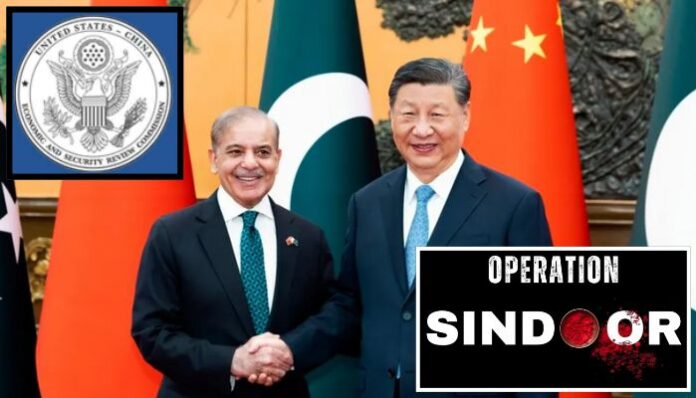
In its recently released report, a US congressional panel has said that China backed Pakistan during the May 2025 military conflict with India following Operation Sindoor as part of its broader efforts to suppress India’s rise.
The panel warned that Beijing is actively working to curb India’s rise across multiple fronts and is using its close military partnership with Pakistan to create additional security challenges for New Delhi.
The findings were published in the US-China Economic and Security Review Commission (USCC) annual report, chaired by Randall Schriver, on 18 November 2026.
In a chapter titled “China’s Other Front: India and the Future of US Strategy in the Indo-Pacific”, the commission examined China’s growing influence in South Asia, its military partnership with Pakistan and the challenges these developments pose to India’s security.
The report identified India as one of the few countries outside the US alliance system with the size and capabilities to compete with China. It warned, “China understands this, and it is actively working to suppress India’s rise across multiple domains.”
Beijing views India’s growing power as a strategic challenge
The commission highlighted India’s position as the world’s most populous country, the largest democracy, a nuclear-armed state and a country with one of the world’s largest militaries.
It also pointed to India’s 2,100-mile disputed border with China and its strategic location along important Indian Ocean shipping routes that carry a significant share of China’s energy supplies and international trade.
The report noted that while the Western Pacific remains the main area of rivalry between the US and China, India presents Beijing with another major strategic challenge, both on land and at sea.
It further explained that China’s approach towards India involves military, economic and maritime pressure aimed at limiting New Delhi’s growing influence.
At the same time, the commission clarified that India’s rivalry with China is driven by its own national interests and commitment to “strategic autonomy”, rather than its alignment with Washington.
China-Pakistan military partnership raises two-front threat for India
The report highlighted China’s growing military partnership with Pakistan and warned that it has increased the possibility of India facing security challenges on two fronts simultaneously.
In its assessment, the commission said Beijing’s growing security support for Islamabad has made the possibility of a two-front conflict an increasingly serious concern for India.
Referring to the May 2025 military confrontation, the report said, “During the fighting, which followed India’s launch of Operation Sindoor in response to a deadly April terrorist attack that New Delhi attributed to Pakistan-backed terrorists, Pakistan reportedly used advanced weaponry procured from China.”
The commission said the conflict demonstrated how Beijing could strengthen Pakistan’s military capabilities during a crisis without directly entering the hostilities against India. Such support, it noted, makes India’s military planning more complicated in the event of another confrontation with Pakistan.
Chinese weapons, cyberattacks and surveillance during Operation Sindoor
The USCC report also pointed to cyberattacks against Indian infrastructure during the military conflict. It said hackers reportedly targeted India’s critical networks through large-scale distributed denial-of-service (DDoS) attacks.
The report stated, “Additionally, hackers reportedly targeted India’s critical infrastructure, attempting large-scale distributed denial-of-service (DDoS) cyberattacks with the goal of disrupting critical networks during the conflict, including government information technology (IT) infrastructure, telecommunications, and digital services.”
It further noted that China increased pressure on India by deploying a survey vessel equipped with advanced sensors near waters within India’s Exclusive Economic Zone (EEZ).
After the conflict, Indian military officials also said that Pakistan may have received real-time satellite imagery and other intelligence support from Beijing. However, China’s Ministry of Foreign Affairs neither confirmed nor explicitly denied these allegations.
When asked by The Hindu whether China had provided Pakistan with “all possible support”, as claimed by India’s Deputy Chief of Army Staff, Chinese Ambassador to India Xu Feihong said that China-Pakistan security relations were not directed against any particular third country. He maintained that “defense and security cooperation is part of the normal cooperation between China and Pakistan.”
Another significant detail emerged in May 2026, when Chinese state broadcaster CCTV aired an interview with Zhang Heng, an engineer associated with the Aviation Industry Corporation of China’s (AVIC) Chengdu Aircraft Design and Research Institute. During the interview, Zhang confirmed that he and other Chinese AVIC personnel had provided on-site technical support in Pakistan during the May 2025 conflict.
US panel calls for stronger defence cooperation with India
The commission warned that China’s growing military presence in the Indian Ocean and its expanding defence partnership with Pakistan require greater attention from Washington and New Delhi.

It called for the United States to strengthen its operational defence ties with India, particularly in the Indian Ocean region, to address the growing Chinese military presence and maritime activities.
The report noted, “Deeper U.S.-India cooperation on maritime domain awareness, undersea surveillance, and logistics could strengthen India’s ability to manage China’s growing presence while giving the United States greater flexibility in allocating its own forces during a wider Indo-Pacific crisis.”

However, the report also emphasised that India’s strategic choices are guided by its own interests. It noted that New Delhi’s rivalry with Beijing does not mean that India has aligned itself with Washington against China.
The commission’s assessment presents China’s support for Pakistan as part of a wider strategy to restrict India’s emergence as a major regional and global power.
It warns that Beijing is using military cooperation, economic pressure and maritime activities to challenge India’s growing influence, while its partnership with Islamabad creates additional security concerns for New Delhi.
Operation Sindoor: Why India launched military strikes against Pakistan
The developments highlighted in the USCC report took place during the military confrontation that followed India’s launch of Operation Sindoor on 7th May, 2025.
The operation was launched in response to the horrific terrorist attack in Pahalgam, Jammu and Kashmir, on 22nd April, in which Pakistani terrorists gunned down 26 civilians after specifically identifying them as Hindus.
The terrorists questioned victims about their religion before shooting them dead. The Resistance Front (TRF), an offshoot of Pakistan-based Lashkar-e-Taiba (LeT), initially claimed responsibility for the attack.
Following the massacre, India decided to strike the terrorist infrastructure operating from Pakistan and Pakistan-occupied Jammu and Kashmir (PoK).
The Indian Armed Forces launched Operation Sindoor on 7th May last year, carrying out precision strikes on nine terrorist facilities associated with Pakistan-based terrorist organisations, including Lashkar-e-Taiba, Jaish-e-Mohammed (JeM) and Hizbul Mujahideen.
The 9 terror sites were the JeM training camp at Markaz Subhan Allah, Bahawalpur, Lashkar-e-Taiba’s training centre Markaz Taiba in Nangal Sahdan, Muridke, Sheikhupura, Sarjal / Tehra Kalan facility of Jaish-e-Mohammad, Sarjal, Mehmoona Joya Facility of Hizbul Mujahideen (HM), Sialkot, Markaz Ahle Hadith of Lashkar-e-Taiba in Barnala, PoK, Markaz Abbas of Jaish-e-Mohammad in Kotli, PoK, Maskar Raheel Shahid of Hizbul-Mujahideen in Kotli, PoK, Shawai Nallah Camp of Lashkar-e-Taiba, Muzaffarabad, PoK, and Syedna Bilal Markaz of Jaish-e-Mohammad, Muzaffarabad, PoK.
The Indian government said the targets were selected based on intelligence inputs and their involvement in terrorist activities against India. The strikes were conducted using precision weapons to destroy terrorist infrastructure while avoiding civilian areas.
According to the Ministry of Defence’s initial statement on 7th May, nine sites were targeted, and no Pakistani military installations were attacked during this first phase of the operation.
Apart from the terror camps, India also launched unprecedented attacks on the Pakistani military establishment, including the Ghulni military bases, the Nur Khan Airbase in Rawalpindi, the 12th Corps headquarters in Quetta and the Khwazai Camp in Khyber Pakhtunkhwa’s Mohmand Agency.
Pakistan’s military infrastructure suffered significant damage during the confrontation. Indian military officials also reported damage to Pakistani air defence systems and radar installations, which affected Islamabad’s ability to defend its airspace.
India emerges victorious despite China’s military support to Pakistan
Ultimately, the events of May 2025 demonstrated that even the combined weight of Pakistani aggression and covert Chinese backing could not deter India’s resolve or blunt its operational superiority.
Despite facing a multi-domain challenge that included Chinese-supplied weaponry, on-site technical assistance, real-time surveillance, and coordinated cyberattacks, the Indian Armed Forces executed Operation Sindoor with decisive precision.
By systematically dismantling nine major terror hubs and neutralising critical Pakistani air defence systems, radar installations, and military bases, New Delhi exposed the limitations of Beijing’s proxy strategy.
Rather than suppressing India’s rise, Operation Sindoor underscored New Delhi’s military capability, technological resilience, and unwavering commitment to strategic autonomy, proving that India can independently neutralise cross-border threats and emerge victorious even against an adversary bolstered by a global superpower.


