

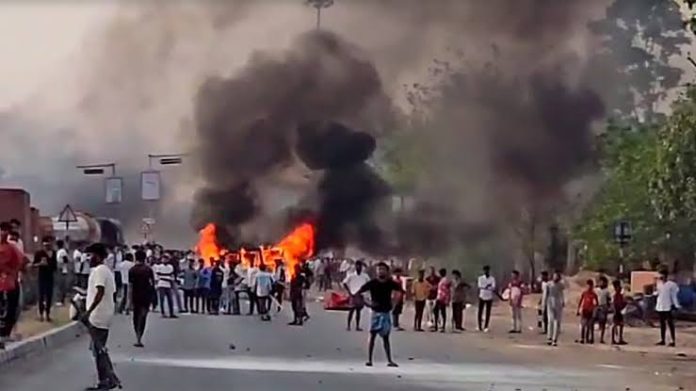
A report submitted by a fact-finding committee constituted by the Calcutta High Court has implicated a leader of the ruling Trinamool Congress (TMC) in the communal violence that erupted in Murshidabad last month. The report states that the violence, which coincided with the passage of the Waqf Amendment Bill, was targeted at members of the Hindu community and resulted in extensive damage to life and property.
The committee, comprising members of the National Human Rights Commission (NHRC), the West Bengal State Legal Services Authority, and the Judicial Services, conducted field visits to affected areas, including Betbona, Samserganj, Hizaltala, and Shiulitala. The findings were presented before a division bench of the Calcutta High Court.
Key Findings
- Involvement of Political Figures:
The report identifies local TMC councillor Mehboob Alam as having led a group of miscreants involved in the attack. It also names Amirul Islam, who allegedly directed the mob to properties that had not yet been attacked, prompting further arson. - Police Inaction:
The local police are reported to have been “completely inactive and absent” during the violence. Calls for help from the villagers of Betbona reportedly went unanswered. The incident occurred within a 300-metre radius of the local police station, yet no intervention was made.
Additionally, a Member of the Legislative Assembly (MLA) was allegedly present during the attacks but did not attempt to prevent or stop the violence. - Extent of Damage:
According to the report:
- 113 homes in Betbona village were severely damaged and rendered uninhabitable.
- Water connections were deliberately severed to prevent residents from extinguishing fires.
- Victims, particularly women, have taken refuge with relatives due to fear and lack of shelter.
- Casualties and Communal Targeting:
On April 12, a Hindu man and his son were killed by their Muslim neighbours, the report noted. The violence that followed led to the destruction of several businesses and places of worship. - Looting and Arson of Commercial Properties:
- Twenty-nine shops were affected in Ghoshpara.
- A mall-style shopping complex was looted and shut down.
- Grocery stores, hardware shops, textile outlets, and temples were destroyed.
The report concludes that the violence was organized and communal in nature, with clear political involvement and failure of law enforcement to protect citizens. The findings are likely to intensify the political debate in the state and raise serious concerns regarding the state’s response to communal unrest and the politicization of local governance structures.
The High Court is expected to deliberate further on the report’s findings and may consider directing the state government to take appropriate action against those named.


