

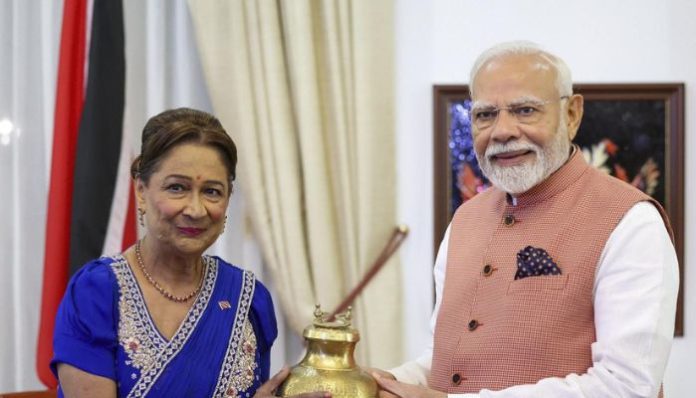
Prime Minister Narendra Modi, on his first official visit to Trinidad and Tobago, addressed the Indian diaspora in the capital city Port of Spain and referred to the deep cultural and ancestral roots between the two nations. This was not only ceremonial, this was an emotional gesture to honour India’s centuries-old spiritual and cultural connection with the Indian diaspora in the Caribbean country.
During his speech, PM Modi remembered that the people of Trinidad and Tobago had previously sent holy water and ‘shilas’ (holy stones) to be used for the Ram Mandir in Ayodhya.
He added that it was a subject of great pride and dedication for him to present a replica of the Ram Mandir and holy water of the Sarayu River in Ayodhya as a present for the Indian community there.
“I know how much you all revere Prabhu Shri Ram. Your Ram Leelas are just wonderful. I am sure you were all pleased to witness Ram Lalla returning to Ayodhya after 500 years,” PM Modi added.
The Indian Prime Minister also spoke about his previous visit to Trinidad and Tobago some 25 years ago. He mentioned how Indian culture there still flourishes, with festivals such as Navratri, Mahashivratri, and Janmashtmi being celebrated enthusiastically, and traditional songs such as Chautal and Bhaitak Gana are still popular.
PM Modi complimented the courage and resilience of the Indian-origin people, stating, “Your ancestors abandoned the Ganga and Yamuna, but took the Ramayana in their hearts. They were not mere migrants; they were bearers of an ageless culture.”
Referring to the Indian diaspora as “our pride,” the Indian PM continued, “Each one of you is a ‘Rashtradoot’, an ambassador of India’s values and heritage.”
He also said that Trinidad and Tobago Prime Minister Kamla Persad-Bissessar is originally from Buxar, Bihar, and she is a “Bihar ki Beti” to many. PM Modi appreciated Bihar’s history in democracy, education, and politics.
Notably, last year, on 22nd January 2024, a grand ceremony was organised in Trinidad and Tobago to commemorate the consecration of Ram Lalla in Ayodhya. More than 5,000 people attended the ceremony, watched cultural performances and devotional songs dedicated to Lord Ram. The Ram Janmbhumi Sthapana Samiti, together with Indian community organisations, lit 550 lamps during the ceremony.
#WATCH | Ram Janmabhoomi Sthapna Samiti, Trinidad and Tobago in association with Overseas Friends of Ram Mandir and the Indian diaspora celebrate ahead of the Pran Prathishtha in Ayodhya. pic.twitter.com/jiEZmyUYyp
— ANI (@ANI) January 22, 2024
The Indian High Commission shared on X at the time, “Indeed, an honour to be part of the grand celebrations by the Indian Diaspora in Trinidad & Tobago on the eve of Pran Pratishtha of Shri Ram Lalla in Ayodhya.”
Indo-Trinidadians and Tobagonians comprise roughly 42% of the population and have maintained their link with Indian culture through generations.


