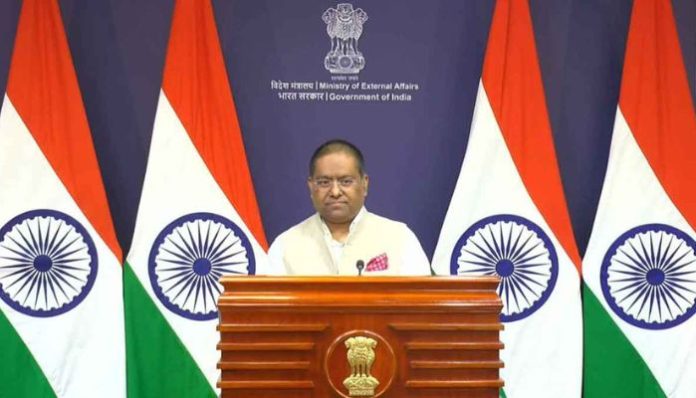
India on Thursday,14th August, sent a strong warning to Pakistan’s leaders, saying any “misadventure” against the country will bring “painful consequences.” The Ministry of External Affairs (MEA) spokesperson Randhir Jaiswal made the statement during the weekly press briefing, referring to reports about war mongering and nuclear threats from Pakistan.
#WATCH | Delhi | On Pakistani leadership's comments against India, MEA spokesperson Randhir Jaiswal says, "We have seen reports regarding a continuing pattern of reckless, war-mongering and hateful comments from Pakistani leadership against India. It is a well-known modus… pic.twitter.com/YlmHhIo7lV
— ANI (@ANI) August 14, 2025
“Pakistan should tone down its rhetoric. Any misadventure will have painful consequences, as we have shown recently,” Jaiswal said.
The warning came after Pakistan’s Army Chief, General Asim Munir, made shocking nuclear threats against India. While on a visit to the US, Munir reportedly said that if Pakistan ever faced an “existential threat” from India, it would “take half the world down” with it. According to reports, this is the first time such a nuclear threat has been issued from US soil against another country.
“We are a nuclear nation. If we think we are going down, we’ll take half the world down with us,” Munir was quoted as saying.
He also threatened to attack India’s infrastructure on the Indus River, which could affect the water supply to Pakistan. Munir criticised India’s decision to suspend the Indus Waters Treaty after the Pahalgam terror attack in April, claiming it could push 250 million Pakistanis toward starvation.
“We will wait for India to build a dam, and when it does, we will destroy it with 10 missiles. The Indus River is not India’s private property. We have no shortage of missiles, alhamdulillah,” he reportedly said.
Responding to a question regarding the award by the Court of Arbitration under the Indus Waters Treaty, Jaiswal said that India never accepted the legality, legitimacy, or competence of the so-called ‘Court of Arbitration.’
#WATCH | Delhi | On a question by ANI regarding the award by the Court of Arbitration under the Indus Water Treaty, MEA spokesperson Randhir Jaiswal says, "India has never accepted the legality, legitimacy, or competence of the so-called Court of Arbitration. Its pronouncements… pic.twitter.com/cx8zdrAtYN
— ANI (@ANI) August 14, 2025
“Its pronouncements are therefore without jurisdiction, devoid of legal standing, and have no bearing on India’s rights of utilisation of waters. India also categorically rejects Pakistan’s selective and misleading references to the so-called “award”. The Indus Waters Treaty stands in abeyance by a sovereign decision of the Government of India,” he added
The MEA’s response came after Pakistani leaders, including Prime Minister Shehbaz Sharif, threatened India for keeping the Indus Waters Treaty in abeyance following the ghastly Pahalgam terror attack.
Sharif said, “I want to tell the enemy today that if you threaten to hold our water, then keep this in mind you cannot snatch even one drop of Pakistan”, while addressing an event in Islamabad on Tuesday, 12th August.
He warned that if India tried, “you will again be taught such a lesson that you will be left holding your ears.”
Adding to the aggressive statements, former Pakistani Foreign Minister Bilawal Bhutto also attacked India and Prime Minister Narendra Modi. Speaking at a cultural event in Sindh on Monday, Bhutto accused India of causing “great damage” to Pakistan and called for national unity against Modi.
“The actions of the Indian government under Narendra Modi have harmed Pakistan. We must unite as a people to stand against these aggressions,” Bhutto said.
He also hinted that Pakistan could go to war if India continues to keep the Indus Waters Treaty suspended.
“If India continues on this path, we will have no choice but to consider all options, including war, to protect our interests. The people of Pakistan are strong enough to fight for all six rivers,” Bhutto declared.
Bhutto further warned that Pakistan would not “bow down” in front of India. “If you attack us, know that people from every province of Pakistan are ready to fight. This will be a war you will lose,” he said.
On several occasions, Munir has blamed India without any evidence for the recent tensions in the region in the aftermath of the 22nd April Pahalgam terror attack.