

In a major overhaul of the existing Goods and Services Tax (GST) regime, the Modi government has introduced several middle-class-friendly changes in the indirect taxes on a wide range of items from everyday essential items to luxury cars.
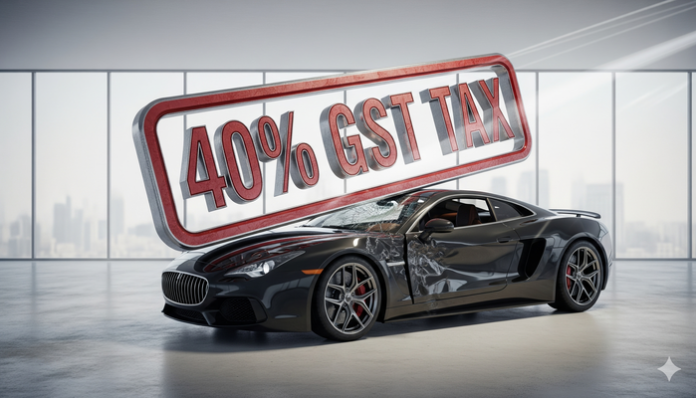
Under the new reforms announced on Wednesday (3rd September), after a meeting of the GST Council, luxury cars have been brought under a newly created tax category of 40%. Under the new rules, cars over 4 metres long and having petrol engines above 1200 or diesel engines above 1500 cc have been categorised as ‘luxury goods’.
As per the existing tax system, luxury cars are taxed at 28% GST with an additional compensation cess of 17%-22%. This makes the net tax on luxury cars 45-50%. But, after the new GST reforms, a consolidated tax of 40% will apply to the luxury cars without any compensation cess. This way, the cost of luxury cars will be reduced by 5-10%.
Luxury cars fall in the category of ‘sin goods’ under the new GST reforms. Sin goods are products, which are considered harmful to health or society, and include tobacco, gutka, pan masala, alcoholic or sugary beverages, Cars larger than 1,200 cc (petrol) or 1,500 cc (diesel), Motorcycles above 350 cc, and Aircraft for personal use. Sin goods have historically been heavily taxed by the government to discourage their consumption.
The reason behind bringing luxury cars under the ‘special tax rate’ of 40% is that the government intended to get rid of a separate compensation cess without dropping the overall tax. Therefore, it merged the compensation cess with the GST and provided a relief of 5-10%.
Government revises GST rates on other vehicles
Three-wheelers and buses will attract reduced GST rates of 18% from the earlier 28% after the reforms. Ambulances, which fall in the category of vehicles fitted with all equipment and furniture required for an ambulance, will also be taxed at 18%. Similarly, the GST rates for Lorries and trucks will also be reduced to 18%.
Besides, 5% tax will be levied on the trailers, semi-trailers of tractors with 1800 cc and non-road tractors will be taxed at 5%. An 18% tax rate will apply to road tractors for semi-trailers with an engine capacity of above 1800 cc engine capacity. Bikes with up to 3500 engine capacity will be taxed at the rate of 18% but the those exceeding 3500 cc will attract a 40% tax rate.


