The International Monetary Fund (IMF), on 13th October, stated that India remains among the fastest-growing major economies, with the FY27 GDP growth rate projection raised by 0.6 percentage points to 7.0%. The IMF report comes right after the Reserve Bank of India (RBI) raised the GDP growth estimate to 7.1% for the current financial year.
“India’s growth remained robust, underpinned by domestic demand and services, despite higher oil prices. China’s second-quarter performance was weaker than expected, at 4.3 percent year over year,” the IMF report titled World Economic Outlook states.
Meanwhile, the IMF has also raised India’s FY28 growth forecast by 0.3 percentage points to 7%. The IMF highlighted robust domestic demand and services activity in India despite elevated oil prices due to the West Asia crisis.
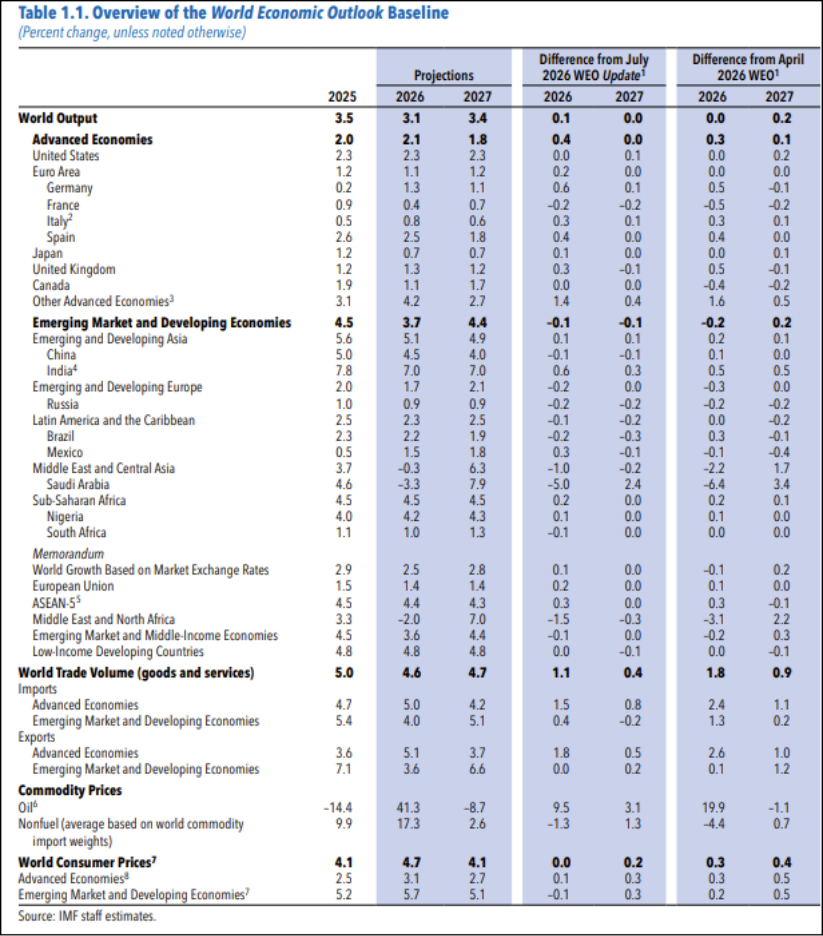
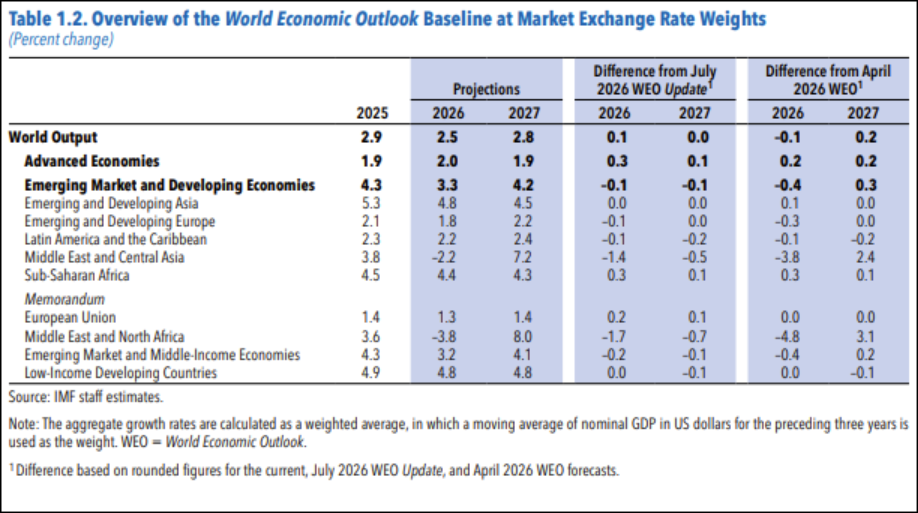
The IMF stated that global growth is projected to decelerate from 3.5% in 2025 to 3.1% in 2026 before recovering to 3.4% in 2027, unchanged from that in April for 2026 and revised upward by 0.2 percentage point for 2027.
“But the stable aggregate masks large cross-country offsetting movements and a greater concentration of global growth: 32 economies now account for 95 percent of global growth, compared with 54 economies in April, while downward revisions have,” the IMF report states.
India’s stable 7% growth reflects stronger-than-expected momentum
The IMF report forecasted that growth in emerging and developing economies is set to slow from 4.5% in 2025 to 3.7% in 2026. However, the IMF projects recovery to 4.4% in 2027.
“The outlook is heterogeneous, reflecting differences in commodity dependence, geographic exposure to the Middle East conflict, remittances and tourism receipts, financial conditions, policy frameworks, and position in the global technology value chain. Those directly impacted by the war drive the V-shaped pattern, whereas other regions are expected to follow a more even growth path,” the IMF report states.
The IMF report says that India remaining among the fastest-growing major economies reflects “stronger-than-expected” momentum, backed by “resilient domestic demand and robust services activity.”
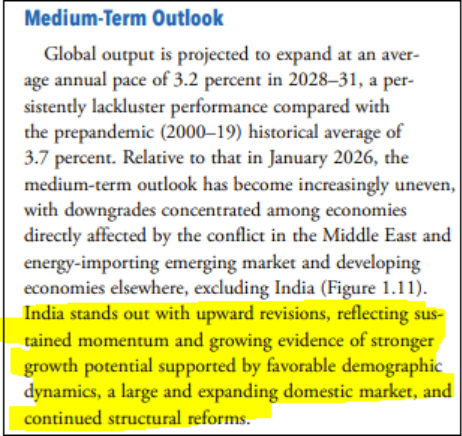
IMF says global output is set to expand at an average annual pace of 3/2%, with a mid-term outlook that is uneven for countries affected by the Middle East conflict, except India
It is pertinent to note that mid-term outlook refers to an assessment of macroeconomic trends, growth rates, inflation, and financial markets over an intermediate time frame, typically spanning 1 to 3 years.
Regarding the mid-term outlook, the IMF report makes a comparison between the pre-pandemic numbers and its forecast for 2028 to 2031. The IMF described the projected global output expansion at an average annual pace of 3.2% as a “persistently lacklustre performance.”
India, however, remains an exception with upward revisions, which reflect sustained momentum and evidence of stronger growth potential.
“Global output is projected to expand at an average annual pace of 3.2 percent in 2028–31, a persistently lackluster performance compared with the pre-pandemic (2000–19) historical average of 3.7 percent. Relative to that in January 2026, the medium-term outlook has become increasingly uneven, with downgrades concentrated among economies directly affected by the conflict in the Middle East and energy-importing emerging market and developing economies elsewhere, excluding India,” the IMF report states.
Regarding India, the report says, “India stands out with upward revisions, reflecting sustained momentum and growing evidence of stronger growth potential supported by favorable demographic dynamics, a large and expanding domestic market, and continued structural reforms.”
IMF hails India-EU and India-UK trade deals
Besides, the IMF also hailed the European Union’s trade agreements with India and the India-UK Free Trade Agreement, stating that these new regional and bilateral trade agreements could “lower tariffs and non-tariff barriers on traded goods and services among participating economies, facilitate adjustments to recent trade policy changes, and strengthen supply-chain resilience”.
Notably, in September this year, the IMF backed India’s latest economic data, stating the country’s economy remains resilient despite the global energy price shock. The IMF’s comments come after India reported real GDP growth of 7.8% in the April-June quarter of FY27, a figure that was higher than both the Reserve Bank of India’s earlier estimate of 7% and the expectations of several observers.
Last month, JPMorgan Chase CEO Jamie Dimon said that India’s economy could triple over the next decade. He said that India’s economic growth could lead to a much larger corporate and research ecosystem over the next 10 years.
While detractors of the Modi government have been engaged in casting aspersions on the GDP growth rate by the RBI, international forums like the IMF have consistently stated that India’s economic growth numbers.