

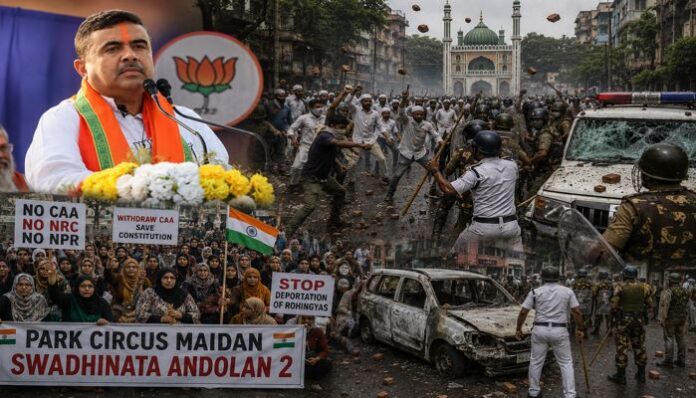
The Park Circus area of central Kolkata has once again come into focus after violence during protests over restrictions on roadside prayers and loudspeaker use led to clashes with police, damage to vehicles and injuries to security personnel. The latest confrontation has also triggered a larger political discussion around Park Circus, a locality that has repeatedly emerged as a major site of mass protests and mobilisations over the years, particularly during issues involving the Muslim community. West Bengal Chief Minister Suvendu Adhikari has now issued a strong warning against those trying to disturb public order, saying the administration will no longer tolerate violence or attempts to create unrest.
CM Suvendu Adhikari’s warning after Park Circus violence
Reacting to the recent stone-pelting incident, Chief Minister Suvendu Adhikari said the state government would take a strict approach against people involved in violence and warned that “hooliganism” would not be allowed to continue in Bengal.
#WATCH | Kolkata: On yesterday's incident of stone pelting in Park Circus area, West Bengal CM Suvendu Adhikari says, "Such incidents no longer occur in Kashmir. In Bengal, people had become accustomed to a certain laxity—they felt that the government would not take any action… pic.twitter.com/j0cvU5LLhO
— ANI (@ANI) May 18, 2026
He said law enforcement agencies had been given a free hand to act under the law and that the period when police personnel were left exposed without strong backing was over.
The Chief Minister said some people had become used to what he described as administrative softness and believed no action would be taken against them. He added that the government wanted to send a clear message that stone-pelting, disturbing public order or using religious slogans to create tension would not be accepted. He also mentioned that police were examining social media activity after claims that information about the disturbance had appeared online even before the incident happened.
Adhikari further spoke about plans to strengthen the Kolkata Police force through better infrastructure and logistics support. He also appealed to the Union Home Minister to allow the paramilitary companies already stationed in the state to continue for some time, saying their withdrawal could create manpower pressure. At the same time, he asked people to cooperate with the police and administration in maintaining peace.
Police action after clashes in Park Circus
The violence took place near the Park Circus Seven Point crossing where protests had been organised against the government’s restrictions on roadside namaz and loudspeaker volume limits.
Muslims ran riot at Park Circus, Kolkata, instigated by #ChorTMC leader Crime-Corruption-Communal hate-sponsor Mamata Banerjee.
— Kanchan Gupta 🇮🇳 (@KanchanGupta) May 18, 2026
Reason? Ban on namaz on road, no loudspeakers, no slaughter in public places.
Nice to see @KolkataPolice has found its long-lost mojo. Way to go KP! pic.twitter.com/rutUHAcRJH
Muslim protesters gathered in the area and blocked parts of the road, leading to traffic disruption. Police had already deployed forces after receiving prior information about the demonstration.
According to officials, tensions increased when police moved to clear the road blockade. The confrontation soon turned violent, with stones and bricks thrown at security personnel and vehicles present in the area. Police vehicles suffered damage and several parked vehicles were also hit during the unrest. Visuals from the area showed broken windscreens and damage caused by stones.
Police responded with a lathi charge to disperse the crowd and regain control of the situation. Additional forces were rushed to the location and traffic movement was restored around the Park Circus Seven Point area. Authorities later confirmed that several people had been arrested and flag marches were carried out in Park Circus and other sensitive locations. Senior officers were directed to strictly enforce the new public order measures.
Officials also linked the incident to tensions that had started earlier in Rajabazar during Friday prayers when police tried to implement the state government’s policy against offering prayers on public roads. That episode had also seen confrontations and police action after roads were blocked.
The present government has taken a tougher line on roadside religious activities. BJP leaders have publicly stated that prayers should remain within mosques and not affect public movement on roads. Restrictions on loudspeaker volume and public gatherings have also become part of the administration’s approach.
Park Circus and its history of large community mobilisations
The latest developments have revived discussion about Park Circus and its long history as a centre of large-scale protests. The locality has repeatedly emerged as a gathering point during community-driven movements, especially because of its location, connectivity and ability to attract large crowds quickly.
Park Circus is one of Kolkata’s better-connected neighbourhoods and sits close to several important roads and densely populated localities. The area also witnesses large gatherings around Friday prayers, which has often made mobilisation easier during periods of social or political tension. Over the years, many demonstrations linked to Muslim community concerns have either started here or built momentum in the locality.
Anti-CAA and NRC movement at Park Circus maidan
One of the biggest examples was the anti-CAA and NRC agitation that turned Park Circus Maidan into a major protest site during the winter of 2020. Inspired by Delhi’s Shaheen Bagh movement, Muslim women-led sit-ins continued day and night with protesters saying they would remain until the Citizenship Amendment Act, NRC and NPR-related concerns were addressed.
The Muslim women from the locality and nearby areas regularly gathered at the site. Many brought children and family members while students and activists joined them. Protesters raised slogans, organised cultural programmes and demanded facilities such as tents, toilets and loudspeakers as the demonstration expanded. The movement eventually became known locally as “Swadhinata Andolan 2” or the second freedom struggle by some participants.
Several participants said they had never joined political protests before but felt compelled to participate because of fears over citizenship issues. Cultural figures, activists and political leaders also visited the venue. The protest became one of Kolkata’s most visible anti-CAA demonstrations and turned Park Circus into a national reference point during the movement.
Rally against Rohingya deportation
Park Circus again became the starting point for another major mobilisation when over a thousand of Muslim people joined a rally opposing the proposed deportation of Rohingya Muslims to Myanmar. The march was organised by multiple Muslim organisations and began from the Park Circus ground before moving toward the Myanmar Consulate office.
The demonstration also sparked political reactions, with BJP leaders criticising the then state leadership and accusing it of vote-bank politics around the issue. The event further added to Park Circus’s image as a regular site for issue-based mass gatherings involving Muslim organisations.
The prolonged women-led sit-in and its social impact
The anti-CAA protest at Park Circus was not only political but also carried a strong social dimension. Thousands of women, many of whom had never been part of public demonstrations earlier, remained active in the movement for weeks. The protest saw participation from homemakers, students, working women and families.
The death of a Muslim woman participant, Sameeda Khatoon, after a cardiac arrest at the protest site became an emotional moment for the movement. Many protesters described her as one of the faces of the resistance. Writers and activists later reflected on how Park Circus had changed from being viewed mainly as a neighbourhood identified through stereotypes into a major political and social space during that period.
Participants frequently spoke about citizenship, belonging and fears linked to documentation. For many Muslim women at the protest, the movement was also about protecting what they described as their “home” and identity. The sit-in continued for an extended period and became one of the most discussed protest spaces in eastern India at the time.
Changing law-and-order approach after political transition
The recent police response in Park Circus is now being viewed by supporters of the present BJP government as a sign of changing administrative priorities after the end of TMC rule in the state. The government maintains that public order enforcement is becoming stricter and that groups involved in road blockades, stone-pelting or violent protests will face immediate action.
Supporters of the new administration argue that incidents which earlier ended without strong consequences are now seeing arrests, deployment of additional forces and visible police presence. Flag marches in sensitive areas, enforcement of roadside gathering rules and quick police intervention are being projected as examples of this shift.
With Park Circus once again at the centre of political and social debate, the latest episode has brought together multiple strands its history as a protest hub, its role in past mass movements and the government’s attempt to project a tougher law-and-order policy. The administration’s message, as stated by the Chief Minister, is that while peaceful activity will continue under the law, any attempt to turn protests violent or disturb public order will invite action.


