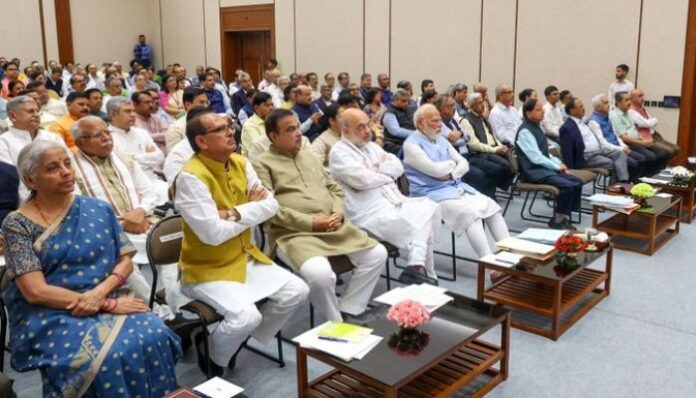
On 21st May 2026, Prime Minister Narendra Modi chaired a full Council of Ministers meeting at the Seva Teerth. The meeting, which lasted for nearly 4.5 hours, came right after PM Modi returned from a five-nation tour, boosting energy, defence, and strategic relations amidst the West Asia crisis.
The meeting, headed by PM Modi, served as a midterm review of the government’s performance as NDA completes two years into the third term. The core agenda of the meeting was accelerating reforms to achieve the goal of a Viksit Bharat by 2047, improving Ease of Living, Ease of Doing Business, and addressing the fallout of the ongoing West Asia crisis.
In an X post published on 22nd May morning, Prime Minister Narendra Modi informed about the agenda of the Council of Ministers meeting held on Thursday.
“Had a fruitful meeting of the Council of Ministers yesterday. We exchanged perspectives and best practices relating to boosting ‘Ease of Living, ‘Ease of Doing Business’ and how to further reforms in order to realise our shared dream of a Viksit Bharat,” the Prime Minister wrote.
Had a fruitful meeting of the Council of Ministers yesterday. We exchanged perspectives and best practices relating to boosting ‘Ease of Living, ‘Ease of Doing Business’ and how to further reforms in order to realise our shared dream of a Viksit Bharat. pic.twitter.com/ifKpB8le17
— Narendra Modi (@narendramodi) May 22, 2026
West Asia crisis to Viksit Bharat: What was discussed in the Council of Ministers meeting?
During the meeting, several ministers, including Labour, Commerce, Finance, Power, Agriculture, Railways, NITI Aayog, Petroleum, Shipping, Coal, etc, gave a detailed presentation on their successes, ongoing work, future plans, and targets. Various ministries classified reforms into categories like administrative, policy, legislative, etc.
Notably, Defence Minister Rajnath Singh and Health Minister JP Nadda did not attend the high-level meeting since Singh is on a key visit to South Korea and Nadda is in Geneva. Though unavailable for the meeting, Minister Singh is leading a high-power informal group of ministers to monitor the West Asia crisis.
The Council of Ministers meeting focused on reform push, with discussions on curbing compliance burdens, simplifying procedures, quicker file clearance, and decision-making coupled with minimising delays.
Building on the recent GST recalibration, PM Modi emphasised continuing and accelerating economic reforms and planning beyond the current fiscal year.
Reports say that the Council of Ministers meeting also reviewed the implementation and progress of various schemes and projects, in addition to interministerial coordination.
A key agenda of the meeting held on Thursday was the prevailing West Asia crisis amidst a fragile ceasefire between Iran, the US and Israel. The discussions in the Thursday meeting focused on the impact of the ongoing global crisis on energy security, oil prices since crude prices have skyrocketed over $110/barrel, fuel supplies, supply chains, inflation, agriculture, fertilisers, aviation, shipping, and logistics.
Prime Minister Narendra Modi directed ministries to take measures to ensure “minimum inconvenience to citizens”.
Besides, the Prime Minister conducted a broader governance review, seeking details of ministry functioning, recent policy outcomes, etc.
PM Modi was also felicitated for the successful five-nation tour and the BJP’s historic victory in West Bengal.
Pertinently, speculations were rife that the Council of Ministers meeting might result in the announcement of a cabinet reshuffle. However, no such announcement has been made.
The timing of the meeting, amidst an escalating West Asia crisis, is crucial. India imports over 85 to 90% of its crude oil, and is vulnerable to price spikes, inflation, and supply chain disruptions. While the government has taken measures to diversify import sources, the ongoing crisis has impacted fertilisers, power and the aviation sector.
PM Modi earlier held CCS meetings to address the security aspects. The Council of Ministers meeting came after the Prime Minister returned from his visit to the UAE, Norway, the Netherlands, Sweden, and Italy, securing $40 billion investment for India’s semiconductors, logistics, green energy, and other key sectors. Though explicit details are not out yet, the meeting held on Thursday focused on the diplomatic and economic outcomes of PM Modi’s five-nation tour.
Two years into the term, the Prime Minister essentially held a midterm stocktaking to review the progress and working style of his ministers, while also setting the tone for the remaining period, especially amidst global uncertainties.
The Prime Minister also urged the cabinet to avoid needless controversies and focus on expediting the completion of delayed projects. Overall, the central focus of the meeting remained on the long-term Viksit Bharat 2047 ambition, and the current West Asia crisis.