

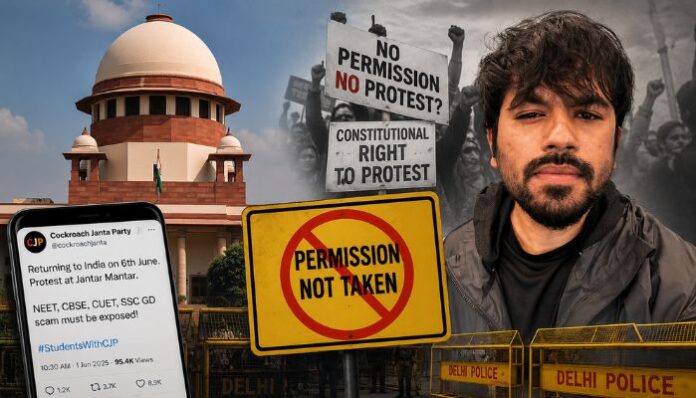
AAP worker turned Cockroach Janta Party (CJP) founder Abhijeet Dipke announced on 1st June that he would return to India from the United States on 6th June and lead a protest in New Delhi over alleged irregularities in examinations such as NEET, CBSE, CUET and SSC GD.
In a video posted on X, Dipke called upon supporters to gather at Delhi airport when he lands and then proceed towards Parliament Street Police Station before holding a demonstration at Jantar Mantar. While describing the proposed event as a “peaceful” and “constitutional” protest, the announcement immediately attracted attention because it sought to convert an online campaign into a physical mobilisation in the national capital.
Important announcement:
— Cockroach is Back (@Cockroachisback) June 1, 2026
CJP Founder @abhijeet_dipke will return to India on June 6 for a peaceful protest at Jantar Mantar, Delhi, demanding the resignation of the Education Minister. pic.twitter.com/x9M1v38Pwu
However, as the date of the protest approaches, questions are being raised over whether the organisers have followed the mandatory procedures required for holding demonstrations at Jantar Mantar. As of the announcement, there was no indication that Delhi Police had been informed in writing about the proposed gathering or that any formal process had been completed to obtain permission for the event.
Dipke himself admits that he did not take permission
The controversy deepened just days before his arrival in India when Dipke admitted during a public interview that he had not obtained police permission for the protest.
On Wednesday, 3rd June, during an interview with journalist Ajit Anjum, Dipke was directly asked whether he had taken the necessary police permission required for the proposed demonstration. His response was a simple “No.”
CJP only wants to do Drama, not Protest
— Ankur Singh (@AnkurSingh) June 3, 2026
Anjum- Have you taken Police Permission required to organise Protest?
Dipke- No
Anjum- it's procedure to obtain prior permission and give undertaking of how many people will be there, timing of protest, etc.
Dipke- I will go to Police… pic.twitter.com/Zh2EiAMxQn
Anjum then pointed out that organisers are generally required to apply in advance and provide details such as the number of participants expected, the timing of the event and other logistical information. Dipke replied that he would go to the police station on the same day and seek permission.
When Anjum noted that same-day permissions are generally not granted and questioned why the process had not been initiated earlier, Dipke responded, “I will wait in the police station till they give permission.”
Asked again why permission had not been sought beforehand, Dipke reportedly replied, “We want to do things our way; we will stick to that.”
Anjum- CJP has many members in Delhi, why don't they take police permission for protest on 6th?
— Ankur Singh (@AnkurSingh) June 3, 2026
Dipke: we want to do things our way, we will stick to that.
It's very clear that Abhijeet Dipke doesn't want to do peaceful protest. He wants to do chaos and get Detained to show… pic.twitter.com/fD0U83pyDV
The remarks immediately triggered debate online, with a protest described as peaceful and constitutional would not follow the established legal process that has been in place for years.
CJP spokespersons questions the need for prior permission
Adding to the controversy, the Cockroach Janta Party held a press conference on Wednesday, 3rd June, where party spokespersons openly questioned the very idea of obtaining prior permission for protests.
During the media interaction, CJP spokesperson Saurav Das argued against the existing system and said: “You are asking us to take permission. Tell me, how many months in advance should we apply? Then the permission gets rejected, and then we go to court. Why should we ask for permission in the first place? Does it make sense that you go to Jantar Mantar at 10 in the morning, leave at 5 in the evening, raise slogans and then everything ends there? Is that how protest works in a democracy? That is the culture we are fighting against. That has to change.”
CJP Gen-Z nahi Gen-C hai
— Ankur Singh (@AnkurSingh) June 3, 2026
Gen- Chutiya
CJP says why to take police permission before?
Next they will say why file nomination for elections before?
We will go to Election Commission office on morning of Voting. In a Democracy they'll have to allow us to contest elections.
Can… pic.twitter.com/w9U218xPu2
The comments have further intensified questions over whether the group intends to comply with the existing legal framework governing demonstrations or whether challenging that framework is itself part of its political strategy.
Permission requirement is not a new rule
The debate surrounding permission for protests is not new. In fact, Delhi Police has been operating under specific guidelines for demonstrations at Jantar Mantar since 2018. These guidelines were framed following directions issued by the Supreme Court and require organisers to inform the police in writing before holding any demonstration.
Under the rules, anyone wishing to organise a protest at Jantar Mantar must submit a written application 7 days in advance to the New Delhi District Police.
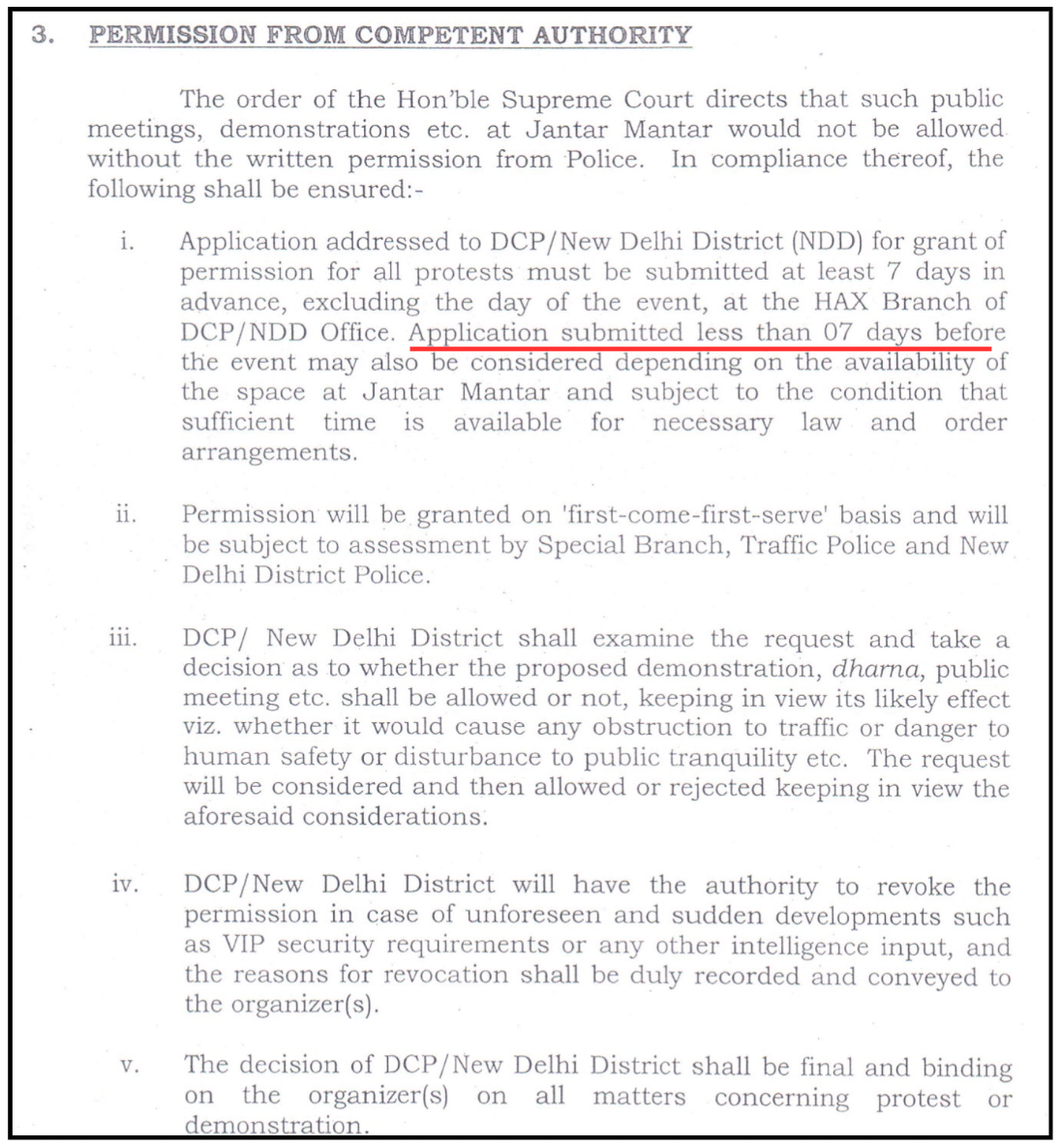
The requirement exists because authorities need time to assess issues such as law and order, security arrangements, traffic management, availability of the venue and other public safety concerns.
Therefore, the requirement for prior permission is neither a recent development nor an extraordinary restriction. It has been part of the legal framework governing protests in Delhi for several years.
Dipke’s AAP background and the Atishi petition
Dipke is likely to beware of these rules because of his earlier association with the Aam Aadmi Party (AAP).
Interestingly, the Aam Aadmi Party itself has previously dealt with the same issue in court proceedings.
In 2020, AAP leaders, including Atishi Marlena, approached the Delhi High Court regarding permissions for protests. In response, Delhi Police filed an affidavit referring to the same 2018 guidelines and explained that demonstrations at certain sensitive locations could not be allowed without following the prescribed process.
The affidavit also reiterated that written applications for demonstrations were required in advance, in accordance with the framework created after the Supreme Court judgment.
Because of AAP’s previous legal engagement on the matter, Dipke and others associated with the party’s ecosystem would already be familiar with the permission requirements applicable to demonstrations in Delhi.
Abhijeet Dipke’s links with AAP
Abhijeet Dipke has long been associated with AAP’s social media ecosystem.
Several reports during the 2020 Delhi Assembly elections identified him as a member of AAP’s social media and digital campaign machinery. Reports described him as a key figure involved in creating memes, short videos and digital content designed to promote Arvind Kejriwal and counter political opponents.
Dipke is also a part of AAP’s wider election war-room operations and social media coordination efforts.
He was quoted in media interviews discussing campaign strategies aimed at millennials and first-time voters and worked with AAP’s IT and media teams during election campaigns.
His political views have also been visible through social media activity over the years, including posts critical of Prime Minister Narendra Modi and supportive of various opposition narratives.
This clearly shows that Dipke is not a concerned youth who suddenly entered public life through the Cockroach Janta Party, but someone with an established political background linked to AAP’s communication and campaign operations.
What does the 2018 Delhi Police order say?
The Delhi Police guidelines issued in 2018 clearly state that demonstrations at Jantar Mantar cannot be organised without prior written permission. Under these guidelines, an application must be submitted to the Deputy Commissioner of Police of New Delhi District at least 7 days before the proposed event.
After receiving the application, Delhi Police consults various agencies including the Special Branch, Traffic Police and district authorities before deciding whether permission can be granted. The guidelines further state that factors such as traffic disruption, security concerns, risk to human life, availability of the venue and law-and-order considerations must be examined before a final decision is made.
Permission is generally granted on a first-come, first-served basis when multiple applications are received.
The police also reserve the right to revoke permission if intelligence inputs, VIP movements or unforeseen security concerns emerge after approval has already been granted.
What did the Supreme Court say?
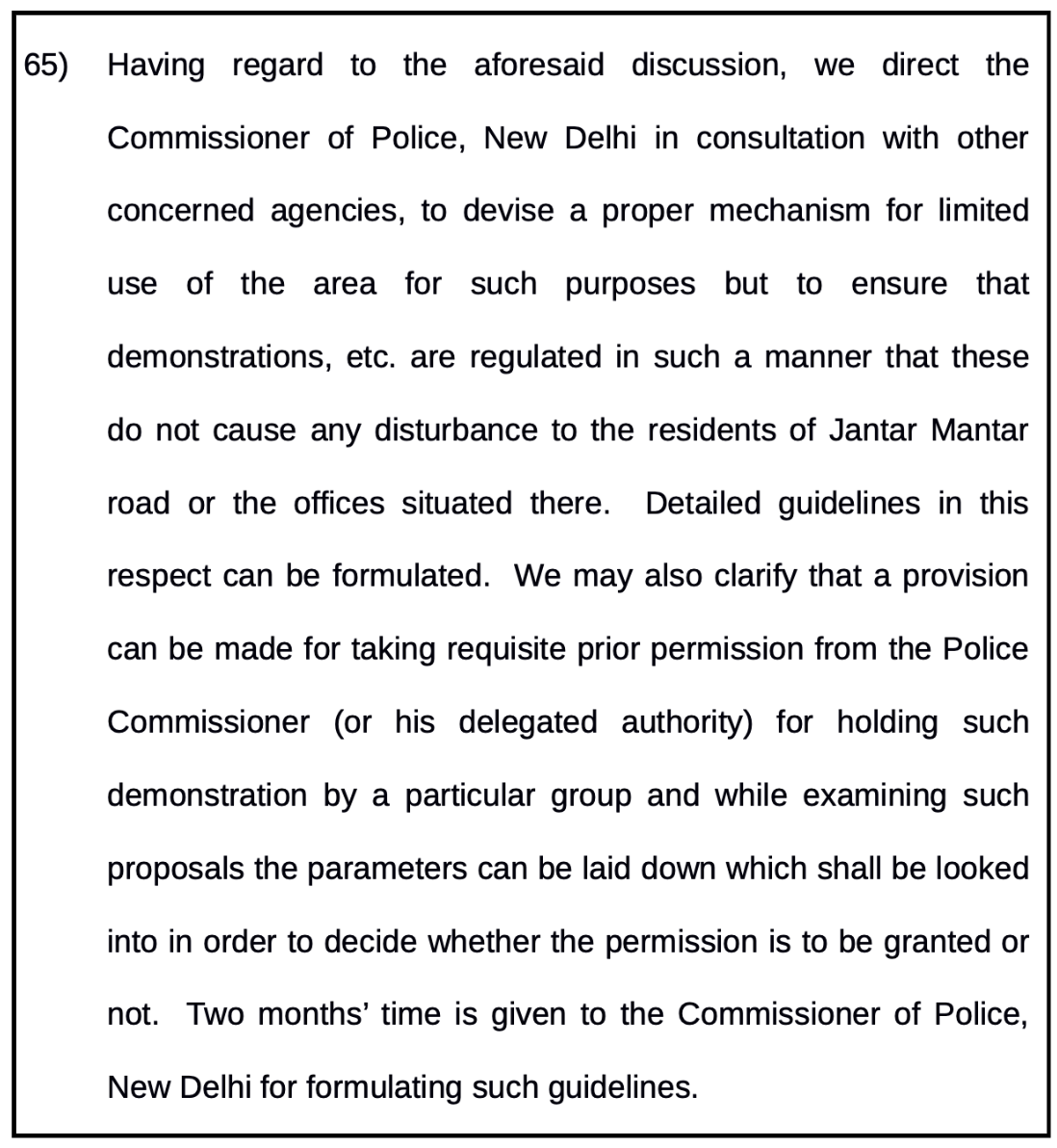
The Delhi Police framework originated from a Supreme Court judgment delivered in 2018 in a case involving the Mazdoor Kisan Shakti Sangathan.
The dispute arose after restrictions were imposed on demonstrations around Jantar Mantar following complaints about noise pollution, traffic congestion and inconvenience caused to local residents.
In 2017, the Mazdoor Kisan Shakti Sangathan had filed a writ petition in the Supreme Court challenging the orders of the Delhi Police under CrPC 144, which had banned demonstrations and demonstrations near Parliament and some government offices. The petition also raised objections to an order of the NGT. This order of the NGT had completely banned demonstrations on Jantar Mantar Road based on complaints from locals about noise pollution, traffic, etc.
While hearing the matter, the Supreme Court held that the right to peaceful protest is a fundamental right in a democracy. However, the Court also clarified that this right is not absolute and must be balanced against the rights of local residents and broader public interests.
Instead of supporting a blanket ban on demonstrations, the Court ordered the Delhi Police to prepare guidelines for the use of Jantar Mantar for demonstrations, and in this order, the court also clearly stated that a provision should be added to the guidelines to inform the Delhi Police in writing before the demonstration.
Following this order of the Supreme Court, Delhi Police prepared guidelines, according to which written permission has to be obtained 7 days before the demonstration.
The motive is to play victim card and then blame the system
With only days remaining before the proposed demonstration, the debate has shifted from the issues raised by the Cockroach Janta Party to the manner in which the protest itself is being organised.
There’s also another question: why members or spokespersons associated with the Cockroach Janta Party could not have completed the permission process before he arrived in India.
The motive is so clear that he doesn’t want a peaceful protest; instead, want to create drama and play the victim card that if permission is denied due to procedural issues, he could later claim that authorities blocked the protest. It most likely gives the impression that Dipke is preparing for a confrontation with authorities rather than ensuring all procedural requirements are completed beforehand.
Nevertheless, by calling on students and supporters from across the country to gather in the national capital, Dipke appears to be testing whether the outrage cultivated online can translate into visible pressure on the streets.


