

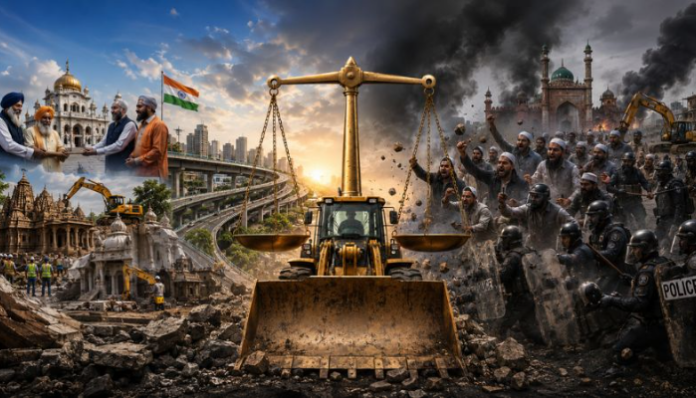
A persistent trend of obstructionism frequently emerges in India concerning development and the enforcement of law. A specific community starts to protest each time the government utilises bulldozers to modernise a city, expand roadways or remove encroachments from public land, characterising the action as an “assault on religion.” Events from Jaipur to Delhi and Faridabad to Varanasi illustrate that when temples, gurdwaras or governmental structures are dismantled, the action is regarded as a part of development, and the sacrifice is readily accepted.
Nevertheless, when the tables turn towards mazar or madrasa, a crowd of Islamists quickly assembles, and security personnel are attacked with stones as a narrative of victimisation is disseminated globally even though this particular mob is accountable for the greatest number of illegal constructions.
Administration’s action against “Noorani Mosque” in Jaipur
On 8th June (Monday), the Jaipur Development Authority (JDA) took down the unauthorised “Noorani Mosque” located in the Nandipuri region of Jaipur. This measure was necessary to expand the Jagatpura-Malviya Nagar road from 30 feet to 80 feet. The administration stated that two temples, a mazar and a satsang hall also fell on this route alongside the mosque. Notably, the demolition of the temples did not provoke any unrest, but the administration had to deploy 3,000 police officers to execute the action against the mosque.
The city was placed under a high alert, resulting in the temporary suspension of internet services. This ban was deemed necessary as radical factions exploit social media to organise crowds and circulate incendiary posts designed to disrupt the law and order of the city. The police executed a flag march and deployed personnel throughout every neighbourhood. This troubling event happened solely because a group was intent on infusing a religious colour into a development project.
Varanasi’s multi-modal station: Action under the cover of darkness
Bulldozers arrived at midnight to assist in the expansion of the Kashi railway station in Varanasi. During this operation, a Hanuman temple and the Ajgaib Shahid Mosque, both on railway land, were taken down. Heavy contingents of the Pradeshik Armed Constabulary (PAC) and Railway Protection Force (RPF) were stationed by the administration.
The railways indicated that the station is planned for development similar to that of an airport. All unauthorised structures were completely razed in about an hour. This ₹336-crore project aims to serve millions of passengers. The temple’s representatives did not raise any objections or cause any disturbances. Religion was not allowed to obstruct this significant development effort, a hallmark of a mature society.
Delhi’s Turkman Gate: Uproar over destruction of illegal structures and attack on police
Islmaic hardliners threw stones at the cops when unlicensed structures were being removed at the Turkman Gate area in Delhi. A dispensary and a wedding hall next to the mosque were deemed illicit by the Delhi High Court. However, as the anti-encroachment initiative began, demonstrators congregated at the site and hindered the police from carrying out their duties and launched violent assaults.
They pelted stones, resulting in critical injuries to the Station House Officer (SHO) of the Chandni Mahal police station. The police were compelled to use tear gas shells. Ironically, residents had been given time to remove their belongings before the operation started. However, it appeared that their only purpose was to create unrest instead of following the law. Attacking the persons in uniform seemed to be more important for them.
The magnanimity of Sikhs: They gave up a 72-year-old Gurdwara in Kashmir
The Sikh community has consistently exemplified commitment to the progress of the nation. A 72-year-old “Damdama Sahib Gurdwara” was required to be demolished to enable the construction of the Srinagar-Baramulla highway in Kashmir. Established in 1947, the religious site had been catering to thousands through its langar or community kitchen. However, the Sikhs offered complete cooperation to the authorities.
The community willingly came forward and agreed to the demolition action. They facilitated the construction of the highway by prioritising development. The administration promised them alternative land and aide in exchange. There were no internet shutdowns or instances of stone-pelting. This shows that a truly devout person values the nation’s progress above all else.
Jhandewalan and Warangal: Law was upheld amid demolition of temples
An ancient 800-year-old temple complex along with more than a hundred residences were dismantled in Jhandewalan of Delhi. The local inhabitants expressed feelings of anger and grief. However, no one instigated disorder. Despite the complex’s proximity to the Rashtriya Swayamsevak Sangh (RSS) headquarters, the Hindu community refrained from taking the law into their own hands, opting instead to voice their dissent peacefully and demand justice.
Likewise, an 800-year-old Shiva temple from the Kakatiya period was demolished to facilitate the construction of a school in Warangal of Telangana. The community was disheartened but they did not engage in violent protests. Complaints were lodged against the authorities and legal measures were sought. This reflects the resilience of the Hindu community which even in the face of temple demolitions chooses not to resort to rioting.
Demolition in Faridabad: When a temple and mosque fell together
A significant demolition campaign was executed in the NIT-3 area of Faridabad after orders from the courts and the National Green Tribunal (NGT). Twenty unlawful structures which included two places of worship, a mosque and a temple, were demolished. More than 1,000 police officers were deployed, and mobile internet services were suspended throughout the operation. The administration recognised that certain groups might try to provoke unrest as soon as action begins against the mosque.
This operation was crucial for the establishment of a railway corridor and an elevated road. The temple was dismantled without any untoward incident, but efforts were made to incite conflict regarding the mosque. The administration had to execute the operation from 2:00 am to 2:00 pm. This was not a discriminatory act but rather a continuous imposition of the law which only a specific community decided to reject.
The Gujarat Model: When the Modi government demolished temples
Gujarat stands out as the most relevant example in relation to discussions of religious structures and development. During Narendra Modi’s time as the chief minister, many temples in Gandhinagar were demolished in just one month to enable road widening. The administration had decided to eliminate all illegal structures erected on government land.
This operation was remarkably carried out around the Diwali period and was completed without any violence. The temples were removed overnight and the public cooperated. PM Modi declared that the “duty towards the nation” or Rashtra Dharma is greater than any religion. There was some pushback from Hindu outfits, but the government remained firm in its decision, successfully widening the roads in Gandhinagar.
According to PM Modi, officials tend to target Hanuman temples at first to instill fear in politicians, believing that such actions would elicit a backlash and disrupt the proceedings. However, he showcased courage in Gujarat. As a result, the traffic congestion problem was successfully resolved, and the city became more pleasant.
“Land Jihad” and the media’s perspective
It is an unfortunate reality that the most common unlawful intrusions on public land manifest as mazars. This occurrence is often referred to as “Land Jihad” due to the fact that these structures are usually constructed overnight. Subsequently, efforts are made to preserve them by designating them as “historic.” For example, Jaipur’s Noorani Mosque was claimed to be 45 years old. However, does age truly justify an encroachment?
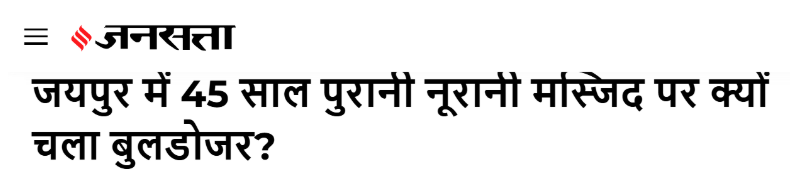
A segment of the media, the “Leftist cabal” also draws attention to actions taken against mosques, prominently featuring headlines that conveniently hide the fact about their illegal status.

However, the media coverage is seldom significant when the matter is related to temples. It is merely referred to as an “anti-encroachment drive” while the destruction of these mosques is depicted as “persecution of Muslims.” This narrative contributes to instigate the Muslim extremists.
Equality before the law
The wheels of progress do not stop based on anyone’s faith. If India is to transform into a developed nation by 2047, it is crucial to obliterate all such illegal occupation. The perspective of a certain community arguing that “my illegal construction is part of my religion’” is the foremost blockade to the country’s development. They should take inspiration from Sikhs and Hindus, who realise that sacrifice is necessary for the betterment of the nation.
The pressure on the administration to cut off internet access and mobilise thousands of security personnel illustrates that religious extremism undermines the nation’s sovereignty. Until every citizen comprehends that encroaching on public land is a criminal act rather than a religious practice, the sound of the bulldozer will continue to be inevitable. Afterall, the rule of law is the fundamental characteristic of a democracy.
Read the original report in Hindi here.


