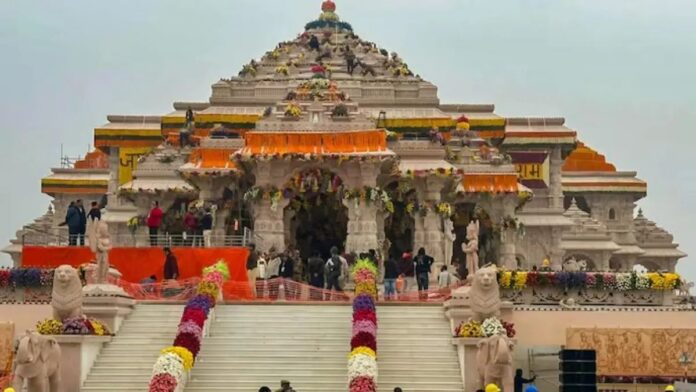
The Shri Ram Janmabhoomi Mandir in Ayodhya is not merely a temple. For millions of Hindus across the world, it is the culmination of a centuries-long civilisational struggle, legal battle, and social movement that finally culminated in the consecration of Ram Lalla in January 2024.
Since the Pran Pratishtha ceremony, the temple has received an overwhelming response from devotees. Lakhs visit Ayodhya every month and donate generously in cash, gold, silver, jewellery and other offerings.
It is therefore understandable that allegations of embezzlement involving Ram Mandir donations have triggered widespread concern. Claims of missing funds, suspicious property acquisitions by employees, alleged disappearance of donated valuables and possible manipulation of records have transformed what began as local reports into a national controversy.
However, amid political mudslinging and sensational headlines, one crucial fact is often ignored: the Shri Ram Janmabhoomi Teerth Kshetra Trust is an autonomous body and not an institution whose finances are controlled by the Uttar Pradesh government. This distinction is central to understanding both the controversy and the ongoing investigation.
How the Ram Mandir donation controversy erupted
The controversy began after local media reports highlighted alleged irregularities in the accounting of donations received at the Ram Mandir.
The issue entered the political arena on 7th June when Samajwadi Party chief Akhilesh Yadav cited media reports claiming crores of rupees in offerings could not be accounted for.
Calling it an issue linked to the faith of crores of devotees, Akhilesh Yadav questioned the silence surrounding the matter and demanded judicial intervention. For someone who didn’t attend the consecration ceremony of the Ram Temple in Ayodhya, it was politically convenient to lap up a controversy that could be weaponised to target the Yogi Adityanath government.
Over the following days, allegations snowballed.
Initially, reports suggested that donations worth between Rs 5 crore and Rs 7.5 crore were allegedly unaccounted for. Subsequently, some reports claimed the scale of the alleged discrepancy could be far larger, with estimates crossing Rs 200 crore.
While the exact figures remain disputed and unverified, the allegations triggered demands for a comprehensive investigation.
What exactly are the allegations?
The controversy revolves around multiple allegations involving different aspects of donation management.
According to reports, some cash-counting staff allegedly recorded lower amounts in vouchers than the actual cash collected from donation boxes.
Questions have also been raised regarding the handling and accounting of gold, silver and jewellery donated by devotees.
Further suspicion emerged after allegations that CCTV footage from cash-counting areas covering several months had allegedly been deleted.
There are also allegations that complaints regarding irregularities were either ignored or not acted upon adequately.
Collectively, these claims created concerns that a section of the donation-handling chain may have been compromised.
The whistleblower claims and allegations of a cover-up
One of the individuals at the centre of the controversy is Mahipal Singh, identified in media reports as a former accounts-in-charge associated with temple operations.
Singh alleged that donation theft had been taking place for a considerable period and claimed that concerns were raised internally.
According to his version, he informed senior functionaries regarding the alleged irregularities but was removed from his position soon afterwards.
He also alleged that CCTV footage covering several months had been deleted.
These allegations have not yet been judicially established, but they significantly contributed to the public perception that a deeper probe was necessary.
Missing Ram Shilas and allegations dating back decades
The controversy took a dramatic turn when Dharmsena founder Santosh Dubey made sensational allegations regarding precious Ram Shilas.
According to Dubey, around 1,250 Ram Shilas made from gold, silver, diamonds, rubies and other precious materials, which were allegedly brought to Ayodhya after being worshipped across India and abroad, have disappeared.
He claimed that concerns regarding valuable donations and precious items associated with the Ram Mandir movement dated back several decades.
Dubey even alleged that theft of valuables associated with the Ram Mandir cause had been occurring since 1989.
These allegations remain claims and are now part of the larger controversy demanding investigation and verification.
How donations are collected at the Ram Mandir
Understanding the collection process is important to understand the allegations.
The Shri Ram Janmabhoomi Teerth Kshetra Trust has installed multiple donation boxes or hundis at designated locations around the darshan route.
Every day, thousands of devotees deposit cash offerings in these boxes.
The Trust authorised the State Bank of India to undertake the counting process. The bank subsequently outsourced the actual counting work to a private agency.
As a result, the donation-handling chain involves temple personnel, outsourced cash counters, supervisors, banking teams and accounting mechanisms.
The allegations currently focus on what may have happened after donations were collected rather than suggesting that offerings disappeared directly from the donation boxes themselves.
The suspicious wealth trail that intensified concerns
Perhaps the most damaging aspect of the controversy concerns allegations regarding disproportionate assets.
Several employees involved in donation handling reportedly came under scrutiny after investigators allegedly discovered assets significantly beyond their known sources of income.
Reports suggest that some employees earning approximately Rs 18,000 to Rs 20,000 monthly acquired expensive properties, vehicles and businesses.
Two employees reportedly purchased land worth Rs 1.5 crore and Rs 40 lakh respectively.
Naturally, questions emerged regarding how such acquisitions were financed. These developments strengthened suspicions that certain individuals may have benefited from irregularities in donation management.
Arrest of Lavkush Mishra puts spotlight on donation handling
The investigation gathered momentum after the arrest of cash-counting employee Lavkush Mishra. According to reports, investigators recovered around Rs 10 lakh from his residence.
Media reports further stated that some of the cash was allegedly hidden beneath cow dung. Authorities reportedly began scrutinising Mishra after internal audits and CCTV reviews raised concerns regarding his conduct.
The arrest transformed the controversy from a purely political issue into an active criminal investigation.
Champat Rai rejects allegations of missing donations
The Shri Ram Janmabhoomi Teerth Kshetra Trust has strongly denied allegations that crores of rupees have disappeared.
Trust General Secretary Champat Rai has maintained that no financial irregularities have been detected in internal audits.
The Trust has consistently asserted that its accounting and audit mechanisms remain functional and transparent.
Importantly, the Trust did not oppose scrutiny.
Instead, it approached Uttar Pradesh Chief Minister Yogi Adityanath and sought an independent investigation into the allegations.
According to official statements, the Trust argued that a formal inquiry was necessary both to establish facts and to counter what it described as misinformation intended to damage the image of the Ram Mandir.
Why linking the controversy directly to the Uttar Pradesh government is misleading
As the controversy gained traction, opposition leaders attempted to portray it as a failure of the Uttar Pradesh government.
However, the legal and institutional structure of the Ram Mandir Trust tells a different story.
The Shri Ram Janmabhoomi Teerth Kshetra Trust was not created by the Uttar Pradesh government. It was established through a Central Government notification issued in February 2020 pursuant to the Supreme Court’s Ayodhya verdict. Ownership of the acquired land was vested directly in the Trust through that legal framework.
The Trust functions independently and manages its own affairs. The President, General Secretary and Treasurer are elected within the Trust structure and exercise control over administration, finances and donations.
The Uttar Pradesh government’s role is largely limited to law-and-order arrangements, security, crowd management and administrative coordination. State nominees on the Trust board do not possess voting rights and do not control financial decisions.
Similarly, the Ayodhya District Magistrate serves in an ex-officio capacity primarily to facilitate coordination on administrative matters rather than to manage donations or supervise temple accounts.
Consequently, if wrongdoing is ultimately established, accountability would primarily lie with those directly involved in donation collection, counting, accounting and oversight rather than with a state government that does not operate the Trust’s financial machinery.
Yogi government orders SIT probe after Trust seeks inquiry
Recognising the seriousness of the allegations, Chief Minister Yogi Adityanath constituted a three-member Special Investigation Team.
The SIT includes senior officers from the administration, police and finance departments.
Notably, the decision followed a request from the Trust itself, which sought an independent probe to establish the truth behind the allegations.
The SIT has been directed to investigate claims of financial irregularities, examine available evidence and identify any individuals responsible for wrongdoing.
Its findings are expected to determine whether the controversy involves systemic embezzlement, isolated misconduct by a few employees, procedural lapses or exaggerated claims amplified through political narratives.
PILs, political pressure and demands for greater transparency
The controversy has also reached the judiciary. A Public Interest Litigation before the Lucknow Bench of the Allahabad High Court has sought a court-monitored CBI investigation into alleged irregularities involving temple donations.
Simultaneously, BJP leaders and Ram Mandir movement veterans have demanded strict action against anyone found guilty of misappropriating devotees’ offerings.
There have also been calls for greater public disclosure regarding donations, expenditures, assets and financial records to ensure complete transparency.
The larger issue: Protecting the faith of millions of devotees
For crores of Hindus, uthe issue extends beyond accounting records and criminal investigations. Every donation made at the Ram Mandir represents an act of devotion.
The temple itself is the product of generations of faith, sacrifice and struggle. Any attempt by individuals to misuse offerings made in the name of Lord Ram would amount not merely to financial misconduct but a betrayal of devotees’ trust.
At the same time, allegations alone cannot substitute evidence.
The investigation must distinguish between proven wrongdoing, administrative shortcomings, accounting discrepancies and politically motivated accusations.
Political narrative takes precedence over facts
The Ram Mandir donation controversy has raised serious questions that deserve answers. Allegations involving missing funds, unexplained wealth, missing valuables and deleted footage cannot simply be ignored.
The SIT investigation, arrests and ongoing scrutiny indicate that authorities are taking the matter seriously.
However, it is equally important to separate facts from political narratives.
The Shri Ram Janmabhoomi Teerth Kshetra Trust is an autonomous body that manages its own finances, donations and administration. The Uttar Pradesh government’s role is largely confined to security and administrative coordination and does not extend to controlling temple accounts or handling donations.
If criminal misconduct occurred, the guilty must be identified and punished. If allegations have been exaggerated, that too should become clear through evidence.
Ultimately, the issue is not about politics but about preserving the sanctity of offerings made by millions of devotees at one of Hindu civilisation’s most important sacred sites.