

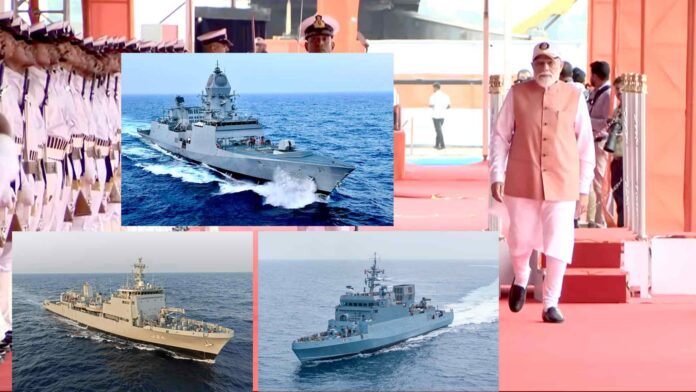
On Sunday, 21st June, Prime Minister Narendra Modi commissioned three indigenously built naval ships at Kolkata’s Syama Prasad Mookerjee Port, describing the occasion as a major milestone in India’s journey towards defence self-reliance and maritime strength. The three vessels, INS Dunagiri, INS Sanshodhak and INS Agray, have been designed and built in India and are expected to significantly strengthen the Indian Navy’s capabilities in surface warfare, hydrographic surveying and anti-submarine operations.
The commissioning ceremony was held in the presence of West Bengal Governor RN Ravi, Chief Minister Suvendu Adhikari and Chief of the Naval Staff Admiral Krishna Swaminathan. The event came on a symbolic day, coinciding with International Day of Yoga as well as World Hydrography Day.
आज 21 जून को World Hydrography Day के रूप में भी मनाया जाता है।
— PMO India (@PMOIndia) June 21, 2026
और यह बहुत ही अद्भुत संयोग है कि आज के दिन हमने भारत का सबसे advanced hydrography जहाज़ “INS संशोधक” कमीशन किया है: PM @narendramodi
The three ships represent different dimensions of India’s maritime capability. INS Dunagiri is a modern stealth-guided missile frigate designed for multi-role combat operations. INS Agray is an anti-submarine warfare vessel meant to detect and neutralise underwater threats in shallow coastal waters. INS Sanshodhak is an advanced survey vessel tasked with mapping the seabed, collecting oceanographic data and supporting both military and civilian maritime operations.
A New Chapter Begins with the commissioning of powerful symbols of Maritime Strength.
— Ministry of Defence, Government of India (@SpokespersonMoD) June 20, 2026
Designed, built and integrated in India, Dunagiri, Agray, and Sanshodhak, showcase the power of #AatmanirbharBharat.
From Kolkata to the Indian Ocean, India sails forward with confidence.… pic.twitter.com/B03RXWkTIw
The induction of the three vessels comes at a time when India is rapidly expanding its naval capabilities amid increasing strategic competition in the Indian Ocean region and growing concerns over maritime security.
India’s strength lies in Self-Reliance: PM Modi
Addressing the gathering after the commissioning ceremony, Prime Minister Modi said the three ships symbolised India’s growing confidence and determination to become self-reliant in defence manufacturing.
“These three vessels also symbolise three important national commitments. They have been built in India. They have been designed in India. The talent of Indian industries has contributed to their construction. The skills of Indian engineers and the hard work of Indian workers have gone into building them. This is the greatest strength of the new India,” he said.
A milestone for India’s maritime security! Speaking at the Tri Commissioning ceremony of INS Agray, INS Dunagiri and INS Sanshodhak in Kolkata. @indiannavy https://t.co/obmbDiY4T0
— Narendra Modi (@narendramodi) June 21, 2026
The Prime Minister stressed that India could no longer remain dependent on foreign suppliers for its defence requirements.
“India no longer wishes to remain merely a buyer in the defence sector. Our military strength cannot become a market for the rest of the world. My strength cannot be defined by becoming a market for the world. The true measure of my strength and capability lies in my self-reliance,” he said.
#WATCH | Kolkata, West Bengal: Prime Minister Narendra Modi says, "These three ships also symbolise three important resolutions of India. They were built in India, designed in India. They are the result of the talent of Indian industries, the skill of Indian engineers, and the… https://t.co/JJlkxUovpb pic.twitter.com/PqTZvyToEo
— ANI (@ANI) June 21, 2026
Modi highlighted how India’s maritime future would shape its economic and strategic influence in the coming decades.
“The world has witnessed that no nation can become a major power without maritime capability. Development is connected with the sea. Security is connected with the sea. Prosperity is connected with the sea,” he said.
#WATCH | Kolkata, West Bengal: Prime Minister Narendra Modi says, "A country whose maritime power is strong will also have a strong economic and strategic influence and India understands this reality well. India is preparing itself for this, and today is a testament to our… https://t.co/JJlkxUp3eJ pic.twitter.com/C22rtZ7DTo
— ANI (@ANI) June 21, 2026
The Prime Minister also linked the commissioning of the three vessels to the broader transformation taking place within India’s defence sector.
“A few years ago, when we dedicated INS Vikrant to the nation, India announced the beginning of a new chapter in its maritime strength. The journey from INS Vikrant to the present day is not merely a journey involving new warships. It is also the journey of India’s growing self-reliance. Today, INS Agray, INS Dunagiri and INS Sanshodhak are giving fresh momentum to that journey,” he added.
A ceremony with strategic significance
The commissioning ceremony carried significance beyond the induction of three ships.
PM Modi used the occasion to underline India’s growing shipbuilding capabilities and the role of the maritime sector in generating employment and economic growth. He revealed that more than 40 indigenously built warships and submarines had joined the Indian Navy over the past few years and that another 45 major naval platforms are currently under construction.
The Prime Minister also highlighted the contribution of Indian industry, particularly small and medium enterprises, in strengthening the country’s defence manufacturing ecosystem.
According to him, more than 200 MSMEs contributed to the construction of the three ships commissioned on Sunday.
He further pointed to India’s ₹70,000 crore incentive package for the shipping sector and ongoing initiatives such as Sagarmala, which aim to modernise ports, expand logistics networks and strengthen India’s maritime economy.
Three ships, three different roles
While all three vessels were built in India and share the common objective of strengthening India’s maritime capabilities, each ship serves a very different operational purpose.
INS Dunagiri is designed for frontline naval combat and long-range maritime operations. INS Agray focuses on hunting enemy submarines in coastal waters. INS Sanshodhak is dedicated to hydrographic surveys and the collection of critical underwater data.
Together, they provide the Navy with a powerful combination of combat capability, underwater surveillance and maritime domain awareness.
INS Dunagiri: India’s new stealth combat frigate
Among the three ships commissioned, INS Dunagiri is perhaps the most powerful combat platform. It is the fifth warship under Project 17A and belongs to the Nilgiri-class of stealth-guided missile frigates. Designed by the Indian Navy’s Warship Design Bureau and constructed by Garden Reach Shipbuilders & Engineers (GRSE) in Kolkata, INS Dunagiri represents the next generation of Indian surface combatants.
It was delivered to the Indian Navy on March 30, 2026, at Garden Reach Shipbuilders & Engineers (GRSE) in Kolkata. INS Dunagiri is the second Nilgiri-class ship built at GRSE. The ship was laid down on 24 January 2020, and it was launched on 15 July 2022.
Named after the Himalayan peak Dunagiri in Uttarakhand, the vessel carries forward the legacy of the earlier INS Dunagiri, which served the Navy for more than three decades.
At nearly 149 metres in length and displacing around 6,600 tonnes, the warship is built for modern naval warfare. The frigate incorporates advanced stealth features that reduce its radar signature, making it harder for enemy forces to detect and track.
It is armed with BrahMos supersonic cruise missiles, MRSAM (Medium Range Surface-to-Air Missiles) complex with MFSTAR radar, 76mm Super Rapid Gun Mount (SRGM), close-in weapon systems (30mm and 12.7mm), and rockets and torpedoes for anti-submarine warfare. These weapons allow the vessel to engage enemy ships, submarines and aircraft simultaneously. The warship is equipped with sophisticated radars, electronic warfare systems and anti-submarine sensors, making it capable of operating across multiple domains.
One of its major technological features is the Integrated Platform Management System, which enables centralised monitoring and control of key ship functions.
INS Dunagiri is powered by a Combined Diesel or Gas propulsion system, consisting of two gas turbines and two diesel engines driving controllable-pitch propellers, paired with a state-of-the-art Integrated Platform Management System (IPMS), allowing commanders to balance fuel efficiency and speed depending on mission requirements. This configuration enables high-speed and high-endurance operations, with a top speed around 28–32 knots and a range of up to 5,500 nautical miles at economical speeds.
The vessel can also operate helicopters for anti-submarine warfare, maritime surveillance and search-and-rescue missions. The ship was delivered in 80 months, significantly faster than the 93 months required for the lead vessel of the class, INS Nilgiri.
With increasing naval activity in the Indian Ocean region, particularly from China, INS Dunagiri is expected to become a key element of India’s future blue-water navy.
Project 17A frigates are versatile multi-mission platforms capable of addressing current and future maritime challenges. These represent a substantial upgrade over the earlier Project 17 (Shivalik-class) frigates. The ships also integrate a modern Combat Management System for rapid threat response.
INS Agray: The Navy’s submarine hunter
While INS Dunagiri is built for multi-role combat, INS Agray has a much more specialised mission. The vessel is part of the Arnala-class Anti-Submarine Warfare Shallow Water Craft programme approved by the government in 2013.
INS Agray is the fifth vessel under the programme and has been specifically designed for operations in shallow coastal waters where enemy submarines can attempt to operate undetected. Built by Garden Reach Shipbuilders & Engineers in Kolkata, the vessel measures approximately 77 metres in length and is among the largest Indian naval warships powered by waterjets.
It is equipped with lightweight torpedoes, indigenous anti-submarine rocket launchers and advanced shallow-water sonar systems capable of detecting underwater threats. The vessel’s primary role is to identify, track and neutralise hostile submarines operating near India’s coastline.
This capability has become increasingly important as regional navies continue to invest heavily in submarine fleets. Pakistan, for example, is expanding its underwater warfare capability through the induction of new Hangor-class submarines.
Apart from anti-submarine missions, INS Agray will also support mine warfare and coastal surveillance operations.nThe vessel has more than 80% indigenous content, making it another major example of India’s growing defence manufacturing capability.
The ship also carries historical significance, as it revives the name of the earlier INS Agray, a patrol vessel that served the Navy before being decommissioned in 2017.
INS Sanshodhak: Mapping the Oceans for India
The third ship commissioned on Sunday was INS Sanshodhak, an advanced survey vessel designed to strengthen India’s hydrographic capabilities. INS Sanshodhak is the fourth and final vessel of the Sandhayak-class Survey Vessel (Large) programme.
Built by GRSE Kolkata and designed by the Indian Navy’s Warship Design Bureau, the vessel is approximately 110 metres long and displaces around 3,400 tonnes.
Its primary responsibility is to conduct coastal and deep-water hydrographic surveys. These surveys help identify safe navigational routes, map harbour approaches and produce accurate maritime charts that are critical for both naval and commercial shipping operations. The ship is also capable of collecting oceanographic and geophysical data for defence, scientific and civilian applications.
INS Sanshodhak is equipped with state-of-the-art systems, including Autonomous Underwater Vehicles (AUVs), Remotely Operated Vehicles (ROVs), Digital Side Scan Sonar, Data Acquisition and Processing Systems and advanced positioning equipment.
Powered by two diesel engines, the vessel can achieve speeds exceeding 18 knots. The ship carries more than 80% indigenous content and represents India’s growing capability in specialised naval platforms.
Its commissioning on World Hydrography Day added further symbolic importance to the event.
Why the commissioning matters
The induction of INS Dunagiri, INS Agray and INS Sanshodhak is significant not merely because three new ships have joined the Navy, but because they represent the broader transformation taking place in India’s defence sector.
In his speech, Prime Minister Modi repeatedly emphasised that maritime power would play a decisive role in shaping India’s future economic and strategic influence.
India’s growing dependence on sea-based trade, undersea communication cables, energy routes and critical maritime resources makes naval strength increasingly important.
The three vessels strengthen key areas of capability, combat power, anti-submarine warfare and hydrographic surveying, which are essential for maintaining maritime security in the Indian Ocean Region.
The commissioning also reflects the success of India’s Aatmanirbhar Bharat initiative in defence manufacturing. All three ships were designed and built domestically, with substantial participation from Indian industries and MSMEs.
“India wants to become a manufacturer. The day we become manufacturers, we will also become decisive players,” PM Modi said while highlighting the significance of the commissioning.


