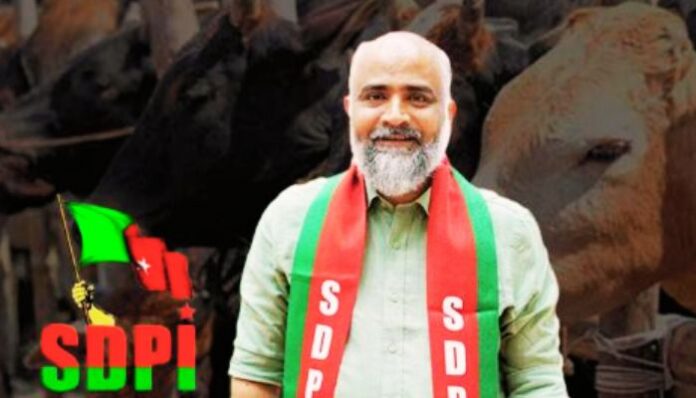
A Principal Civil Judge and JMFC Court in Karnataka’s Belthangady has sentenced Mohammed Riyaz Farangipete, the National General Secretary of the Social Democratic Party of India (SDPI), the ‘political’ front of the outlawed Islamic terror group, Popular Front of India (PFI), to six months in jail in a 2015 hate speech case. The court has also imposed a fine of ₹10,000.
Mohammed Riyaz Farangipete delivered ‘PFI will slaughter cows’ hate speech
The case against Mohammed Riyaz Farangipete stems from a speech he delivered on 23rd July 2015 at a PFI protest meet near the Belthangady Taluk Office.
The police chargesheet said that Riyaz Farangipete had said that “If assaults of Muslims in the name of cows continued, PFI workers will slaughter cows in public and, on Bakrid, we will sell beef in front of the Belthangady bus stand.”
He also threatened to “teach a fitting lesson” to anyone who tried to stop PFI jihadis.
The police had registered a case against Riyaz Farangipete, who remains an active politician in Karnataka’s Dakshina Kannada, under Sections 153A and 295A of the IPC.
In a 33-page judgment delivered on 4th August 2026, the court held that Farangipete’s speech had the potential to disturb communal harmony even though no violence occurred. The court noted that the SDPI leader’s offence cannot be dismissed as trivial.
From inciting anti-Hindu Delhi Riots, to defending pro-Pakistan sloganeering: Islamist activities of Riyaz Farangipete
Serving as the National General Secretary of the Islamist outfit SDPI, Riyaz Farangipete has been embroiled in many controversies, and has several police cases against him.
During the violent 2020 anti-Citizenship Amendment Act (CAA) and National Register of Citizens (NRC) protests in Mangaluru in December 2019, Riyaz Farangipete and another SDPI leader were accused of inciting people via WhatsApp messages despite the imposition of Section 144. Police subsequently registered cases against them under IPC sections for sedition (Section 124A) and promoting enmity between different groups on grounds of religion.
Back in September 2022, the National Investigation Agency (NIA) had raided Farangipete’s residence in Mangaluru. The raid was linked to a case involving a conspiracy to create disruption during Prime Minister Narendra Modi’s rally in Bihar in July 2022. Riyaz Farangipete was serving as the SDPI in-charge for Bihar at the time. The NIA interrogated him for hours and seized certain documents and mobile phones.
Back in July 2022, the NIA had raided his houses in connection with the Phulwari Sharif terror module case busted by the Bihar police. In 2023, Farangipete contested the election from Mangaluru (Ullal) on an SDPI ticket and also lost the deposit, receiving little over 15,000 votes.
Farangipete also has a record of defending pro-Pakistan sloganeering by SDPI members in 2021. In January 2021, during the vote counting for local panchayat elections in Dakshina Kannada, certain SDPI members were accused of raising pro-Pakistan slogans. Defending the members at the time, Riyaz threatened the police that his supporters would create unrest if the arrested members were not released.
In mid-July 2026, Riyaz Farangipete was peddling disinformation about the Special Intensive Revision (SIR) exercise. In a video posted from the SDPI’s official account, Farangipete incited people not to trust the SIR process and claimed that the BJP was “using it” to win elections. He claimed that voters’ names were being deleted from Bihar to Bengal and alleged that the BJP was not winning elections through democratic means.
Riyaz Farangipete, National General Secretary (Organisation), explains how the BJP is misusing the Special Intensive Revision (SIR) process to undermine electoral democracy. #SDPI pic.twitter.com/wvptAePHRh
— SDPI (@sdpofindia) July 18, 2026
Riyaz Farangipete has seven criminal cases against him registered at Belthangady, Mangalore South, Konaje, Mangalore North, Mangalore East police stations, and one case in Delhi. His alleged crimes range from promoting enmity between religious groups to waging, or attempting to wage war, or abetting waging of war, against the Government of India.
The charges against him have been filed under sections 153A, 295A, 143, 147,332, 341, 353, 427, 504, 149, 511, 124A, 121A, among others.
SDPI: The political front of the banned Islamic jihadist group PFI
Founded in 2009, the SDPI is active in electoral politics. However, the activities of the PFI’s political front are not confined to just politics. Several SDPI leaders and workers have been involved in various crimes, ranging from Islamic terrorism, murder of Hindus, to love jihad.
In 2018, SDPI Jihadis hacked an ABVP worker, Shyama Prasad, to death. Prasad was a student of Kakkayangad ITI and also served as the mukhya sikshak of the RSS shakha at 17th Mile in Kannavam, was murdered on the evening of January 19, 2018, under the limits of the Peravoor police station. Later, police arrested four SDPI activists, Parakkandam native Muhammed, Minikkol Salim, Neeveli Ameer, and Palayod native Shahim, in connection with the murder.
Earlier, the SDPI had fielded Shafi Bellare as its election candidate. Bellare is an accused in the brutal murder of BJYM leader Praveen Nettaru in Karnataka.
In 2025, the Enforcement Directorate (ED) had revealed that the Social Democratic Party of India (SDPI) relied on the banned organisation Popular Front of India (PFI) for its daily operations, policy decisions, and candidate selection for election campaigns.
The revelation came after the authorities arrested SDPI President Moideen Kutty K, alias MK Faizy, from Delhi’s Indira Gandhi International (IGI) Airport under the provisions of the Prevention of Money Laundering Act (PMLA), 2002.
The ED said they raided premises linked to the arrested SDPI and recovered some documents that provided insight into the true objectives of the PFI, describing it as an organisation committed to advancing an Islamic movement in India by “endorsing the principles of Jihad in all forms.”
“It positions itself internally as an Islamic movement and externally as a social movement. To achieve these goals, the PFI has established SDPI and several front organisations.
Several copies of minutes of meeting and handwritten documents revealing evidence of PFI funding elections contested by SDPI, approval by the National Executive Council (NEC) of PFI for SDPI to collect funds in Gulf countries, and PFI covering legal expenses for SDPI members accused in criminal cases registered by the police which have seized during the searches conducted at Unity House, Kozhikode (PFI’s Kerala State HQ). It also emerged that PFI had funded SDPI to the tune of Rs 3.75 crore for election-related purposes.
While the PFI was outlawed by the Modi government in September 2022 under the Unlawful Activities (Prevention) Act (UAPA), the Islamic jihadist outfit is furthering its agenda of converting a Hindu-majority India into Dar-ul-Islam, or an Islamic country, by 2047 through various violent and non-violent methods executed via its various fronts, including the SDPI.
OpIndia reported earlier about how the PFI had a long-term plan, code-named “India 2047”, which aimed at establishing Islamic rule in the country. The agenda was discovered during an earlier investigation by the Delhi unit of the investigating agency into a case first registered in Phulwari Sharif of Bihar in 2022. A six-page document outlining the plan was recovered from accused Muhammed Jamaludheen.
The NIA asserted that the murder of RSS leader Sreenivasan in Palakkad was not an isolated act but part of the broader conspiracy aligned with the India 2047 goal. Audio clips and witness testimonies reportedly confirm the dissemination of the plan among PFI cadres. The PFI had prepared a hitlist comprising hundreds of names, mainly of prominent Hindu leaders.
The PFI believed that even 10% of India’s Muslim population would suffice to “subjugate” the majority Hindu community. The PFI had chalked a phased roadmap which involved uniting Muslims under PFI and providing arms/physical training; selective use of violence to exhibit strength and terrorise Hindus. It also pushed for infiltration of institutions and outreach to SC/ST/OBC groups to create divisions among the Hindu community. Through the SDPI, the PFI aimed to establish beneficial political alliances and electoral gains. The PFI wanted to assert its dominance, filling key institutions with loyalists, declaring a new constitution based on Islamic principles, and eliminating remaining adversaries.