

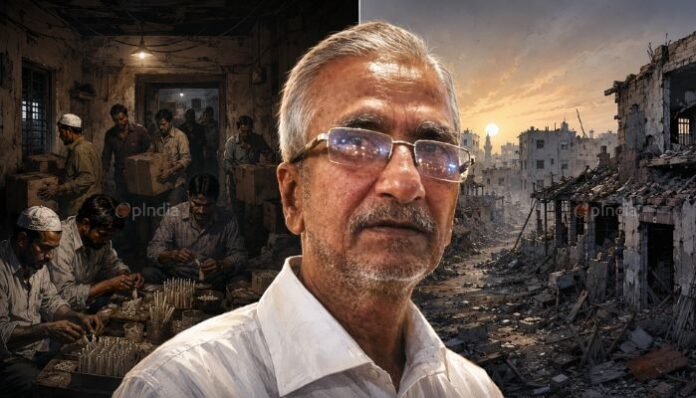
On 22nd June, the Supreme Court stayed the Delhi High Court order granting remission and directing the release of Md Rashid Khan, the TADA convict described by the West Bengal government as the mastermind of the 1993 Bowbazar blast.
Notably, Khan financed a planned bomb-making operation amid communal tensions following the December 1992 demolition of the disputed structure at Ayodhya. He had intended “to kill the Hindus in Calcutta” using bombs through “Muslim brothers”. An accidental detonation at the bomb workshop killed 69 people, none of whom were Hindus, injured dozens and brought down buildings in the densely populated central Kolkata neighbourhood.
A bench of Justices PK Mishra and Sanjeev Sachdeva passed the interim order while hearing the West Bengal government’s challenge to the Delhi High Court judgment dated 5th June. Khan, now around 77 years old, has spent more than 33 years in prison.
Additional Solicitor General SV Raju questioned the High Court’s reliance on the reformative theory of punishment in a case involving a massive explosion and widespread casualties. He also pointed out that the State Sentence Review Board had ultimately advised against Khan’s premature release.
Senior Advocate MR Shamshad, appearing for Khan, referred to his long incarceration, prison conduct, age and poor health. He also invoked the release of co-convict Pannalal Jaiswara in March 2014.
The bench, however, distinguished Khan’s case by observing that he was the “mastermind”. When Shamshad argued that Khan had been released on parole several times and had always returned, the court noted that he had been punished for an act that was “almost a terrorist act”.
The Supreme Court stayed the release order after observing that the appeal could become infructuous if Khan was freed before the challenge was examined. The apex court has scheduled the next hearing in the matter for 28th July.
Delhi High Court granted remission and ordered immediate release
Justice Neena Bansal Krishna of the Delhi High Court had allowed Khan’s petition on 5th June and directed that he be released forthwith if he was not wanted in any other case.
The High Court acknowledged that the Bowbazar blast was not an individual crime and had affected society at large. It nevertheless held that the gravity of the offence could not remain the sole ground for denying remission when the applicable policy did not expressly exclude TADA offences or crimes affecting national security.
A character certificate issued by the Superintendent of Presidency Correctional Home in February 2020 described Khan’s behaviour as “very very good” and stated that he had remained free from prison punishment.
The judgment recorded that he spent 93 days on parole without a police escort, returned within the prescribed period and faced no complaint of threats or communal hostility. Khan was also stated to be suffering from diabetes, hypertension, chronic metabolic disease, benign prostatic hypertrophy, a cataract and other age-related ailments.
The High Court concluded that the possibility of Khan committing another offence was very low. It held that keeping him imprisoned after more than 33 years would serve no fruitful purpose and that his sentence had already achieved its deterrent and reformative objectives.
Instead of directing the government to reconsider his case, the court granted remission itself, saying that sending the matter back to the executive would serve no purpose once the circumstances justified release. The Chief Minister Suvendhu Adhikari-led West Bengal government approached the Supreme Court to challenge the judgment of the Delhi High Court.
Mamata government’s board backed Khan’s release in 2015
In 2007, the CPI(M)-led West Bengal government initiated the process for Khan’s premature release after the prisons department recommended his case following his completion of 14 years in prison. However, the proposal did not result in his release. The Supreme Court subsequently clarified in 2014 that the Union government, and not the State, was the appropriate authority to grant remission to a TADA convict.
The Mamata government later revived the effort, with the State Sentence Review Board recommending his release in March 2015. The West Bengal State Sentence Review Board considered 32 cases and recommended five life convicts, including Khan, for premature release. There were attempts to paint him as a “good person” in media as well because he had “taken up art”.
The Board examined reports from the police, correctional authorities and probation officials. It also considered the duration of imprisonment, physical and mental condition, age, prison conduct, possibility of reoffending, social acceptance and prospects of rehabilitation.
A formal release order was not issued because the Supreme Court had temporarily restrained state governments from exercising remission powers in certain categories of cases while hearing the Union government’s petition in the V Sriharan matter.
Khan’s case became caught in a dispute over whether the State or the Centre was the appropriate authority to grant remission to a convict sentenced under a central law such as TADA.
The Delhi High Court noted that the 2015 recommendation had not been reversed because of any subsequent misconduct by Khan. The judgment described the later denial of remission as a “change of heart” arising from legal confusion over jurisdiction.
Notably, West Bengal’s position changed in subsequent years. The State Sentence Review Board rejected Khan’s request on 29th May 2017 and again on 8th August 2018 after Kolkata Police raised strong objections based on the gravity of the crime, its social impact and Khan’s role.
In February 2019, West Bengal sent an unfavourable recommendation to the Union government. The Ministry of Home Affairs also refused his request, citing the TADA conviction and the effect of the crime on national security.
The West Bengal government, whose Sentence Review Board had recommended Khan’s release in 2015, eventually approached the Supreme Court in 2026 to stop the Delhi High Court’s release order. The main difference was that power in the State was in the hands of a BJP-led government instead of a TMC-led government.
Why Khan approached the Delhi High Court
Khan’s son used the Right to Information Act in 2016 to obtain details about the stalled remission process. The West Bengal government confirmed that the State Sentence Review Board had recommended Khan’s premature release on 25th March 2015, but the decision was subsequently reviewed because of the Supreme Court’s orders restricting states from granting remission in certain cases. A second RTI response in July 2016 again stated that the State had been prevented from implementing the recommendation.
Khan then submitted a representation to the Union Home Ministry on 8th August 2016, citing the release of his co-convict and West Bengal’s earlier recommendation. His son sent several reminders, while the Home Ministry stated in September and November 2017 that the application remained under consideration.
Khan eventually approached the Delhi High Court because TADA was a central law, and he argued that the Union government, based in New Delhi, was the appropriate authority for deciding his remission. He challenged the State Sentence Review Board’s 2017 and 2018 rejections and sought directions for his premature release.
Bombs manufactured above a satta den in Bowbazar
The case arose from a devastating explosion on the night of 16th March 1993 at premises in the 266-268-A and 267 BB Ganguly Street area of Bowbazar in central Kolkata. The records describe the location as a clandestine bomb-making workshop operating above or alongside illegal gambling premises linked to Khan.
According to court documents and media reports, Md Khalid acted under Khan’s instructions and procured nitro-glycerine and other chemicals used to manufacture bombs and grenades. Khan financed the procurement and processing of the explosive material.
Khan’s gambling establishment provided cover for the activities. The movement, noise and late-night operations associated with satta betting allowed explosive materials to be brought in and devices to be assembled without immediately drawing attention.
During the hearing at the Sessions Court, investigators stated that the accused had accumulated quantities of volatile explosive substances far beyond what could be safely handled or stored. Khalid was accused of functioning as the principal bomb-maker, while Khan was presented as the financier, organiser and central figure directing the operation.
The prosecution said that the bombs were being manufactured for later terrorist operations. The blast itself was not the planned attack. It reportedly occurred when the stockpiled explosives and assembled devices detonated accidentally inside the workshop.
The initial ignition reportedly triggered a chain of explosions through the stored material. The force demolished the workshop and tore through surrounding buildings in the congested neighbourhood. Closely packed structures and narrow streets increased the scale of the casualties.
The Bowbazar explosion therefore differed from a timed bombing at a selected public target. According to the prosecution, it exposed an operating bomb factory after explosives intended for future use went off prematurely.
69 killed and buildings reduced to rubble
The First Information Report registered on 17th March initially recorded the deaths of 40 people and grievous injuries to several others. The toll later rose. A New York Times report from March 1993 stated that Kolkata Police stated it was a bomb blast but one officer was quoted saying that a large cache of explosives were stored in the building. According to the officer, the blast happened because of “careless handling” of the explosives.
During subsequent proceedings, the State placed the final figure at 69 people killed and 46 injured. Eight buildings were stated to have been destroyed or damaged. Victims included residents of adjoining multi-storey buildings and people present in the area. The blast wave, falling masonry, shattered debris and fires caused extensive devastation.
Two multi-storey structures were reportedly reduced to rubble, while surrounding buildings were badly damaged. Police personnel and fire brigades reached the site during the night. Rescue operations were complicated by the confined streets, unstable debris and the possibility that further explosive material remained at the location.
Police removed injured people to hospitals and collected material from the wreckage. The complaint lodged by Sub-Inspector BK Chattopadhyay stated that unknown persons, acting pursuant to a criminal conspiracy, had caused the explosion using explosive materials.
Forensic evidence shifted probe towards a bomb factory
The case was initially registered under Sections 120B, 436, 326 and 307 of the Indian Penal Code and provisions of the Explosive Substances Act. Murder charges were added as the casualties mounted.
According to the prosecution, forensic examination of the debris revealed explosive residues, fragments, wiring and materials associated with bomb assembly. Investigators rejected the possibility that the destruction had resulted from a gas leak or an ordinary accident.
Witness accounts and material recovered from the premises also connected the site to Khan’s illegal gambling operations.
TADA provisions were added in May 1993. The police submitted the charge sheet before the Designated Court on 14th June 1993 for offences including criminal conspiracy, murder, destruction by explosives, violations of the Explosive Substances Act and Sections 3 and 4 of TADA.
The prosecution said that Khan had declared an intention to kill Hindus in Kolkata using bombs through Muslim associates. It argued that this demonstrated an intention to disturb communal harmony and strike terror amid the tensions that followed the demolition of the disputed structure at Ayodhya in December 1992.
An earlier Calcutta High Court proceeding concerning the validity of the TADA sanction observed that the explosion itself did not prove an intention to kill Hindus because no Hindu was reportedly killed in the accidental detonation. That proceeding dealt with the sanction and cognisance under TADA, not the final determination of Khan’s guilt.
TADA court convicted Khan and his associates
A designated TADA court convicted Khan and several associates in 2001. Khan was held guilty of offences including murder, criminal conspiracy, violations of the Explosive Substances Act and offences under TADA.
The prosecution identified Khalid as the bomb-maker and Khan as the organiser who financed and directed the operation. West Bengal continued to describe Khan as the mastermind while opposing his premature release.
The Supreme Court subsequently dismissed the appeals filed by Khan and the other convicts and upheld their convictions and sentences.
Conclusion
The case has now returned to the Supreme Court, which will examine whether the Delhi High Court was justified in granting remission to a convict described as the mastermind of a bomb-making operation that killed 69 people. Until then, Khan will remain in prison, with the apex court’s stay preventing the implementation of the release order.


