

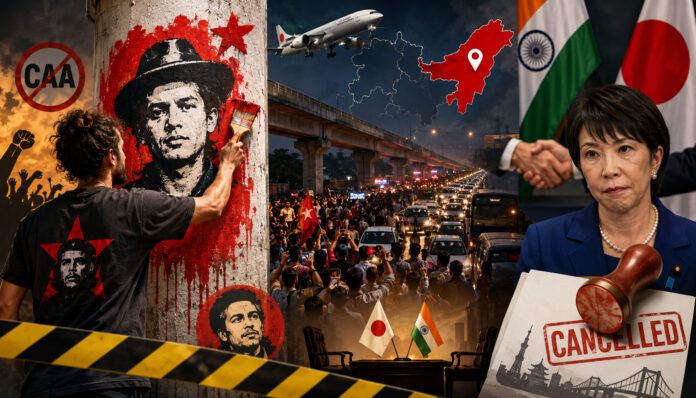
On the evening of June 17, scaffolding was put up on a Ganeshguri flyover pillar. Marshall Baruah painted a mural of Zubeen Garg with the words ‘Comrades Never Die,’ but a Public Works Department worker whitewashed it. It was a part of an effort to beautify the city in advance of the first India-Japan summit to be held in the Northeast, which Assam expected would be a significant diplomatic achievement.
Police at Panbazar had warned Baruah the day before not to repaint till July 3. He disregarded the warning. He came back on June 18 with a red background and new paint. As traffic slowed and occasionally stopped on one of Guwahati’s busiest corridors, a crowd assembled below the flyover and sang Zubeen’s songs till around 9:30 p.m. What was initially portrayed as cultural remembrance turned into an open display that state government officials would subsequently connect directly to a diplomatic disaster.
Chief Minister Himanta Biswa Sarma announced on June 23, five days later, that Japanese Prime Minister Sanae Takaichi would not be travelling to Guwahati. The whole summit was shifted to New Delhi. The official justification mentioned the logistical challenges of hosting a summit outside of the capital as well as Japan’s ongoing Diet session. However, sources in the Assam government, as reported by The Economic Times, say that the cancellation was related to the recent controversy. During the mural demonstration and replacement, the Japanese advance delegation inspecting Guwahati was trapped in traffic for two hours. According to the sources, that disturbance contributed to worries regarding preparedness.
Assam had been planning for weeks. The renovated airport terminal was personally visited by the Chief Minister. The streets were cleaned. The corridors were made more aesthetically pleasing. Investment pipelines, Japanese corporate interest, and the visibility that transforms long-standing JICA initiatives into new manufacturing and jobs were all much expected. Rather, the visit did not happen. A Japanese prime minister’s visit to Guwahati was cancelled for an unprecedented second time in seven years.
Comrade Marshall Baruah’s record: CAA protests, direct attacks on CM Himanta, and repeated defiance
Born in a quiet village in Kakilaguri, Gohpur in Biswanath district, in 1994, Baruah relocated to Guwahati to study mass communication and converted public spaces into his permanent art canvas. He mentions Guernica by Picasso and Banksy as examples of how art can be used as a political tool. In reality, he has continuously attacked the state and its development program with his actions.
He gained notoriety in 2019 and 2020 amid the anti-CAA protests. In addition to opposing a central law, such protests caused the kind of protracted disruption that led to the cancellation of then Japanese Prime Minister Shinzo Abe’s scheduled visit to Guwahati. Due to violence, curfews in place, and constant disputes with the government, Assam lost the opportunity it had. That ecosystem of activists included Baruah.
During protests over the removal of trees for a Bharalumukh flyover in November 2024, he painted ‘Kick Himanta Save Nature,’ a direct and personal insult directed against the Chief Minister. He was taken into custody for 14 days after being held, and has been summoned by a Guwahati court to appear on June 25 for the same case.
The repainting on June 18 followed the same pattern: the disturbance occurred at the precise moment Japanese inspection teams were on the scene, a crowd assembled on an important traffic route during a delicate diplomatic window, and police warnings were disregarded. These links related to the cancellation have now been made by state government sources. Opposition leaders have called any connection ‘speculative’ and denied it. However, the Japanese delegation’s traffic bottleneck has been reported, and the timing cannot be disregarded.
Why a Japanese PM landing in Assam would’ve changed things
The majority of people outside of the region are unaware of Japan’s significant impact on northeastern India. For almost 20 years, the Japan International Cooperation Agency has been one of the most important development partners in the region, and its efforts are evident in the actual landscape. When it is finished, the 19-kilometre Dhubri-Phulbari Bridge, which crosses the Brahmaputra and was largely funded by Japanese financing, would be the longest river bridge in India.
Additionally, JICA has funded the construction of highways in Nagaland, Meghalaya, and Assam, Guwahati’s water supply and sewage systems, and a variety of urban infrastructure that, while seldom making national news, decides whether or not everyday life in the region improves.
Throughout successive governments, this partnership has been maintained through the Act East Forum, a bilateral Japan-India setup with a specific focus on the Northeast. A Japanese industrial township in Assam, which would provide manufacturing jobs, technical training, and corporate networks to a state that has long been trying to move beyond insurgency and towards economic growth, has been openly talked about by the authorities in the state.
The kind of high-profile event that turns aspiration into a road map would have been a prime ministerial visit accompanied by business delegations. Investors take these events seriously and change their risk calculations if necessary.
At the Hinge of Asia’s great power contest, no brushstroke is accidental
Japan’s involvement in India’s Northeast is no accident. The ‘Free and Open Indo-Pacific‘ framework, which Tokyo and New Delhi have jointly developed, is a pragmatic strategic architecture that presents Japanese investment in the region as an obvious counterweight to China’s Belt and Road presence in adjacent Bangladesh, Nepal, and Myanmar. These clashing perceptions are especially noticeable and significant in the Northeast. Any obstacle to a high-profile Japan-India partnership gains resonance in that tense atmosphere, so it wouldn’t be considered elsewhere. It is unclear whether the occurrences of June 18 were a coincidence of timing or something else that the official record does not yet reveal.
On June 25, Marshall Baruah is scheduled to appear in court. At Ganeshguri, the Zubeen Garg mural reappears, this time in a redder background. Delhi, which is far from the Brahmaputra, will host the India-Japan summit. As in the past, Assam is left with the peculiar disappointment of a territory that consistently reaches the verge of international attention, only to discover that the event has been shifted to another place.
For the time being, the scenario that links the paint on the pillar to the ministry’s phone call is told solely through questions and the deliberate sequencing of matters that were never officially disclosed.


