

Over the past few days, opposition leaders and left-liberals have been peddling a rumour that the Modi government has introduced a law to levy a fee on UPI (Unified Payments Interface) transactions, which have been free so far. Several mainstream media platforms have also been publishing misleading and speculative headlines to leverage the stir created by the rumours regarding the law.
The Parliament recently passed the Taxation and Other Laws (Amendment) Bill, 2026, after which the false claims regarding the taxing of UPI transactions started to float. The opposition as well as the left-liberal gang became active and started targeting the Modi government, alleging that it was acting under US pressure.
Congress MP Jairam Ramesh wrote a long message on X, claiming that ordinary people will now have to bear the cost of using UPI transactions. The MP claimed that the Modi government has passed the law to tax the UPI transactions under the pressure of his “good friend Donald Trump”.
“Indeed, the real reason why this amendment is being introduced is perhaps more concerning. It follows the U.S. Trade Representative’s 2026 report, which criticises UPI and RuPay for being free and accuses them of having driven out American payment platforms like Visa and MasterCard. Is the Prime Minister seeking to dilute UPI and open the digital payments sector to American businesses under pressure from his good friend Donald Trump?” Ramesh wrote on X.
The Modi Government's latest Taxation and Other Laws (Amendment) Bill, 2026 removes the statutory guarantee that keeps UPI transactions free. It opens the door to Merchant Discount Rate (MDR) charges, which can easily be expanded to all payments in the future. The cost will… pic.twitter.com/ZWTrcaMvQw
— Jairam Ramesh (@Jairam_Ramesh) August 6, 2026
Commenting on the Congress MP’s post, founding Editor of leftist propaganda portal The Wire, MK Venu, also further pushed the lie and tried to portray the government as anti-poor. Venu claimed that PM Modi has decided to tax the UPI transactions being used by “poor Indians” under his “fraand’s coercion”, which obviously refers to US President Trump.
The one service,UPI payments, which poor Indians receive free is now being charged because Trump is putting pressure on India arguing US payment service giants like Visa , Master Card etc are charged a fee for every transaction. When will PM escape his fraand's coercion? https://t.co/AWceq0QvcP
— M K Venu (@mkvenu1) August 6, 2026
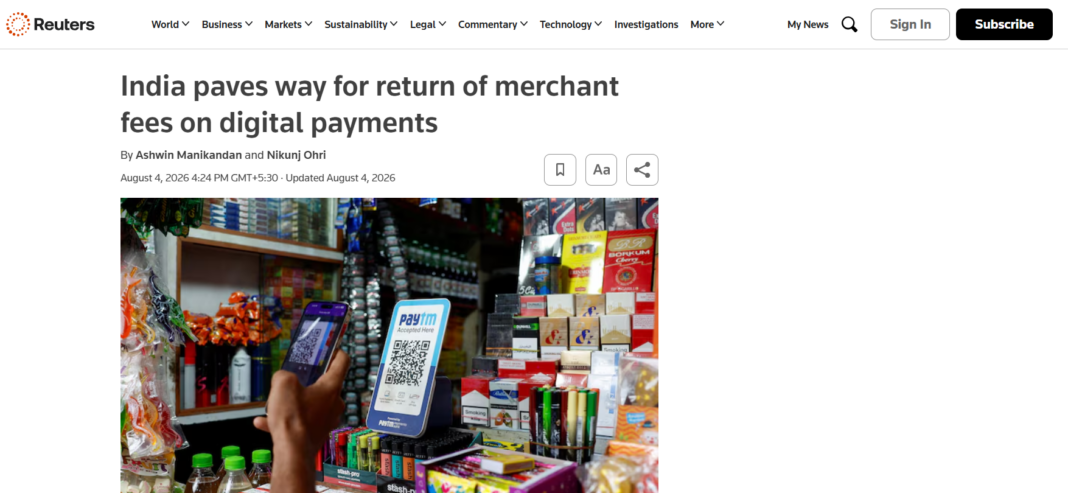
Several mainstream media portals have also been publishing articles with misleading headlines insinuating that the government was indeed going to tax UPI transactions. Reuters published an article after the bill was introduced in the Lok Sabha titled “India paves way for return of merchant fees on digital payments”. The headline of the article suggests a tax on UPI transactions will soon be a reality.
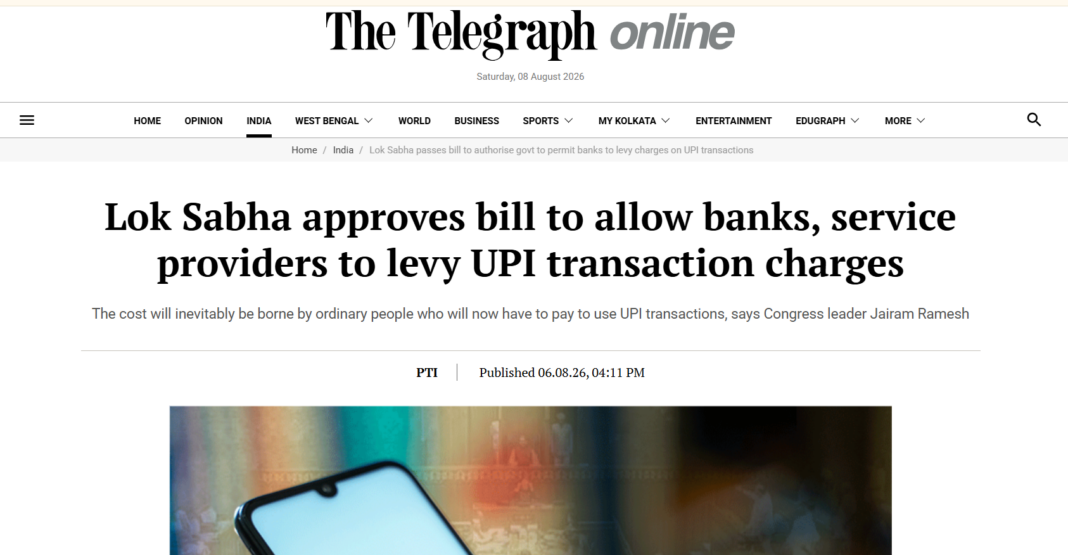
Similarly, The Telegraph published an article after the law was passed in the Lok Sabha, with the headline “Lok Sabha approves bill to allow banks, service providers to levy UPI transaction charges”.
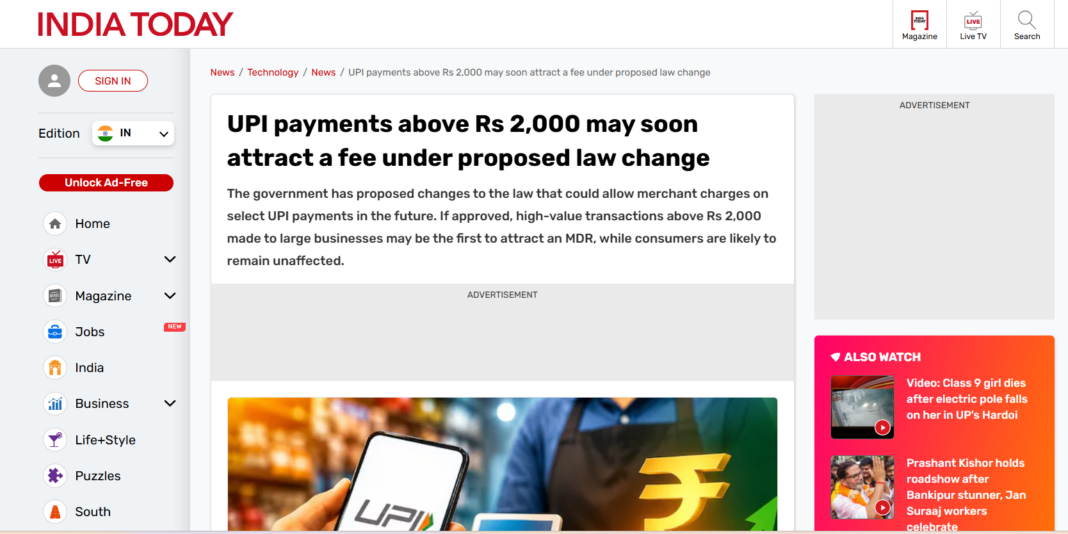
Some media portals claimed that UPI payments only up to ₹2000 will be free and any transaction above that amount will attract a tax.
The social media posts and media reports created panic among ordinary people, who were misled by the headlines and the posts. The misleading headlines and posts not only peddled misinformation about digital payments but also cast suspicions on the government by alleging US pressure behind the decision. The real picture, however, is far from what is being conveyed by the left-liberal propagandists as well as the media.
Does the new law levy a tax on UPI transactions?
The Taxation and Other Laws (Amendment) Bill, 2026 was introduced by Finance Minister Nirmala Sitharaman in the Lok Sabha on August 4, 2026. The bill was passed on August 6, 2026, amid opposition protests over unrelated issued. The amends certain existing laws such as the Income Tax Act of 2025, the Finance Act of 2026, and the Payment and Settlement Systems Act, 2007, which is at the centre of the controversy.
The bill removes Section 10A of the Payment and Settlement Systems Act., which legally barred banks and payment service providers from charging any Merchant Discount Rate (MDR) on transactions made through government-notified digital payment modes, including UPI and RuPay debit cards. MDR is essentially a fee paid by a merchant for processing a digital payment. The provision had so far shielded UPI payments from processing fees.
However, the removal of the provision does not mean that digital payments will now automatically be taxed. The elimination of the provision has conferred on the central government a discretionary power to decide which digital payment methods will be taxed and which digital payments will not be taxed. Essentially, the bill itself does not levy any tax on digital payments; it merely removes a legal prohibition on levying such tax. This means that if the government decides to tax certain digital transactions in future, it can do so through a notification.
Why was the amendment needed?
As part of the government’s plan to boost digital payments across the country, it had waived the MDR on UPI and RuPay transactions. However, these digital transactions incur costs, which the government bears through subsidies or incentives to banks and payment companies.
As a result, UPI transaction volumes registered significant growth over the past few years. Notably, the financial assistance (subsidy) provided by the government is available only for small merchants and small-value transactions of up to ₹2,000. Meanwhile, banks and payment companies face constantly rising costs associated with maintaining servers, ensuring online security (cybersecurity), and keeping the entire payment system running smoothly.
A parliamentary committee noted that sustaining the entire UPI system financially is becoming difficult without MDR, as government subsidies cover only a small fraction of the industry’s actual costs. RBI Governor Sanjay Malhotra also clearly stated that it is not feasible to operate such a massive UPI system entirely free of charge indefinitely, as funds are required to ensure its security and expand the network. However, he also noted that it would be premature to speculate on charges at this stage; the situation will become clear only after the government issues an official notification.
Even if the government decides to implement MDR in future, it will not likely affect the general public or small traders. The speculations that digital transactions above ₹2000 may be taxed emerge from a proposal floated by the Payment Council of India (PCI, a trade body representing non-banking payment players. The PCI urged the government last year to reconsider its zero-MDR policy. The body said that the annual subsidy provided by the government, which amounts to ₹1,500 crore, covers only a fraction of the cost of running and expanding the UPI ecosystem, which it estimated at around ₹10,000 crore.
The PCI requested the government to levy MDR only on large merchants with an annual turnover exceeding ₹50 crore, specifically on transactions above ₹2,000, at a rate ranging from 0.3% to 0.5%. So if a transaction exceeding ₹2000 is made at a large retail chain or e-commerce platform, the large merchant might have to pay a nominal transaction fee (MDR) to the bank for advanced system processing. However, the proposal remains to be implemented by the government.
Therefore, at this stage, all the digital transactions which have been happening free of cost will remain so unless a change is notified by the government. Besides, it is clear from the information provided above that the changes introduced by the government in the law are not due to the US or some other external pressure. They are economic and fiscal measures, not a payments-policy overhaul, and the UPI-related provision is part of a much larger package.


